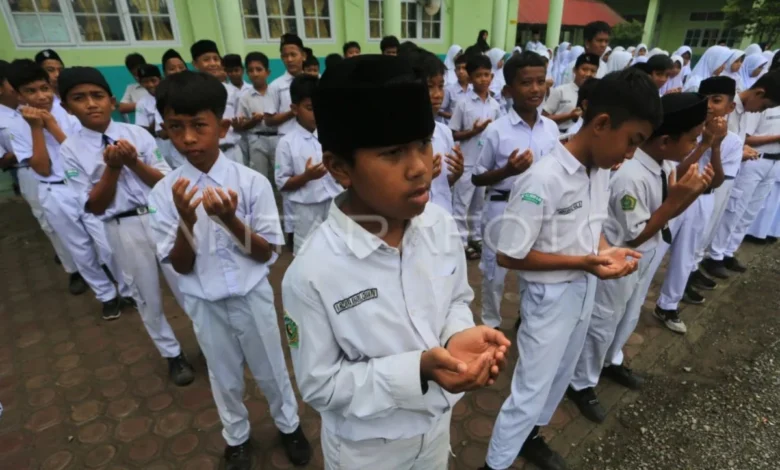
When a child falls ill, the emotional toll on parents is immediate and profound. The primary hope in any household is a swift recovery, allowing the child to return to their normal daily routines, school, and play. Beyond the essential physical care and medical interventions required during times of illness, Muslim parents often turn to spiritual practices, offering earnest supplications (du’a) to Allah SWT. In Islamic tradition, prayer serves as a vital form of internal striving (ikhtiar batin), complementing physical remedies and offering solace to families navigating the anxieties of pediatric illness.
Islamic jurisprudence and prophetic traditions emphasize that seeking spiritual healing is deeply intertwined with physical action. Prophet Muhammad SAW consistently modeled and taught specific supplications to be recited when tending to the sick, whether visiting a companion or comforting a family member. For modern parents balancing medical science with religious faith, understanding these authentic prayers provides a comprehensive framework for holistic child care.
Prophetic Foundations of Healing Supplications
In Islamic teachings, illness is viewed as a test from God, a means of spiritual purification, or a natural part of human vulnerability. When children—who are regarded as pure and beloved creations—fall sick, parents assume the role of caregivers both physically and spiritually.
Prophetic traditions (hadith) recorded in canonical collections such as Sahih Muslim provide specific phrases articulated by the Prophet SAW when seeking divine intervention for the afflicted. These texts establish that supplication is not merely a passive wish, but an active engagement of faith that acknowledges human limitation and divine omnipotence. Parents are encouraged to recite these verses with sincerity, holding their child, wiping their forehead, or gently placing a hand over the site of pain.
Authentic Prayers for Healing and Protection
Islamic literature contains several well-documented supplications tailored for various dimensions of illness, ranging from acute fevers to chronic discomfort and general vulnerability.
1. The Comprehensive Healing Prayer
One of the most frequently cited supplications is the prayer the Prophet SAW recited when visiting sick individuals or members of his household.
Allāhumma rabban-nās, adzhibil-ba’sa, wasyfi antasy-syāfī, lā syifā’a illā syifā’uka, syifā’an lā yughādiru saqaman.
Translation: "O Allah, Lord of mankind, remove the affliction and heal. You are the Healer. There is no healing except Your healing, a healing that leaves no disease behind."
This narration, authenticated in Sahih Muslim, anchors the parent’s hope in the absolute sovereignty of God as the ultimate source of restoration. When reciting this for a child, parents typically focus their intention on the specific ailment affecting their son or daughter.
2. The Supplication of Prophet Job (Ayyub) AS
For children experiencing prolonged, painful, or severe illnesses, parents often turn to the Quranic invocation of Prophet Job, found in Surah Al-Anbiya (21:83). Prophet Job endured profound physical trials with legendary patience before receiving divine relief.
Rabbi annī massaniya-ḍ-ḍurru wa anta arḥamur-rāḥimīn.
Translation: "Indeed, adversity has touched me, and You are the Most Merciful of the merciful."
This verse captures the essence of human suffering coupled with unwavering trust in divine mercy. Reciting this prayer helps instill patience and steadfastness in both the parents and the child, reframing the illness within a narrative of divine compassion.
3. The Prophetic Prayer for Protection (Ruqyah)
Children are often viewed as uniquely vulnerable to environmental stressors, accidents, and psychological distress. To safeguard them, parents frequently employ the protective formula utilized by the Prophet SAW when seeking refuge for his beloved grandsons, Hasan and Husain.
A’ūdzu bi kalimātillāhit-tāmmati min kulli syaithānin wa hāmmatin wa min kulli ‘ainin lāmmah.
Translation: "I seek refuge in the perfect words of Allah from every devil, every poisonous reptile, and from every envious eye [that brings harm]."
This formula acts as a spiritual shield, particularly useful during convalescence or when parents wish to envelop their recovering children in protective grace.
4. Personalized and Contextual Prayers
While traditional Arabic texts hold immense significance, Islamic jurisprudence places no restriction against praying in one’s native language. Parents are encouraged to articulate their specific concerns in their own words. For instance, a generalized personal prayer for a sick son or daughter can be structured as follows:
Allāhumma isyfi ibnī wa ‘āfihi, wa adzhib ‘anhu al-maraḍa, warzuqhu asy-syifā’a wal-‘āfiyah. (Replace ibnī with bintī for a daughter).
Translation: "O Allah, cure my child and grant them health, remove their illness, and bless them with complete recovery and well-being."
Balancing Spiritual Faith with Modern Medical Science
A prevailing challenge in modern public health discourse within religious communities is the potential tension between spiritual reliance and medical intervention. Contemporary pediatric experts and religious scholars consistently emphasize that faith and medicine are not mutually exclusive; rather, they operate in tandem.
Data from global pediatric health organizations indicate that timely medical intervention is critical in preventing minor childhood illnesses from escalating into life-threatening conditions. While spiritual supplications provide psychological comfort, emotional resilience, and a sense of agency for parents, they must be accompanied by rigorous evidence-based healthcare.
Health authorities outline clear guidelines regarding when a sick child requires immediate professional medical evaluation rather than home monitoring alone:
- Respiratory Distress: Difficulty breathing, rapid breathing, or retractions of the chest muscles.
- Neurological Symptoms: Unexplained seizures, lethargy, confusion, or an inability to wake up.
- Dehydration: Absence of tears when crying, dry mouth, or significantly reduced urination over a 24-hour period.
- Infant Fevers: Any fever in infants younger than three months old reaching 38 degrees Celsius (100.4 degrees Fahrenheit) or higher requires immediate emergency assessment, as neonatal immune systems cannot reliably localize infections.
- Persistent Pain or High Temperature: Fevers that fail to respond to standard over-the-counter antipyretics or are accompanied by a stiff neck, persistent vomiting, or a non-blanching rash.
Implications for Family Well-Being and Public Health
The integration of spiritual coping mechanisms into family healthcare routines carries notable psychological and sociological implications. Studies in behavioral psychology and family medicine suggest that rituals such as prayer can significantly reduce parental anxiety and helplessness during medical crises. High levels of parental stress can inadvertently complicate a child’s recovery environment; thus, psychological stabilization through faith practices indirectly benefits the child’s physiological healing process.
Furthermore, public health outreach campaigns increasingly recognize the importance of collaborating with community and religious leaders. By reinforcing the message that Prophet Muhammad SAW strongly advocated for seeking medical treatment ("Make use of medical treatment, for Allah has not made a disease without appointing a remedy for it," as noted in foundational hadith literature), religious communities can bridge the gap between traditional beliefs and modern pediatric protocols.
Ultimately, the practice of offering supplications for sick children serves as a powerful expression of parental love, duty, and spiritual grounding. By harmonizing earnest prayer with prompt, high-quality medical care, families can navigate the uncertainties of pediatric illness with both a fortified spirit and sound scientific backing, ensuring the best possible outcomes for the rising generation.