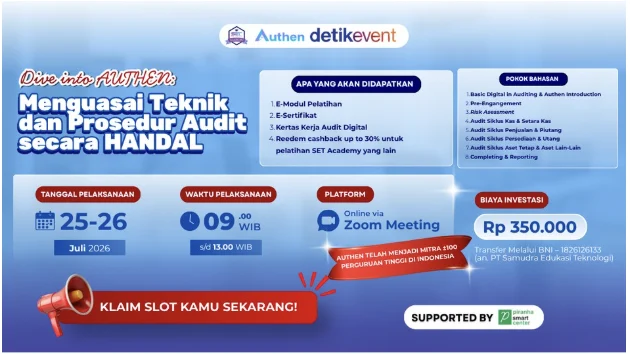
The transition from the academic environment to the professional world remains one of the most significant hurdles for aspiring accountants and auditors in Indonesia. Despite achieving high marks in collegiate auditing courses, many fresh graduates find themselves overwhelmed when confronted with the complexities of real-world audit working papers. The discrepancy between theoretical knowledge—often centered on static textbook examples—and the dynamic, digitized reality of modern firms has created a "skills gap" that professional training programs are now racing to fill. In response to this demand, the Piranha Smart Center (PSC), in collaboration with SET Academy, has announced the second batch of its intensive training program, "Dive Into AUTHEN: Menguasai Teknik dan Prosedur Audit Secara Handal" (Mastering Audit Techniques and Procedures Reliably).
The Digital Imperative in Modern Auditing
The contemporary business landscape is characterized by the rapid digitization of financial records. From cloud-based accounting software to automated transaction logs, the data trails that auditors must follow are no longer physical ledger books but complex digital ecosystems. Consequently, the role of the auditor has evolved from a manual reviewer of documents to a digital systems analyst who must ensure the integrity of electronic data.
Industry data suggests that firms are increasingly prioritizing candidates who possess "Audit 4.0" competencies. According to recent surveys of human resource managers in Tier-1 and Tier-2 accounting firms, the ability to navigate digital audit platforms is often ranked higher than theoretical proficiency alone. This shift is driven by the need for efficiency; digital auditing allows for the testing of entire datasets rather than mere sampling, thereby reducing the risk of undetected material misstatements. The "Dive Into AUTHEN" program is strategically designed to address this specific market need by utilizing the AUTHEN platform—a dedicated digital environment that simulates real-world auditing workflows.
Bridging the Academic-Professional Divide
The phenomenon of the "confused fresh graduate" is well-documented within the Indonesian accounting community. Students often excel at identifying audit assertions or defining "inherent risk" in a classroom setting, yet they struggle to initiate a "Pre-Engagement" phase or perform a "Risk Assessment" when faced with a blank digital working paper. The PSC and SET Academy initiative aims to demystify these processes through a hands-on, case-study-driven methodology.
Rather than relying on traditional one-way lectures, the "Dive Into AUTHEN" Batch 2 program emphasizes interactive demonstrations and simulations. This pedagogical approach ensures that participants do not just learn what an audit is, but how to conduct one using modern tools. By focusing on the practical application of the Indonesian Audit Standards (SA) within a digital framework, the training prepares participants for the immediate rigors of a junior auditor or internal audit role.
Comprehensive Curriculum and Module Breakdown
The two-day intensive workshop is structured to mirror the chronological flow of a standard audit engagement. This logical progression allows participants to understand how each phase of the audit informs the next, creating a cohesive picture of the financial examination process.
Phase 1: Pre-Engagement and Risk Assessment
The training begins with the foundational aspects of any audit: deciding whether to accept an engagement and assessing the risks associated with the client. Participants are taught how to evaluate client integrity, independence requirements, and the specific business risks that could lead to financial errors. In the digital context, this involves analyzing the client’s IT environment and the reliability of their automated controls.
Phase 2: Auditing the Cash and Cash Equivalents Cycle
As one of the most liquid and high-risk areas for fraud, the audit of cash requires meticulous attention to detail. The program guides participants through the verification of bank reconciliations, the performance of cash counts, and the digital confirmation process with financial institutions.
Phase 3: Sales and Accounts Receivable
This module focuses on the revenue cycle, teaching participants how to verify the existence and valuation of receivables. Through the AUTHEN platform, users practice vouching digital invoices and testing the "cut-off" to ensure that revenue is recorded in the correct accounting period.
Phase 4: Inventory and Accounts Payable
Auditing inventory often presents physical and logical challenges. The training covers the procedures for observing physical counts and reconciling them with digital records, as well as verifying that all liabilities (accounts payable) have been properly recorded.
Phase 5: Fixed Assets
The final technical module addresses the audit of long-term assets. This includes verifying the ownership of property, plant, and equipment, and checking the accuracy of depreciation calculations—a task that is increasingly handled by automated modules within the AUTHEN system.
Chronology and Logistics of the Event
The "Dive Into AUTHEN" Batch 2 training is scheduled to take place over a weekend to accommodate both students and working professionals. The sessions will be held on Saturday and Sunday, July 25 to 26, 2026, from 09:00 to 13:00 WIB.
To ensure maximum accessibility across Indonesia’s various regions, the event will be conducted virtually via the Zoom platform. This remote format not only allows for a broader geographical reach but also mirrors the "remote auditing" trend that became a standard practice globally following the digital acceleration of the early 2020s.
Participants who complete the program will receive several professional assets designed to bolster their career prospects:
- E-Module: A comprehensive digital guide serving as a permanent reference for audit procedures.
- E-Certificate: A formal recognition of competency that can be added to professional profiles such as LinkedIn.
- Digital Audit Working Papers: Practical templates and completed examples that participants can use as a blueprint in their future professional endeavors.
Target Audience and Strategic Implications
The scope of the training is intentionally broad, reflecting the universal need for digital audit skills across various sectors of the economy. The primary target groups include:
- Accounting and Audit Students: Those seeking to gain a competitive edge before entering the job market.
- Fresh Graduates: Individuals looking to bridge the gap between their degree and their first professional role.
- Junior and Internal Auditors: Professionals who wish to transition from manual or legacy auditing methods to modern digital platforms.
- Accounting and Finance Staff: Personnel who want to understand the auditor’s perspective to improve their own internal reporting and compliance.
- Lecturers and Academics: Educators who aim to update their teaching materials with current industry practices and digital toolsets.
From a macro-economic perspective, the proliferation of such training programs has significant implications for Indonesia’s financial transparency. As more professionals become adept at digital auditing, the overall quality of financial reporting is expected to rise. High-quality audits are a cornerstone of investor confidence, which in turn drives capital inflow and economic stability.
Expert Analysis: The Shift Toward Continuous Auditing
Industry analysts suggest that programs like "Dive Into AUTHEN" are precursors to a larger shift toward "Continuous Auditing." In this model, audits are not merely annual events but ongoing processes facilitated by real-time data access. While Batch 2 focuses on the fundamental cycles (Cash, Sales, Inventory, etc.), the mastery of digital working papers is the first step toward managing real-time audit dashboards.
Furthermore, the integration of such training helps mitigate the "brain drain" or "talent churn" often seen in the accounting industry. When junior auditors feel equipped with the right tools and knowledge, their job satisfaction increases, and the "burnout" associated with feeling incompetent or overwhelmed is significantly reduced. This leads to better retention rates for accounting firms and a more stable professional ecosystem.
Registration and Participation
The Piranha Smart Center and SET Academy have opened registration through the official DetikEvent portal. Given the interactive nature of the simulation on the AUTHEN platform, slots are often limited to ensure a high mentor-to-participant ratio, allowing for meaningful discussion and personalized guidance.
Prospective participants are encouraged to register early to secure their place in what is becoming a benchmark program for practical audit education in the region. The investment in such training is increasingly viewed not just as an educational expense, but as a critical career investment in an era where digital proficiency is no longer optional.
In conclusion, the "Dive Into AUTHEN" Batch 2 program represents a vital link in the professional development chain for Indonesian accountants. By transforming abstract audit theories into tangible digital skills, the program empowers the next generation of auditors to enter the workforce with confidence, ensuring that they are ready to uphold the integrity of financial systems in an increasingly digital world. As the July 2026 dates approach, the accounting community looks toward such initiatives to set the standard for professional excellence and technological adaptation.