The arrival of the iPhone Duo, Apple’s maiden foray into the foldable smartphone market, has ushered in a new era of mobile hardware design. However, as the industry transitions toward flexible display technology, software developers are grappling with the complexities of adapting established applications to non-traditional form factors. Adam Mosseri, the head of Instagram, has publicly acknowledged the significant technical hurdles his team faced while optimizing the platform for the iPhone Duo, highlighting a friction point that underscores the broader challenges of software-hardware integration in the foldable device era.
The core of the issue lies in the unique ergonomic and interface requirements imposed by the iPhone Duo. Unlike the uniform, vertical aspect ratios of traditional iPhones, the Duo’s dual-mode interface—functioning as both a compact phone and a mini-tablet—requires a dynamic layout that has proven difficult to perfect.
A Chronology of Technical Friction
The technical narrative surrounding the iPhone Duo’s release has been defined by a rapid, iterative development cycle. When the device first reached consumers, the user experience for many high-profile applications was suboptimal. Instagram, despite receiving an official “Made for iPhone Duo” certification from Apple, was not immune to these teething problems.
In the initial weeks following the launch, users reported a disjointed experience. When the device was fully unfolded, the Instagram app often defaulted to a centered, letterboxed view, leaving vast swathes of screen real estate underutilized. When users rotated the device, the interface became erratic: navigation buttons would shift to the top-left corner, and Stories failed to scale, appearing as truncated or improperly cropped media.
By mid-November 2026, the frustration reached a point where Mosseri took to Threads to engage directly with the community. He candidly admitted that the device’s unique form factor—specifically the way the operating system handles navigation—made standard UI layouts incompatible with Instagram’s existing code architecture.
The Anatomy of the Design Conflict
The primary design challenge involves the placement of system-level navigation. To accommodate the hinge and the folding mechanism, Apple relocated key system navigation inputs to the right-hand edge of the outer display.
This hardware decision directly conflicted with Instagram’s established UI patterns. On the standard iPhone, the “Like,” “Comment,” and “Share” buttons for Reels are positioned along the right side of the screen. On the iPhone Duo, these buttons now overlap with Apple’s system-level navigation gestures. This "button collision" created a scenario where users attempting to interact with content frequently triggered system-wide actions instead, leading to a frustrating and repetitive user experience.
According to technical analysis of the iOS 27.1 SDK, developers are expected to move away from rigid, bottom-aligned navigation bars toward more fluid, side-mounted layouts. For Instagram, this necessitated a complete rewrite of the app’s interaction layer to detect the device’s folded state in real-time and adjust the Z-index of its interactive elements accordingly.
The Path to Optimization
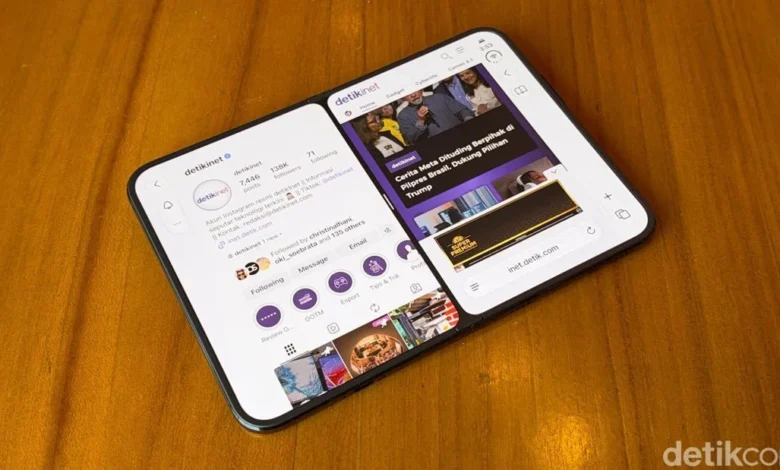
The latest version of Instagram for the iPhone Duo represents a significant shift in layout philosophy. When the device is fully unfolded, the application now utilizes a split-pane architecture. The main timeline expands to fill the larger screen, while the Reels feed has been redesigned to allow for simultaneous viewing of video content and the comment thread. This "side-by-side" functionality is a first for the platform, allowing users to engage with community discussions without obscuring the visual media—a feature that leverages the tablet-like screen real estate of the unfolded Duo.
Furthermore, the integration of Direct Messages (DM) has been overhauled. The app now employs a two-column view that keeps the conversation list visible on the left, while the active chat occupies the right. This utilizes the "book-like" nature of the folding screen to provide a desktop-class experience on a mobile device.
Despite these improvements, the "folded" state of the phone remains a work in progress. As of late November 2026, the application still struggles to reconcile the portrait-mode Reels experience with the device’s physical dimensions when closed, as the system navigation bars continue to occupy the same space as the Reels engagement buttons.
The Broader Ecosystem and Market Impact
The challenges faced by Instagram are representative of a larger trend within the Apple ecosystem. As of November 16, 2026, Greg Joswiak, Apple’s Senior Vice President of Worldwide Marketing, confirmed that over 200,000 applications have been optimized for the iPhone Duo. This represents a 100% increase in optimized apps in less than one month, signaling a massive developer push to support the new hardware.
This growth is largely attributed to the updated iOS 27.1 SDK, which provides more granular control over screen state, hinge-angle detection, and dynamic aspect ratios. However, the sheer volume of apps requiring updates suggests that the "optimization phase" for the iPhone Duo is far from complete. For developers, the economic imperative is clear: failing to optimize for the Duo risks alienating a premium segment of the user base that is increasingly adopting foldable hardware.
Analysis: Implications for Future UI Design
The friction between Instagram and the iPhone Duo provides a compelling case study in the evolution of User Interface (UI) design. We are currently witnessing a shift from "responsive design"—where content simply resizes—to "adaptive design," where the application changes its fundamental logic based on the device’s physical state.
The issues highlighted by Mosseri suggest that the industry standard for foldable devices has not yet matured. In the past, software design was governed by the assumption of a static, flat, rectangular screen. Now, developers must account for variables such as hinge position, device orientation, and physical hardware overlays.
For Instagram, the implication is a move toward more modular code. By separating the UI logic from the content rendering, the platform is better positioned to support future iterations of foldable or even rollable devices. However, this comes at the cost of development complexity and longer testing cycles.
Looking ahead, industry analysts suggest that Apple may eventually be forced to provide more flexible UI guidelines for developers. While Apple’s "Human Interface Guidelines" have historically mandated strict uniformity, the advent of the iPhone Duo may require a more nuanced approach, allowing developers to prioritize application-specific functionality over system-wide navigation consistency in certain contexts.
Conclusion
The journey to optimize Instagram for the iPhone Duo is a microcosm of the current state of the smartphone industry. While the hardware has introduced exciting new possibilities for multitasking and media consumption, the software ecosystem is still playing catch-up.
Adam Mosseri’s transparency regarding these difficulties is telling. It serves as a reminder that even for the most well-resourced technology companies, the leap to a new physical form factor is rarely seamless. As Instagram continues to iterate on its design, the lessons learned from the iPhone Duo’s "button collision" issues will likely inform the development of mobile interfaces for years to come. For now, users must navigate a landscape where the software is constantly evolving to keep pace with the hardware, bridging the gap between the traditional smartphone experience and the promise of the foldable future.