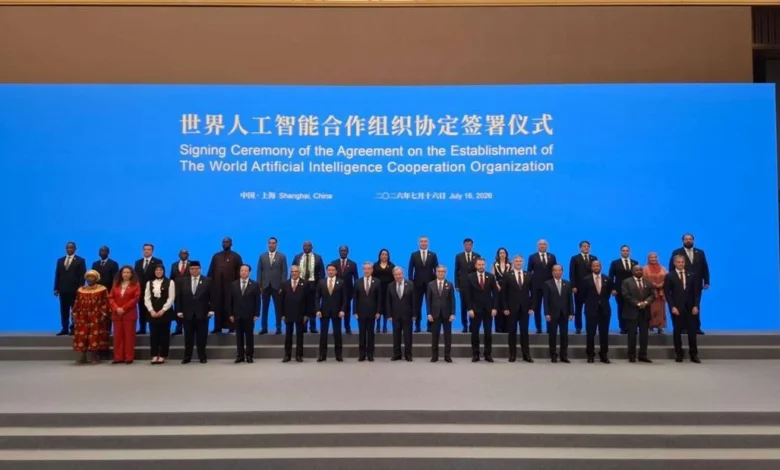
Jakarta, Indonesia has officially cemented its role as a pivotal player in the future of global technology, joining 28 other nations as a founding member of the World Artificial Intelligence Cooperation Organization (WAICO). This landmark international body, established to foster robust global collaboration in the development and governance of Artificial Intelligence (AI), represents a critical step towards creating a unified, ethical, and beneficial framework for one of humanity’s most transformative technologies. Indonesia’s participation underscores its commitment to not only harnessing AI for national development but also contributing actively to its responsible evolution on the world stage.
A New Era of Global AI Collaboration
The formal establishment of WAICO took place with the signing of its foundational documents in Shanghai, China, on July 16, 2026. This significant event saw Indonesia’s delegation led by Coordinating Minister for Economic Affairs Airlangga Hartarto, accompanied by Deputy Minister of Communication and Digital Angga Raka Prabowo, signifying the nation’s high-level commitment to this initiative. The gravity of WAICO’s formation was further amplified by the presence of United Nations Secretary-General António Guterres at the signing ceremony, highlighting the international community’s recognition of the urgent need for a structured approach to AI governance.
WAICO is designed as an independent, non-profit, intergovernmental international organization operating under the overarching framework of the United Nations. Its core mission is multifaceted: to strengthen global cooperation in driving AI innovation while simultaneously ensuring that the development and deployment of this technology proceed in a manner that is open, inclusive, responsible, and universally beneficial. In an era where AI advancements are accelerating at an unprecedented pace, often outstripping regulatory and ethical frameworks, WAICO emerges as a crucial platform to bridge these gaps.
Beyond fostering general collaboration, WAICO’s mandate extends to several critical areas. It aims to facilitate capacity building for human resources in AI, ensuring that all member states, particularly developing ones, have the necessary skills and knowledge to participate effectively in the AI revolution. Furthermore, the organization will work to broaden access to AI technologies, democratizing their reach and preventing a digital divide exacerbated by advanced AI. Strategic coordination among nations regarding AI development pathways, alongside the promotion of international standards for AI governance and ethics, form other key pillars of WAICO’s operational framework. This holistic approach seeks to create a global ecosystem where AI’s immense potential can be realized without compromising fundamental societal values or exacerbating existing inequalities.
Indonesia’s Strategic Embrace of AI Leadership
For Indonesia, becoming a founding member of WAICO is a strategic move with profound implications for its national development and global standing. This membership opens unparalleled opportunities for the archipelago nation to actively participate in shaping the global AI policy agenda, moving beyond being a mere recipient of technological trends to an active co-creator of future AI norms and regulations. It also provides a direct conduit for expanding international cooperation across various critical sectors, including technology transfer, investment attraction in AI-related industries, collaborative research initiatives, and the robust development of its domestic AI ecosystem.
The Indonesian government views WAICO’s establishment as a significant catalyst for accelerating its ambitious national digital transformation agenda. With a burgeoning digital economy projected to reach substantial valuations in the coming years – a report by Google, Temasek, and Bain & Company, for instance, has previously estimated Indonesia’s digital economy to surpass $100 billion, with significant growth potential driven by tech adoption – AI is identified as a primary engine for new economic growth. WAICO is expected to play a crucial role in attracting increased foreign direct investment into Indonesia’s technology sector and stimulating the development of high-value-added technology-based industries, thereby diversifying its economy and creating new job opportunities.
Deputy Minister of Communication and Digital Angga Raka Prabowo emphasized the profound significance of this engagement. "Indonesia’s participation in WAICO marks a strategic moment to reinforce our national AI governance, ensuring it aligns with international best practices," Angga Raka Prabowo stated in a press release dated Saturday, July 18, 2026. He further elaborated, "It simultaneously opens up avenues for cross-national collaboration in fostering an inclusive and responsible AI ecosystem." This statement underscores the dual benefit for Indonesia: strengthening its internal regulatory frameworks while leveraging global partnerships for innovation. The emphasis on "inclusive and responsible" AI development reflects a growing global consensus that technological advancement must be balanced with ethical considerations and equitable access.
The Path Forward: From Signing to Implementation
Following the foundational signing ceremony, the Indonesian delegation was scheduled to participate in an "Informal Preparatory Session on the Establishment of WAICO" on July 17, 2026. This crucial follow-up meeting, chaired by Deputy Minister Angga Raka Prabowo as the head of the Indonesian delegation, served as an initial forum to discuss the operational steps of the newly formed organization and explore concrete opportunities for inter-country cooperation in the field of artificial intelligence. Such preparatory sessions are vital for translating the high-level vision of WAICO into actionable programs and projects. Discussions likely included the development of working groups, allocation of resources, and initial priority areas for collaborative research and policy formulation.
Indonesia joins a diverse group of 28 other founding nations, reflecting a broad international consensus on the necessity of WAICO. This group includes major global players and emerging economies, such as China, Brazil, Russia, Malaysia, South Africa, Pakistan, Kazakhstan, Uzbekistan, Serbia, Kenya, Ethiopia, Venezuela, and Zambia. The geographical and developmental diversity of WAICO’s founding members is a key strength, ensuring that a wide array of perspectives and national priorities are considered in the development of global AI policies. This inclusivity is critical for creating governance frameworks that are truly global in their applicability and impact, avoiding the pitfalls of solutions designed solely by a limited set of dominant technological powers.
The Broader Global Context and the Urgency of AI Governance
The formation of WAICO comes at a time when the global discourse around Artificial Intelligence is reaching a fever pitch. Rapid advancements in areas such as generative AI, large language models, and autonomous systems are reshaping industries, economies, and societies worldwide. While the potential benefits in healthcare, education, climate change mitigation, and economic productivity are immense, so too are the associated risks. Concerns ranging from algorithmic bias, privacy violations, deepfakes and misinformation, job displacement, and the ethical implications of autonomous weapons systems underscore the urgent need for robust international governance.
Existing initiatives, such as the OECD AI Principles, the G7 Hiroshima AI Process, and UNESCO’s Recommendation on the Ethics of Artificial Intelligence, have laid important groundwork. However, WAICO distinguishes itself as an intergovernmental organization with a broad mandate and direct UN backing, offering a potentially more robust and inclusive platform for consensus-building and standard-setting across a diverse global membership. Unlike non-governmental forums or regional groupings, WAICO’s structure is designed to facilitate binding agreements and coordinated actions among sovereign states, lending greater weight to its pronouncements and recommendations.
For Indonesia, its involvement in WAICO also aligns with its broader foreign policy objectives of promoting multilateralism and fostering South-South cooperation. By collaborating with a significant number of developing and emerging economies within WAICO, Indonesia can champion the interests of these nations, ensuring that the benefits of AI are equitably distributed and that AI development respects diverse cultural contexts and developmental needs. This collective voice is crucial in preventing a scenario where AI governance is dictated solely by a handful of technologically advanced nations, potentially marginalizing the concerns of the Global South.
Implications and Future Outlook for Indonesia
Indonesia’s proactive engagement in WAICO positions it as a responsible and forward-looking nation in the global technology landscape. This move is expected to have several long-term implications:
Firstly, it enhances Indonesia’s diplomatic influence in technology policy. By being at the table where global AI norms are being shaped, Indonesia can advocate for its national interests, such as ensuring data sovereignty, promoting local content development in AI applications, and fostering an environment conducive to domestic innovation.
Secondly, it will likely accelerate the development of Indonesia’s national AI strategy and regulatory framework. The insights gained from WAICO discussions, combined with access to international best practices, will enable Indonesia to craft more effective and globally interoperable policies, thereby fostering investor confidence and promoting ethical AI deployment within its borders. This could include developing guidelines for data privacy in AI, ethical AI development principles for businesses, and frameworks for AI accountability.
Thirdly, WAICO membership could unlock significant opportunities for investment and talent development. International collaboration facilitated by WAICO can lead to joint research projects, technology transfer agreements, and educational programs that upskill the Indonesian workforce in AI. This would be crucial for nurturing a vibrant AI ecosystem, fostering local startups, and attracting global tech giants to invest in Indonesia. The government’s target of creating a digital economy that is a new source of growth hinges significantly on its ability to cultivate a skilled AI workforce and attract capital.
Finally, Indonesia’s role as a bridge between developed and developing nations within WAICO could prove invaluable. Its experience as a large, diverse, and rapidly developing economy provides a unique perspective on the challenges and opportunities of AI adoption in varied socio-economic contexts. This allows Indonesia to advocate for inclusive AI policies that address issues pertinent to developing countries, such as infrastructure disparities, digital literacy gaps, and the need for culturally relevant AI applications.
As WAICO begins its operational journey, the global community will be watching closely to see how this ambitious organization translates its vision into concrete action. For Indonesia, its founding membership marks not just a diplomatic achievement but a fundamental commitment to shaping a future where Artificial Intelligence serves humanity responsibly and equitably. The path ahead will require sustained effort, international cooperation, and a steadfast dedication to ethical principles, but Indonesia has clearly signaled its readiness to lead in this crucial endeavor.
Related posts: