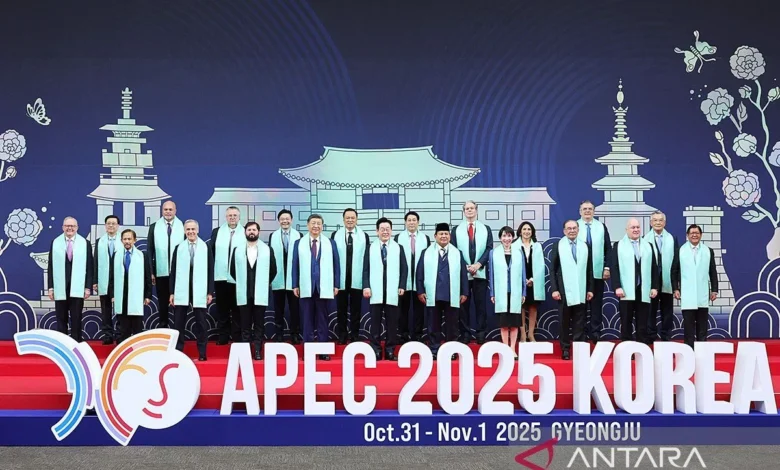
The Asia-Pacific Economic Cooperation (APEC) forum has once again ascended to the pinnacle of the global diplomatic agenda following the high-profile attendance of Indonesian President Prabowo Subianto at the APEC Economic Leaders’ Meeting in Gyeongju, South Korea. Held from October 31 to November 1, 2025, the summit served as a critical platform for Indonesia to reaffirm its commitment to regional stability, sustainable growth, and the deepening of multilateral trade ties. As the world navigates a complex landscape of technological disruption and shifting geopolitical alliances, the Gyeongju summit underscored the enduring relevance of APEC as the premier forum for facilitating economic collaboration among the diverse economies bordering the Pacific Ocean.
President Prabowo’s presence in Gyeongju marks a significant milestone for Indonesia’s foreign policy under his administration. By engaging with leaders from 20 other member economies, the Indonesian head of state emphasized the importance of "downstreaming" industries, food security, and energy transition—themes that have become central to Indonesia’s national development strategy. The summit provided a unique opportunity to align these domestic priorities with the broader regional goals of trade liberalization and digital integration.
Understanding the Framework of APEC
APEC is an intergovernmental forum for 21 member economies in the Pacific Rim that promotes free trade throughout the Asia-Pacific region. Unlike many other international organizations, APEC operates on the basis of non-binding commitments, open dialogue, and equal weight for all participants. Decisions within APEC are reached by consensus, and commitments are undertaken on a voluntary basis. This "APEC way" has allowed the forum to bridge the gap between highly developed economies and emerging markets, fostering a unique environment for economic experimentation and policy alignment.
The forum’s primary mission is to support sustainable economic growth and prosperity in the region. It achieves this through three main pillars, often referred to as the "Three Pillars of APEC": trade and investment liberalization, business facilitation, and economic and technical cooperation (ECOTECH). By reducing tariffs and other barriers to trade, APEC member economies have historically seen a significant surge in cross-border commerce, which has lifted millions out of poverty across Asia and the Americas.
The Genesis and Historical Evolution of APEC
The origins of APEC can be traced back to the late 1980s, a period characterized by significant shifts in the global order. The Cold War was drawing to a close, and the world was witnessing the emergence of powerful regional trade blocs, such as the European Single Market and the North American Free Trade Agreement (NAFTA). Fearing that the Asia-Pacific region might be left behind or fragmented, visionary leaders sought a mechanism to unify the region’s economic interests.
The formal proposal for APEC was made by Australian Prime Minister Bob Hawke during a speech in Seoul, South Korea, in January 1989. Hawke envisioned a forum that would provide a collective voice for the region in global trade negotiations, particularly as the Uruguay Round of the General Agreement on Tariffs and Trade (GATT) faced potential deadlock.
Ten months later, in November 1989, ministers from 12 founding economies met in Canberra, Australia, to officially launch APEC. These founding members included Australia, Brunei Darussalam, Canada, Indonesia, Japan, the Republic of Korea, Malaysia, New Zealand, the Philippines, Singapore, Thailand, and the United States. Indonesia, as a founding member, has played a pivotal role from the outset, ensuring that the interests of developing nations were integrated into the forum’s core objectives.
Expansion and the "Three Chinas" Integration
As the importance of the Asia-Pacific region grew, so did APEC’s membership. The forum’s expansion reflected the changing economic realities of the 1990s. In 1991, APEC achieved a significant diplomatic breakthrough by welcoming the People’s Republic of China, Hong Kong (then a British colony), and Chinese Taipei (Taiwan) simultaneously. This inclusion was crucial, as it brought the major economic engines of the Sinitic world into a single consultative framework, despite complex political sensitivities.
The expansion continued throughout the decade:
- 1993: Mexico and Papua New Guinea joined the forum.
- 1994: Chile became a member, further strengthening the link between Asia and South America.
- 1998: Peru, Russia, and Vietnam were the last to be admitted, bringing the total membership to 21.
Since 1998, APEC has maintained a moratorium on new membership to focus on deepening cooperation among existing members, although several nations, including India and Colombia, have expressed interest in joining.
From Ministerial Dialogue to Leaders’ Summits
In its infancy, APEC functioned primarily as a ministerial-level meeting and a forum for senior officials. However, the need for higher-level political commitment became apparent as the agenda grew more ambitious. In 1993, U.S. President Bill Clinton invited the leaders of APEC member economies to Blake Island, Washington, for the first-ever APEC Economic Leaders’ Meeting.
This transition from a bureaucratic dialogue to a summit of heads of state transformed APEC into a high-stakes arena for economic diplomacy. It allowed leaders to engage in "informal" retreats where they could discuss sensitive issues away from the rigid protocols of traditional diplomacy. It was during these early summits that the famous tradition of leaders wearing the traditional attire of the host nation began, symbolizing the spirit of regional brotherhood and cultural respect.
Indonesia’s Legacy: The Bogor Goals of 1994
One of the most defining moments in APEC’s history occurred on Indonesian soil. In 1994, during the summit held in Bogor, Indonesia, leaders adopted the "Bogor Goals." This landmark declaration committed APEC economies to the ambitious objective of achieving free and open trade and investment in the Asia-Pacific by 2010 for industrialized economies and by 2020 for developing economies.
The Bogor Goals served as a North Star for the forum for over a quarter of a century. They spurred a massive reduction in average tariff rates across the region—dropping from nearly 17% in 1989 to approximately 5% by 2020. While the goals were not fully met in every sector, they fundamentally reshaped the regional economy, making it the most dynamic and integrated trade zone in the world.
The Economic Powerhouse: APEC by the Numbers
The scale of APEC’s influence is reflected in its staggering economic data. The 21 member economies represent:
- Approximately 3 billion people, accounting for nearly 40% of the world’s population.
- Roughly 62% of global Gross Domestic Product (GDP), making it the world’s most powerful economic bloc.
- Nearly 48% of global trade, illustrating the region’s role as the "factory of the world" and a primary hub for global services.
For Indonesia, APEC members are vital partners. More than 70% of Indonesia’s total trade is conducted with APEC economies, and a significant portion of Foreign Direct Investment (FDI) flowing into the Indonesian archipelago originates from APEC partners like Singapore, Japan, China, and the United States.
The 2025 Gyeongju Summit: Navigating New Frontiers
The 2025 summit in Gyeongju, South Korea, comes at a time when the global economy is transitioning toward a "Twin Transition"—digitalization and decarbonization. Under the theme of "Building a Sustainable and Resilient Tomorrow," the leaders focused on several critical areas:
- Digital Trade and AI Governance: With the explosion of Artificial Intelligence, APEC leaders discussed the need for interoperable regulatory frameworks to ensure that AI serves as a tool for inclusive growth rather than a source of regional inequality.
- Supply Chain Resilience: Learning from the disruptions of the early 2020s, the Gyeongju declaration emphasized the "friend-shoring" and "near-shoring" of critical supply chains, particularly in semiconductors and battery minerals.
- Climate Finance: A significant portion of the dialogue was dedicated to how developed APEC economies can assist developing ones in financing the transition to renewable energy without compromising industrial growth.
President Prabowo Subianto, in his interventions, highlighted Indonesia’s role as a key provider of critical minerals—such as nickel—necessary for the global electric vehicle (EV) revolution. He advocated for a trade regime that allows developing nations to process their raw materials domestically, thereby moving up the value chain.
Geopolitical Implications and Indonesia’s "Prabowo Doctrine"
While APEC is strictly an economic forum, it inevitably operates within the shadow of geopolitical tensions, particularly the strategic competition between the United States and China. Indonesia, under President Prabowo, has maintained a "Free and Active" foreign policy, refusing to align exclusively with any single power bloc.
At the 2025 summit, Indonesian diplomacy focused on "bridge-building." Analysts suggest that Prabowo’s approach—often dubbed the "Prabowo Doctrine"—seeks to leverage Indonesia’s strategic location and natural resources to demand a more equitable international order. By engaging both Washington and Beijing within the APEC framework, Indonesia serves as a stabilizing force, ensuring that economic cooperation remains a priority even when political tensions flare.
Statements from the Indonesian Ministry of Foreign Affairs indicated that the President held several bilateral meetings on the sidelines of the Gyeongju summit. These talks reportedly focused on securing investments for the new capital city (IKN) and expanding agricultural exports to North Asian markets.
The Road to 2040: The Putrajaya Vision
As the Bogor Goals reached their deadline in 2020, APEC transitioned to a new long-term roadmap: the APEC Putrajaya Vision 2040. This vision aims for "an open, dynamic, resilient and peaceful Asia-Pacific community by 2040, for the prosperity of all our people and future generations."
The Putrajaya Vision shifts the focus from purely reducing tariffs to broader issues such as:
- Inclusive Growth: Ensuring that Small and Medium Enterprises (SMEs), women, and marginalized groups benefit from international trade.
- Innovation and Digitization: Promoting a paperless trade environment and digital literacy.
- Environmental Sustainability: Addressing the existential threat of climate change through regional cooperation.
Conclusion: APEC as a Pillar of Regional Stability
The 2025 APEC Summit in Gyeongju has reaffirmed that despite the rise of various "minilateral" groupings, APEC remains the only forum that brings all the major players of the Asia-Pacific to the same table. For Indonesia, APEC is not merely a talk shop; it is a vital instrument for national interest.
President Prabowo Subianto’s active participation underscores a clear message: Indonesia is ready to lead in the Asia-Pacific. By championing the interests of the Global South while maintaining productive ties with established powers, Indonesia is positioning itself as a central hub in the new global economy. As the forum moves toward the realization of the Putrajaya Vision 2040, the cooperation fostered in Gyeongju will likely be remembered as a crucial step in maintaining the "Pacific Century" as an era of shared prosperity and peace.
Related posts: