The Indonesian Automotive Landscape in Transition: Popular Models That Reached the End of the Road in 2025


The Indonesian automotive market underwent a significant structural transformation throughout 2025, driven by evolving consumer preferences, stringent global emissions regulations, and a decisive industry-wide pivot toward electrification. Amid a fiercely competitive landscape marked by the aggressive influx of new energy vehicles and tightening government incentives for hybrid and electric technologies, several long-standing favorites and recent market entrants were quietly phased out. For automotive manufacturers operating in Southeast Asia’s largest economy, 2025 will be remembered as a transitional watershed year where legacy internal combustion engine (ICE) portfolios were systematically trimmed to make room for cleaner, more technologically advanced alternatives.
While the discontinuation of these models marks the end of an era on showroom floors, it simultaneously injects dynamic activity into the secondary market. Consumers seeking reliable personal transportation are finding unexpected value in pre-owned variants of these recently retired vehicles. Because these models ceased production only recently, prospective buyers face minimal immediate risk regarding spare parts availability, servicing infrastructure, or technological obsolescence. Industry analysts note that the secondary market absorption of these phased-out vehicles has been remarkably smooth, cushioned by robust brand equity and lingering consumer familiarity.
Strategic Shifts and Market Dynamics Driving the 2025 Phase-Outs
The decision by major automotive players—including Honda, Chery, Suzuki, and Toyota—to discontinue specific models was rarely arbitrary. Rather, it reflected deep strategic recalibrations designed to optimize production lines, meet shifting consumer demands, and comply with Indonesia’s ambitious roadmap toward net-zero emissions. Over the past several years, the Indonesian government has rolled out a suite of fiscal incentives and regulatory frameworks designed to encourage the adoption of electrified vehicles, ranging from mild hybrids to battery-electric vehicles (BEVs).
Consequently, maintaining production lines for conventional, high-emission powertrains became economically unviable for certain segments. Manufacturers realized that capital expenditure was better deployed toward scaling hybrid electric vehicle (HEV) technology, which has emerged as the most pragmatic bridge technology for Indonesian consumers wary of range anxiety and limited public charging infrastructure. As showroom floors prioritize fuel efficiency and lower carbon footprints, legacy models that failed to integrate these new technological imperatives were inevitably retired.
Honda HR-V Turbo: Making Way for Hybrid Dominance
One of the most notable casualties of the 2025 product rationalization strategy was the Honda HR-V Turbo. PT Honda Prospect Motor (HPM), the sole agent and distributor of Honda automobiles in Indonesia, officially pulled the plug on the turbocharged variant of its immensely popular five-passenger compact SUV following the introduction of the vehicle’s latest generation in June 2025.
The standard-setting HR-V has long been a crown jewel in Honda’s Indonesian portfolio, captivating urban professionals with its sleek coupe-like silhouette and agile driving dynamics. However, as global and regional directives forced a heavy emphasis on carbon reduction, HPM made the calculated decision to pivot the flagship tier of the HR-V lineup toward advanced hybrid technology. The newest iteration of the compact SUV dropped the high-pressure turbo engine in favor of a sophisticated e:HEV hybrid system, which promises superior fuel economy and drastically reduced tailpipe emissions without sacrificing performance.
For consumers who still crave the spirited acceleration and punchy mid-range torque of the discontinued forced-induction engine, the secondary market has proven to be a lucrative hunting ground. Data compiled from leading Indonesian automotive classifieds indicate that pre-owned models of the Honda HR-V Turbo retain strong residual values. A well-maintained 2022 model year currently changes hands within the price bracket of Rp310 million, while newer, lower-mileage variants from the 2024 model year command approximately Rp360 million. Industry observers point out that because these vehicles feature relatively modern electronics and share platform architecture with the broader HR-V family, maintenance and parts replacement remain entirely unproblematic for the foreseeable future.
Chery Tiggo 5 X: Refining the Chinese Brand’s Local Strategy
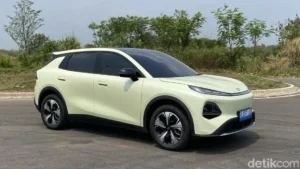
The rapid expansion of Chinese automotive brands in the Indonesian market has added a layer of intense competition, forcing companies to constantly fine-tune their product offerings to find a winning formula. A prime example of this agile corporate strategy occurred in March 2025, when Chery Sales Indonesia (CSI) made the strategic decision to halt the production of the Chery Tiggo 5 X.
Having entered the market with high aspirations to capture the budget-conscious compact SUV segment, CSI quickly re-evaluated its domestic lineup to eliminate internal cannibalization and streamline marketing efforts. The company elected to prioritize the newer Tiggo Cross, a vehicle positioned to better capture the evolving tastes of tech-savvy, younger Indonesian buyers who demand modern connectivity features, aggressive styling, and comprehensive driver-assistance systems at a competitive price point.
Despite its relatively brief tenure on the official assembly lines, the Chery Tiggo 5 X left behind a solid footprint of early adopters. For budget-conscious buyers entering the used car market, this discontinuation has created an attractive value proposition. A pre-owned Chery Tiggo 5 X from the 2024 model year is currently trading at an accessible price point of around Rp165 million. This aggressive pricing in the secondary market offers exceptional value for money, providing modern styling and high feature density at a fraction of the cost of a brand-new entry-level crossover.
Suzuki Baleno Hatchback: The End of an Imported Era
While domestic manufacturing decisions account for several vehicle retirements, shifting import strategies also played a crucial role in shaping the 2025 automotive landscape. PT Suzuki Indomobil Sales (SIS) confirmed that the iconic Suzuki Baleno Hatchback would no longer be imported into Indonesia, effectively bringing its commercial lifecycle in the country to a close.
The decision to cease imports and wind down sales of the Baleno Hatchback was implemented progressively, culminating in a complete halt by September 2025. For years, the Baleno Hatchback served as a reliable, economical, and stylish choice for urban commuters and small families looking for Japanese reliability packaged in a compact, easy-to-park footprint. However, shifting corporate priorities toward localized production of hybrid commercial and passenger vehicles—such as the Ertiga Hybrid and XL7 Hybrid—meant that importing a niche non-hybrid hatchback from overseas no longer aligned with Suzuki’s long-term profitability and volume objectives in Indonesia.
The secondary market for the Suzuki Baleno Hatchback is exceptionally liquid, given the vehicle’s widespread popularity and long-standing reputation for bulletproof mechanical reliability. Used car market data reveals a predictable depreciation curve: a well-maintained 2020 model year commands roughly Rp144 million, while late-model 2025 units—representing the final batches cleared from inventory—trade closer to Rp219 million. Because Suzuki maintains an extensive, nationwide network of spare parts distribution and authorized service centers, owners of the discontinued hatchback face virtually zero risk regarding long-term maintenance support.
Toyota Veloz Petrol: The Complete Electrification of a Family Staple
Perhaps the most monumental shift in the Indonesian mass-market automotive sector occurred toward the end of 2025, when automotive titan PT Toyota-Astra Motor (TAM) officially terminated the production and sale of its conventional, petrol-powered Toyota Veloz. As one of the undisputed kings of the Multi-Purpose Vehicle (MPV) segment—a vehicle class that forms the absolute backbone of family mobility in Indonesia—the Veloz has always been a bellwether for industry trends.
By sunsetting the pure internal combustion engine (ICE) variant of the Veloz near the close of 2025, Toyota completed a massive strategic pivot, confirming that all future production iterations of the Veloz will exclusively feature hybrid powertrain technology. This move aligns seamlessly with Toyota’s multi-pathway global strategy and satisfies the heavy local demand for fuel-efficient family haulers capable of navigating Indonesia’s congested urban arteries and long-distance toll roads with minimal fuel expenditure.
The ripple effects of this transition are clearly visible in the pre-owned market, where traditional petrol-powered Veloz units remain immensely sought after due to their legendary durability, cavernous cabin space, and low cost of ownership. Pricing for a pre-owned Toyota Veloz from the 2020 model year hovers around the Rp175 million mark. Meanwhile, newer, late-model 2025 conventional petrol variants—which represent the final chapter of pure-ICE family motoring for this specific nameplate—command an average price of Rp260 million. Automotive analysts emphasize that while these secondary market figures provide a reliable baseline, final transaction prices remain flexible, subject to vehicle condition, mileage, service history, and direct negotiation between buyers and sellers.
Implications for Consumers, Dealers, and the Broader Industry
The sweeping retirement of these notable models throughout 2025 serves as a clear indicator of a maturing automotive market. For prospective car buyers, the current economic climate presents a unique window of opportunity. Purchasing a recently discontinued model allows budget-conscious consumers to acquire modern, technologically competent vehicles at discounted prices, bypassing the steepest part of the depreciation curve. Furthermore, because these vehicles were discontinued due to strategic portfolio realignments rather than catastrophic mechanical failures or sudden corporate bankruptcies, owners enjoy peace of mind regarding ongoing parts availability and mechanical servicing.
For automotive dealerships and used car operators, the phase-out of these models has necessitated dynamic inventory management. Dealerships have had to adjust pricing strategies to accommodate the influx of nearly new trade-ins, particularly as consumers upgrade to the new generation of hybrid and electric vehicles occupying showroom floors. Used car platforms have reported healthy liquidity and steady demand for these specific nameplates, proving that brand reputation and practical utility continue to outweigh the novelty of brand-new status for a large segment of the Indonesian population.
Ultimately, the events of 2025 underscore a permanent paradigm shift in Indonesian mobility. As regulatory pressures mount and environmental consciousness grows among urban consumers, the era of unmitigated internal combustion engine dominance is steadily drawing to a close. The vehicles that took their final bow in 2025—whether high-performance turbocharged SUVs, imported hatchbacks, or mass-market family MPVs—have transitioned from showroom centerpieces to foundational pillars of a vibrant, evolving secondary market, ensuring that their legacy on Indonesian roads will endure for many years to come.
Related posts: