Battery Subscription Models Transform Electric Motorcycle Ownership in Indonesia September 2026

The landscape of electric vehicle (EV) adoption in Indonesia has undergone a significant transformation by September 2026, driven largely by the proliferation of innovative financing schemes, specifically the battery-as-a-service (BaaS) or battery subscription model. By decoupling the battery from the vehicle’s purchase price, manufacturers have effectively lowered the entry barrier for prospective consumers, making the transition from internal combustion engine (ICE) motorcycles to electric alternatives more financially accessible than ever before.
As of September 2026, data indicates that monthly subscription fees for motorcycle batteries range from IDR 84,000 to IDR 250,000. This pricing structure is designed to mitigate the high upfront costs typically associated with lithium-ion battery technology, which often accounts for nearly 40% of the total vehicle price. By opting for a subscription, consumers essentially shift the capital expenditure of the battery into operational expenditure, providing more flexibility for budget-conscious riders.
The Evolution of the Battery-as-a-Service Model
The emergence of the battery subscription model in Indonesia can be traced back to the broader national effort to accelerate the transition to sustainable energy. Following the government’s push to achieve net-zero emissions and the introduction of various subsidies for electric motorcycle conversions, manufacturers recognized that the high initial price point remained the primary deterrent for mass adoption.
Historically, potential buyers were wary of the "hidden costs" associated with EV ownership, specifically the perceived long-term expense of battery degradation and replacement. To address this, industry players began piloting subscription models between 2024 and 2025. These programs serve two purposes: they lower the retail price of the motorcycle unit and shift the responsibility of battery health maintenance to the manufacturer, thereby alleviating consumer anxiety regarding long-term reliability.
Comparative Analysis of Market Offerings
Several prominent manufacturers have solidified their presence in the Indonesian market by implementing distinct battery subscription tiers. Each program is tailored to the specific technical requirements of the motorcycle models and the intended usage patterns of the riders.
VinFast: The Competitive Entry Point
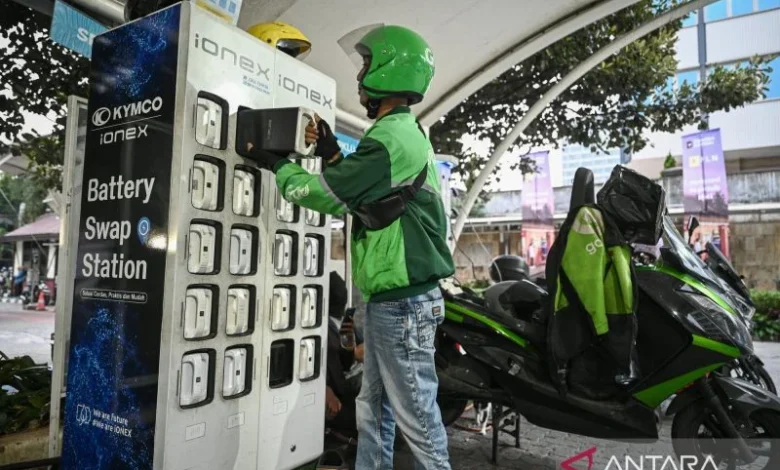
VinFast has emerged as a leader in cost-efficiency for budget-conscious consumers. Its subscription program, applicable to the Evo, Feliz II, and Viper models, starts at an entry-level price of IDR 84,000 per month for a single battery. For users requiring extended range, the two-battery configuration is priced at IDR 144,000 per month. A key feature of the VinFast ecosystem is its compatibility with battery-swapping infrastructure, which allows riders to bypass lengthy charging times by exchanging depleted units at designated kiosks.
Polytron: Performance-Driven Subscription
Polytron has adopted a model that segments its subscription fees based on the power capacity of the vehicle. Its high-performance Fox 500 and the popular Fox R models are positioned at a subscription rate of IDR 200,000 per month. Meanwhile, the Fox 200 model carries a more affordable fee of IDR 125,000 per month. Beyond the financial aspect, Polytron provides a vital service guarantee: if the battery’s health capacity drops below 85% during standard usage, the company commits to a replacement, effectively insulating the owner from the risk of premature battery failure.
ALVA: The Premium Tier Experience
ALVA, known for its focus on premium electric mobility, offers its "BEBAS" (Berlangganan Baterai Sewa) program for the N3 and CERVO models. The subscription cost for the ALVA N3 is set at IDR 150,000 for a single battery or IDR 250,000 for a dual-battery setup. The ALVA CERVO, which utilizes a dual-battery system, is also priced at the top-tier rate of IDR 250,000 per month. These figures are inclusive of taxes, providing a transparent cost structure for users. By integrating the battery into a service-based model, ALVA ensures that the vehicle remains a perpetual asset under their ecosystem.
Financial and Technical Implications
While the subscription model offers clear benefits in reducing upfront costs, financial analysts emphasize that it is merely one component of the total cost of ownership (TCO). Prospective buyers must still account for:
- Unit Purchase Price: The base cost of the motorcycle chassis, excluding the battery.
- Charging Costs: The electricity tariffs incurred during home or public charging.
- Maintenance: While the battery is covered by the subscription, the mechanical components—brakes, tires, and electrical systems—require routine servicing.
- Taxation and Insurance: Statutory costs remain mandatory regardless of the battery ownership model.
From a technical standpoint, the subscription model encourages a "circular economy." By retaining ownership of the batteries, manufacturers are incentivized to ensure long-term performance and eventually facilitate the recycling or "second-life" usage of these batteries in stationary energy storage systems (ESS). This model directly supports the government’s objective to build a localized, sustainable supply chain for EV components.
Regulatory Context and Government Support
The Ministry of Industry (Kemenperin) has been a vocal proponent of these initiatives, noting that the growth of the electric motorcycle population—which surpassed 280,000 units by mid-2026—is a critical benchmark for the country’s green ecosystem. Legislative bodies, including the DPR RI, have consistently urged the acceleration of the national battery industry to reduce dependence on imported energy and components.
Furthermore, the government’s commitment to providing incentives for electric vehicle adoption remains a cornerstone of its 2026 fiscal policy. By subsidizing the manufacturing side and encouraging the expansion of swapping and charging networks, the government aims to lower the "barrier to entry" to the point where electric motorcycles become the default choice for urban commuters.
Expert Perspectives on Future Trends
Industry observers suggest that the next phase of the battery subscription model will likely involve "usage-based billing." Currently, most subscriptions are flat-rate monthly fees. However, as telematics technology becomes more sophisticated, manufacturers may introduce tiered pricing based on the actual kilowatt-hours (kWh) consumed, allowing lower-mileage riders to pay even less than the current entry-level rates.
Moreover, the competition between manufacturers is expected to intensify, likely leading to further price compression in the subscription market. As battery energy density improves and production scales, the cost of the subscription is projected to remain stable or potentially decrease, even as the performance capabilities of the motorcycles themselves increase.
Conclusion: Weighing the Options
For the average Indonesian consumer, the decision to opt for a battery subscription depends on individual usage patterns and financial liquidity. Riders who prioritize a lower initial investment and peace of mind regarding battery health are ideally suited for the subscription model. Conversely, those who prefer long-term asset ownership without ongoing monthly obligations may still opt for outright purchase.
As the industry matures, the clarity of these programs will be the deciding factor for mass-market penetration. With manufacturers like VinFast, Polytron, and ALVA setting clear benchmarks for monthly fees, the Indonesian market is demonstrating that it is ready to move beyond early adoption and into a phase of widespread, sustainable, and economically viable electric mobility. As of late 2026, the data confirms that the battery subscription model is no longer a niche financial experiment, but a robust framework underpinning the future of the nation’s transportation sector.
Related posts: