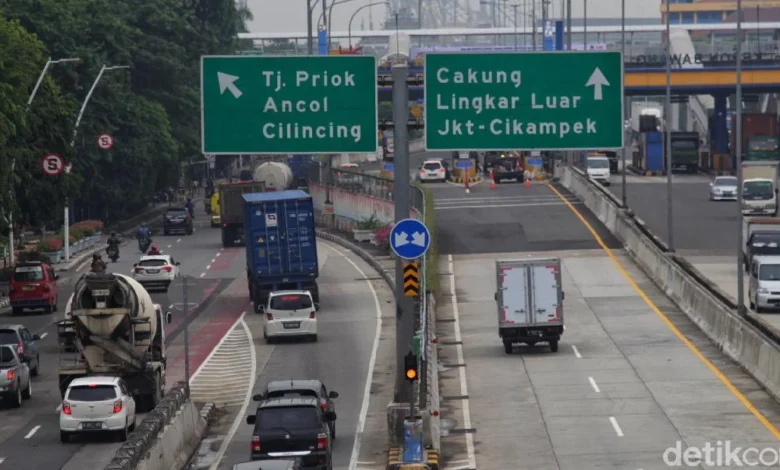
The metropolitan area of Greater Jakarta, or Jabodetabek, stands at a critical juncture regarding its transportation infrastructure. As the region grapples with chronic traffic congestion and the mounting pressures of an expanding logistics sector, the Indonesian government is currently fast-tracking the development of a unified toll road tariff system. This initiative, aimed at harmonizing the disparate pricing structures across the vast network of Jakarta’s toll roads, is seen as a strategic move to optimize vehicle distribution and enhance the efficiency of national supply chains.
Recent findings from a survey conducted by the Forum Konsumen Berdaya Indonesia (FKBI) underscore the urgency of this transition. According to the data, 74.1% of respondents—primarily logistics operators and daily commuters—strongly support the integration of toll tariffs. The consensus among these stakeholders is that the current fragmented pricing model creates inefficiencies, incentivizing drivers to avoid modern, faster toll roads in favor of congested, older routes simply due to cost disparities.
The Rationale Behind Integrated Toll Networks
The Indonesian government’s long-term vision for infrastructure is outlined in the National Toll Road Network General Plan 2020-2040. This blueprint envisions a seamless, interconnected system where roads function as a cohesive network rather than isolated segments. However, the reality on the ground has been complicated by the asynchronous development of various sections. Because different toll roads were commissioned at different times, often under varying investment schemes and concession agreements, a uniform pricing strategy was never initially established.
This lack of alignment has resulted in "islands" of infrastructure. In some instances, newer, high-capacity toll roads remain underutilized because the cost of entry is perceived as too high compared to legacy routes. Conversely, older segments suffer from excessive traffic volume, leading to degradation of road surfaces and increased accident rates. By integrating the tariffs, the government hopes to create a "fluid" network where traffic is naturally distributed based on road capacity rather than price barriers.
Strategic Logistics: The Case of the Cibitung-Cilincing Corridor
A pivotal component of this integration strategy focuses on the logistics corridor connecting the Cibitung-Cilincing toll road, the Jakarta-Cikampek line, and the Tanjung Priok Access Toll (ATP). This specific triad serves as the primary artery for goods moving from the industrial heartlands of West Java to the Tanjung Priok Port, the country’s busiest maritime gateway.
Sony Sulaksono Wibowo, a member of the Toll Road Regulatory Agency (BPJT) under the Ministry of Public Works, stated on Thursday, October 29, 2026, that the harmonization of these specific segments is a priority. "The goal is to facilitate smoother traffic flow through a more equitable distribution of vehicles and to optimize interconnected segments," Wibowo explained. He noted that the Ministry is currently finalizing the regulatory framework, including the drafting of Ministerial Decrees, to ensure that these changes can be implemented with legal certainty.
Economic Realities: The Logistics Perspective
While the government views integration as a solution to congestion, industry players urge caution. The logistics sector operates on razor-thin margins, and the cost of transport—which includes fuel, driver wages, vehicle maintenance, and toll fees—is a highly sensitive variable.
Ahmad Sugiono, a representative of the Indonesian Logistics and Forwarders Association (ALFI) Jakarta, emphasized that the decision to use a toll road is not solely based on travel time. "In the logistics industry, a time saving of one or two hours does not necessarily equate to a shift in route if the cost of the toll outweighs the fuel savings or the efficiency gains," Sugiono noted.
Logistics companies often operate on fixed-rate contracts where the "driver’s money" (uang jalan) must cover all expenses. If the toll cost increases, it directly reduces the net income of the driver or the profit margin of the logistics firm. Therefore, unless the integrated tariff model accounts for the total logistics ecosystem—including the bottlenecks encountered before entering the toll road and the potential for return loads—simple integration may not lead to the desired shift in driver behavior.
Theoretical Framework and Policy Challenges
The debate surrounding toll integration touches on the core purpose of infrastructure investment. Gibran Sesunan, Executive Director of the Center for Strategic Infrastructure Studies (PUKIS), argues that a blanket policy for toll pricing is insufficient. "We must distinguish between tolls meant for passenger mobility and those built specifically for industrial logistics," Sesunan said.
He suggests that for logistics-heavy corridors, the government should consider a subsidized or preferential tariff structure. By lowering the entry barrier for heavy goods vehicles, the government could effectively offload arterial roads, thereby improving overall road safety and reducing the environmental footprint of heavy transport. However, this creates a fiscal challenge: how to maintain the economic viability of the private companies that operate these toll roads under long-term concessions.
The Financial Burden on Drivers: A Simulation
A simulation provided by Sugi Purnoto, a Senior Consultant at Supply Chain Indonesia, illustrates the complexity of the issue. Currently, toll costs on standard logistics routes account for approximately 7% to 14% of a driver’s total operational budget. However, if that same driver were to switch to a more modern, integrated logistics-specific route without a carefully calibrated pricing structure, that cost could spike to 28% to 40% of their total budget.
"When the toll cost consumes nearly half of the operational budget, the driver has no choice but to opt for the existing, congested arterial roads," Purnoto explained. "Connectivity is not just about physical asphalt; it is about economic feasibility. If the price is too high, the infrastructure becomes a white elephant."
Future Outlook and Policy Implications
As the government prepares to roll out the new regulatory framework, the success of the Jabodetabek toll integration will depend on a multi-pronged approach. First, the legal aspect must be ironed out to ensure that the disparate revenue-sharing agreements between various toll road operators are preserved or adjusted equitably.
Second, the government must move toward a more dynamic, "smart" pricing model. This could involve off-peak discounts, loyalty programs for logistics fleets, or tax incentives for companies that utilize designated logistics routes. The ultimate goal is to move beyond the current "static" toll model to a "systemic" model that views the toll road network as a public utility essential to the economic health of the capital region.
The Broader Impact on Jabodetabek
The implications of this policy extend far beyond the logistics industry. For the millions of commuters residing in the satellite cities of Bogor, Depok, Tangerang, and Bekasi, an integrated toll system could provide more reliable travel times. If the distribution of traffic becomes more efficient, the congestion that plagues the Jakarta inner-ring roads could be significantly mitigated.
Furthermore, the reduction of idling time for thousands of trucks and cars will have a measurable impact on carbon emissions. As Jakarta continues to struggle with air quality, the optimization of traffic flow through toll integration becomes an environmental imperative as well as an economic one.
As of late 2026, the progress remains in the administrative phase. Stakeholders are waiting for the issuance of the Ministerial Decree, which will serve as the signal for the actual implementation of the tariff changes. Whether the government can strike the delicate balance between investor return, logistical affordability, and the public’s demand for a congestion-free commute remains the central question of this infrastructure reform.
In conclusion, while the support for an integrated toll network is high, the road to implementation is paved with economic complexities. The government’s ability to reconcile the needs of logistics firms with the operational requirements of toll road concessionaires will determine whether the Jabodetabek toll network can finally live up to its potential as a catalyst for regional economic growth. The focus moving forward will likely shift toward nuanced, segment-specific tariff adjustments that prioritize the movement of goods while maintaining the financial sustainability of the nation’s road infrastructure.
Related posts: