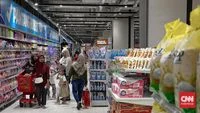
In a decisive move to address the sudden scarcity of premium rice in modern retail outlets across Indonesia, Minister of Agriculture and Head of the National Food Agency (Bapanas), Andi Amran Sulaiman, has formally instructed state logistics firm Perum Bulog to immediately inject an additional 300,000 tons of premium rice into the supply chain. This directive is designed to eliminate artificial shortages, reassure consumers, and stabilize retail prices amid shifting regulatory oversight on fortified rice products nationwide.
Speaking at a press conference held at his private residence in South Jakarta on Monday, September 21, Minister Amran emphasized that the volume of rice designated for retail distribution can be tripled to 900,000 tons if market demand necessitates such an escalation. The policy underscores the government’s assertion that national rice reserves are not only secure but currently at historic highs, rendering localized retail gaps a logistical friction rather than a macroeconomic deficit.
Current National Reserves and Storage Capacity
To contextualize the robust state of national food security, Minister Amran highlighted that the Indonesian government currently commands a massive stockpile of government-held rice reserves (CBP), hovering between 4.6 million and 5 million tons. This abundant reserve buffer has prompted the administration to expand physical storage capacities aggressively, including the procurement of an additional 2 million tons of commercial warehouse space to safeguard the harvest.
"We have already instructed Bulog. The rice is abundant, approximately 5 million tons, specifically 4.6 million tons today. We are renting an additional 2 million tons of warehouse capacity. Everything is accounted for, and our supply is entirely safe," Minister Amran stated firmly during the briefing.
This colossal reserve volume provides the state with unmatched market intervention capabilities. Historically, agricultural policies in Indonesia have had to balance farmer protection with consumer affordability; however, the current administration’s aggressive deployment of state-owned logistics aims to preempt speculative pricing, hoarding, or panic buying by retail consumers who have encountered empty shelving in major supermarket chains.
Root Cause of the Retail Gap: The Fortified Rice Crackdown
Industry observers and government regulators have clarified that the empty spaces in modern retail aisles do not signal a macro-level scarcity of staple grains in Indonesia. Instead, the temporary supply contraction is directly linked to an ongoing, stringent regulatory crackdown on fortified rice brands that failed to comply with statutory quality, nutritional, and administrative standards.
Bapanas recently initiated comprehensive market surveillance targeting fortified rice brands following discoveries of widespread non-compliance. In July and August, regulatory audits spanned 11 provinces, yielding 190 samples across 27 distinct commercial trade names. Laboratory and administrative evaluations revealed that several market players were distributing products whose nutritional content diverged significantly from label claims, while others lacked the requisite Fresh Food of Plant Origin Distribution Permits (PSAT).
By the first week of September, regulatory pressure forced 25 distinct fortified rice brands—owned by 11 separate business entities—to halt production entirely. Twelve of these brands have already executed complete product recalls from retail shelves, while the remaining companies remain locked in mandatory administrative withdrawal processes. Minister Amran pointedly addressed this transition, noting that unscrupulous practices by certain legacy vendors had temporarily disrupted the predictable flow of premium-branded goods, despite the underlying raw grain being identical in quality.
"There is no issue with fortification standards moving forward. We are dealing with premium supply. If certain brands are absent from the shelves, it is because those were the legacy operators engaging in non-compliant practices. Yet, the physical quality and availability of the rice itself remain completely unchanged," Amran explained.
Bulog’s Strategic Distribution Framework
In alignment with the overarching directive from the Ministry of Agriculture, Perum Bulog has already initiated a massive logistical deployment to restock shelves across major supermarket and minimarket chains. Ahmad Rizal Ramdhani, Director of Perum Bulog, outlined the corporation’s operational blueprint for the upcoming month, noting that 110,000 tons of rice will be channeled directly into 10 major modern retail networks over a 30-day window.
This immediate distribution package comprises 75,000 tons of premium rice and 35,000 tons of medium-grade rice. Major retail partners participating in this coordinated supply injection include nationwide giants such as Indomaret, Alfamart, Tip Top, Indogrosir, and Hero.
To ensure price transparency and consumer accessibility, Bulog has designated its flagship premium product, BeeFood, as a primary vehicle for retail restocking. BeeFood is slated for commercial distribution at a controlled retail price ceiling of IDR 74,500 per 5-kilogram packaging unit. Simultaneously, the state logistics enterprise remains on track to launch its subsidized and standardized medium-grade rice brand, locally known as Beras Kita, ensuring that budget-conscious households retain uninterrupted access to affordable staples.
"Our retail distribution channels are operating at full capacity. The physical flow of goods will continue unabated because our inventory levels are exceptionally high," Amran affirmed, dismissing any speculation of a systemic breakdown in distribution logistics.
Chronology of Events Leading to the Intervention
The sequence of events leading up to the government’s aggressive market intervention highlights a coordinated multi-agency approach to consumer protection and market stabilization:
- July – August: Bapanas executes extensive market surveillance across 11 key Indonesian provinces, gathering 190 samples representing 27 brand names of fortified rice to evaluate nutritional compliance and administrative licensing.
- Late August: Laboratory tests reveal multiple administrative and nutritional discrepancies, including mislabeled nutritional values and missing PSAT distribution permits among 25 specific brands operated by 11 business entities.
- Early September: Bapanas formally mandates the cessation of production for all non-compliant fortified rice brands. Simultaneously, initial product recalls begin filtering through commercial supply chains, creating localized gaps in modern retail inventory.
- Mid-September: Consumers and retail analysts report localized stockouts of specific premium rice brands in urban supermarkets and minimarkets, sparking public discussion regarding potential food inflation and availability.
- September 21: Minister of Agriculture and Bapanas Head Andi Amran Sulaiman convenes an emergency press conference, issuing a direct executive order to Perum Bulog to inject an immediate 300,000 tons of premium rice into modern retail networks, backed by a potential threefold expansion capacity.
Broader Economic and Market Implications
The intervention orchestrated by the Ministry of Agriculture and Bapanas carries significant implications for Indonesia’s domestic food economy. By swiftly addressing the modern retail vacuum, the government has preempted potential inflationary spirals driven by speculative panic. In developing economies like Indonesia, staple food items such as rice exert a disproportionate psychological and financial influence on headline inflation and consumer confidence.
Furthermore, the stringent regulatory actions taken against non-compliant fortified rice producers signal a paradigm shift toward stricter consumer safety enforcement. While the crackdown temporarily disrupted established supply channels—causing friction for retailers accustomed to specific brand portfolios—it ultimately reinforces institutional credibility regarding nutritional labeling and food safety standards.
Market analysts note that Bulog’s enhanced operational role demonstrates the enduring relevance of state logistics interventions in stabilizing modern retail supply chains. By partnering directly with nationwide hypermarket and minimarket chains, the state ensures that price ceilings remain enforceable and that essential calories are equitably distributed across urban demographic centers.
As Perum Bulog accelerates its 110,000-ton monthly distribution quota and stands ready to scale up to the Ministry’s mandated 300,000-to-900,000-ton reserve deployment, Indonesian consumers can anticipate a rapid normalization of retail shelving. The combination of massive government-held reserves, proactive logistical coordination, and uncompromising quality oversight ensures that national food security remains insulated from localized administrative transitions.