A Civil Servant in Pekalongan Faces Disciplinary Action and Heavy Criticism After Driving Through Freshly Poured Wet Concrete


The actions of a local government employee in Pekalongan, Central Java, have sparked widespread public outrage and triggered formal administrative investigations after a video of his vehicle plowing through freshly poured, wet concrete went viral across social media platforms. The incident, which took place on Jalan Letjen Suprapto within the Buaran region of Pekalongan Regency, has not only resulted in significant material damage to ongoing municipal infrastructure projects but has also reignited vital public discussions regarding the professional ethics, accountability, and behavioral standards expected of public servants holding government positions.
Municipal authorities have confirmed that the driver at the center of the controversy is officially registered as a Civil Servant (Aparatur Sipil Negara or ASN) serving within the Pekalongan City government framework. Following the rapid circulation of the incriminating footage online, the individual in question was swiftly identified, summoned by government oversight bodies, and subjected to a formal administrative inquiry. During the initial interrogation session conducted by local government officials, the civil servant acknowledged his direct involvement in the incident and formally extended an apology for the public disruption and infrastructural damage caused by his unauthorized vehicular movement over the un-cured construction site.
The growing public backlash highlights the sensitive nature of conduct involving public officials in Indonesia, where government employees are legally and morally bound to uphold strict codes of conduct both inside and outside the workplace. As regional agencies coordinate to determine the appropriate administrative penalties, the incident serves as a stark reminder of the fragile balance between public infrastructure development and civic compliance.
Chronology of Events and the Traffic Dilemma
According to detailed official statements and project reports gathered by municipal investigators, the sequence of events leading up to the controversial intrusion began during a weekend construction cycle. On Sunday evening, road maintenance crews initiated a critical phase of structural improvement along Jalan Letjen Suprapto, focusing on the installation of the foundation layer, known technically as Lean Concrete (LC). This preparatory sub-base layer, designed to provide a stable foundation for the primary structural roadway, was poured to a thickness of approximately 10 centimeters.
The labor-intensive pouring process, which required meticulous timing and material management, commenced during the evening hours and extended past midnight, concluding at around 12:00 AM. Project contractors had planned to allow the foundational concrete adequate time to settle and cure before moving forward with the subsequent application of the main structural concrete layer scheduled for the following night.
However, before the foundational material could achieve the necessary structural integrity, the integrity of the worksite was severely compromised. During the bustling morning rush hour on Monday, as commuter traffic surged through the heavily congested corridor, the civil servant attempted to navigate the blocked route. Facing heavy traffic congestion and gridlock behind his vehicle, the driver made the unilateral decision to bypass the physical warning markers and barricades, driving his car directly across the soft, un-cured concrete surface.
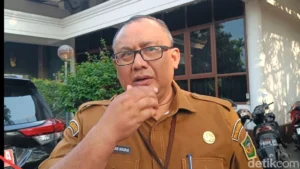
Rusmani Budiharjo, the Head of the Pekalongan City Agency for Personnel and Human Resources Development (BKPSDM), shed light on the driver’s defense during the preliminary administrative hearing. According to Budiharjo, the civil servant cited extreme morning rush hour congestion as the primary motivation for his risky maneuver. The driver claimed that the lane behind him was completely blocked with stalled commuter vehicles, creating immense pressure to move forward despite the obvious presence of ongoing construction activity.
"Today, we have conducted a thorough examination of the case. The individual in question has openly admitted to the act and has formally expressed his remorse and apologies," stated Rusmani Budiharjo during an official telephonic briefing with reporters. Addressing the driver’s defense regarding the congested roadway, Budiharjo acknowledged the chaotic nature of morning peak hours in the district but firmly rejected the justification. "At that time, it was indeed peak morning activity hours, and the area was extremely congested with traffic backed up behind him—or so is the information provided, though I do not know the exact micro-conditions. He felt pressured to cross that specific section. However, regardless of the circumstances, we view this action as fundamentally flawed and inappropriate, which is why the individual is required to issue a formal apology."
Financial Losses and Project Delays
The physical intrusion of a heavy passenger vehicle onto a delicate construction site resulted in immediate, measurable damage to public assets. Cacap Suherman, the 35-year-old operational project manager overseeing the roadway rehabilitation initiative, detailed the extensive nature of the destruction caused by the unauthorized vehicle crossing.
According to Suherman, the vehicular tracks carved deep grooves into the freshly laid Lean Concrete, disrupting the flat, level surface required for the successful application of the subsequent structural layers. The affected zone required immediate, labor-intensive remediation work to restore the structural baseline of the roadway before the overarching construction schedule could resume.
"When calculated thoroughly, the total material and labor losses incurred as a direct result of this incident amount to approximately Rp 25 million," Suherman explained during an interview. He further elaborated on the technical specifications of the damaged section, noting that the volume of concrete utilized specifically for the compromised foundational layer ranged between 18 and 20 cubic meters.
The unexpected disruption forced project contractors to divert resources, manpower, and additional construction materials to scrape away, re-level, and reinforce the damaged segments. Because the incident occurred before the planned secondary pouring phase, construction crews had to execute emergency patching operations to ensure the underlying stability of the road was not permanently compromised by the deep tire ruts left behind by the car. This unexpected setback not only inflated project expenditures but also threatened to push back municipal timelines for reopening the vital transportation link to daily public use.
Imminent Disciplinary Measures and Legal Frameworks
The administrative repercussions for the Pekalongan civil servant are currently being deliberated by specialized internal disciplinary teams within the local government structure. The BKPSDM is systematically reviewing the full scope of the infraction to establish a proportionate and legally sound punitive response that reflects the severity of the misconduct.
Rusmani Budiharjo emphasized that the agency is collaborating closely with internal disciplinary enforcement committees to evaluate the exact parameters of the punishment. "We are still studying the case alongside the disciplinary enforcement team. We are carefully formulating what constitutes an appropriate disciplinary sanction for the individual involved," Budiharjo remarked.
The legal foundation governing the conduct of Indonesian civil servants is robustly structured to prevent actions that bring disrepute to public institutions. Government regulations clearly outline that state employees are held to a higher standard of behavioral accountability, both in their professional capacities and during personal engagements within the public sphere.
In the case of Pekalongan City civil servants, behavioral expectations are codified under specific regional and national legislative frameworks. Budiharjo explicitly referenced Regional Regulation (Peraturan Wali Kota or Perwal) Number 24 of 2017, which delineates the comprehensive Code of Ethics for Civil Servants. Furthermore, these local guidelines are reinforced by overarching national statutes, specifically Government Regulation (Peraturan Pemerintah or PP) Number 94 of 2021 concerning Civil Servant Discipline. These legislative instruments clearly categorize actions that damage public property, display blatant disregard for public order, or project a negative image of the civil service as violations subject to formal administrative penalties, ranging from written reprimands and demotions to temporary suspensions or dishonorable discharge depending on the severity of the established precedent.
Broader Implications for Public Trust and Civic Leadership
The viral incident has catalyzed a broader regional dialogue regarding the responsibilities of public officials as visible representatives of government authority. In contemporary Indonesian society, the widespread adoption of social media has transformed everyday public spaces into transparent environments where the actions of government employees are constantly scrutinized by citizen journalists and digital observers.
Experts in public administration note that civil servants occupy a unique social contract wherein their adherence to the law must be exemplary, particularly in situations requiring patience, community cooperation, and respect for public infrastructure. Road construction projects, while frequently causing temporary inconveniences such as traffic congestion and delayed commutes, are essential public investments designed to improve long-term regional connectivity and safety. When a public servant chooses to bypass infrastructure safeguards for personal convenience, it undermines public trust in the institutions meant to serve and protect community interests.
Furthermore, the financial impact—calculated at Rp 25 million in public project damages—adds an economic dimension to the infraction. In an era where municipal budgets are carefully allocated to maximize public welfare and infrastructure modernization, unnecessary expenditures driven by individual negligence or impatience place an avoidable burden on regional financial resources.
As the disciplinary process moves toward its final conclusion, municipal leadership in Pekalongan has reiterated its commitment to transparency and accountability. By openly acknowledging the wrongdoing, pursuing formal disciplinary pathways, and cooperating with project contractors to address the infrastructural damage, local authorities aim to demonstrate that no government employee is exempt from established legal and ethical boundaries.
The case ultimately stands as a cautionary tale for public officials across the nation, illustrating that the privileges of civil service carry an inseparable obligation to respect community rules, protect public investments, and maintain exemplary standards of personal conduct in every facet of public life.