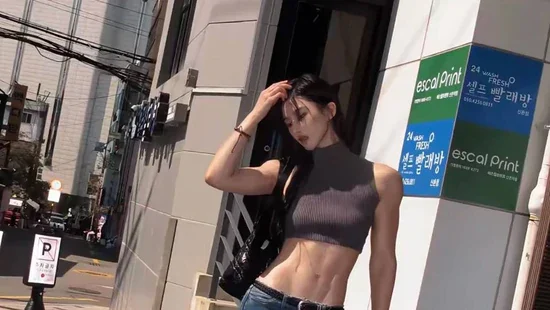
The intersection of fashion, fitness, and viral social media culture manifested vividly on the bustling sidewalks of South Korea, where a candid photograph of a foreign woman swiftly transcended regional platforms to become a global talking point. Captured unawares by a passerby, the individual in question—later identified as Zi Lang, a prominent and athletically built fashion model from the People’s Republic of China—prompted widespread fascination due to her striking physical conditioning. Featuring sharply defined abdominal muscles, commonly referred to as "abs," and powerfully sculpted arms that contrast sharply with traditional models of delicate femininity, Zi Lang’s appearance in South Korea initiated a broader, transnational conversation regarding the ongoing evolution of global aesthetic norms, physical fitness cultures, and the redefining of beauty in East Asia.
The incident underscores the profound influence of candid street photography in the modern digital ecosystem, where algorithmic amplification can transform a fleeting public moment into an international news event. As discussions surrounding physical empowerment and non-traditional body types continue to gain traction across international media landscapes, the viral phenomenon surrounding Zi Lang offers a timely lens through which to examine shifting cultural perceptions of health, strength, and identity in the contemporary fashion industry.
Main Facts and Chronological Overview of the Viral Sensation
The sequence of events leading to international viral prominence began on a routine afternoon in an undisclosed metropolitan district in South Korea. According to visual documentation uploaded initially to regional networks and subsequently cross-posted to global platforms, Zi Lang was navigating a busy urban thoroughfare when her distinct physical presentation caught the attention of local pedestrians.
Unlike the prevailing street style typically associated with high-fashion districts in Seoul—which often emphasizes oversized silhouettes, minimalist tailoring, or conventional feminine aesthetics—Zi Lang opted for an ensemble engineered to highlight her rigorous physical training. She wore a tailored combination featuring a fitted crop top paired with low-rise trousers, an aesthetic choice that unapologetically showcased her deeply etched abdominal musculature and exceptionally low body fat percentage.
Chronologically, the progression of the event unfolded through several distinct phases:
- The Initial Encounter: Pedestrians on a South Korean street observed Zi Lang’s physical stature, noting her commanding posture, tall frame, and intensely toned arms and core. Several individuals approached her in real-time to request photographs, captivated by her physical presence.
- Digital Capture and Upload: A candid photograph, alongside short-form video clips capturing the impromptu interactions, was uploaded to Weibo, China’s premier microblogging and social media platform.
- Algorithmic Acceleration: Within hours, the content crossed regional boundaries, disseminated across international digital forums, and began trending across multiple social media channels, garnering millions of impressions and widespread commentary.
- Identification of the Subject: Online sleuths and fashion industry insiders quickly identified the subject as Zi Lang, a professional model known within domestic markets for her athletic editorial work and commitment to rigorous physical conditioning.
Background Context: The Evolution of Chinese and South Korean Modeling Standards
To fully comprehend the magnitude of the public reaction to Zi Lang’s appearance, it is necessary to examine the historical and contemporary beauty standards prevalent in both China and South Korea. For decades, the dominant commercial and editorial paradigms in East Asia favored slenderness, delicate facial structures, and minimal muscle definition. In China, the historical concept of the "aesthetically fragile" woman often dictated commercial success in the entertainment and modeling sectors, where ultra-slim figures and porcelain skin were paramount. Similarly, South Korea’s hyper-competitive beauty and entertainment industries have historically prioritized slender physiques, v-line jawlines, and a slender, non-muscular build.
However, the past decade has witnessed a steady, profound paradigm shift. The proliferation of fitness culture, the rise of gym-going demographics among urban youth, and the global dissemination of wellness content via social media have begun to dismantle monolithic aesthetic expectations. Women across urban centers in China and South Korea are increasingly investing in strength training, functional fitness, and athletic pursuits.
Within this evolving ecosystem, Zi Lang represents a vanguard of models who bridge high fashion with elite athletic conditioning. Her physical presentation—characterized by broad shoulders, a tightly corseted waist, visible abdominal definition, and powerful limbs—challenges the historical boundaries of the fashion industry. By embodying the "handsome girl" (shuai ge) persona, a term increasingly used in Chinese pop culture to describe women who exude assertive charisma, strength, and non-conformist confidence, Zi Lang aligns with a growing appetite for representations of female empowerment that reject passive conventionality.
Supporting Data and Physiological Analysis of Athletic Modeling
The physical presentation that propelled Zi Lang into viral prominence is not merely a stylistic choice; it is the result of disciplined, long-term athletic conditioning that requires precise physiological management. Sports science and fitness analytics offer clear insights into the dedication required to maintain a physique characterized by prominent abdominal definition and a low body fat percentage alongside linear muscle hypertrophy.
According to data compiled from global health and fitness observatories, maintaining visible "abs"—specifically rectus abdominis hypertrophy combined with a low subcutaneous fat layer—requires women to sustain a body fat percentage typically ranging between 14% and 20%, depending on genetic predispositions. Achieving this while retaining upper-body and core muscularity demands a rigorous regimen that integrates:
- Resistance Hypertrophy Training: Targeted lifting protocols designed to stimulate muscle fiber growth in the shoulders, arms, back, and core.
- Macronutrient Precision: Controlled caloric intake with high protein availability to support muscle recovery while preventing unwanted adipose tissue accumulation.
- Cardiovascular Conditioning: Strategic aerobic and high-intensity interval training (HIIT) to optimize metabolic rate and maintain exceptional cardiovascular health.
Industry observers note that while such physiques are common among professional athletes, bodybuilders, and fitness competitors, they remain relatively rare within the traditional commercial modeling sector, where editorial standards have historically favored lean, non-muscular frames. Zi Lang’s ability to successfully navigate both the high-fashion editorial space and elite fitness parameters illustrates a lucrative and expanding niche within the modern modeling industry.
Industry and Public Reactions
The public reception to Zi Lang’s street sighting in South Korea was overwhelmingly positive, though it also reignited broader debates concerning body image and health. Across digital platforms, commentators lauded her for defying regional aesthetic homogenization.
Fashion critics and cultural analysts pointed out that Zi Lang’s ability to turn an ordinary street walk into a viral sensation points to a deep public hunger for authenticity and physical vitality. Rather than projecting an image of effortless, genetic thinness, Zi Lang’s physique communicates agency, labor, and intentional self-care.
Comments across digital forums highlighted several key themes:
- Inspiration for Female Fitness: Numerous social media users expressed admiration for her dedication, noting that her visibility encourages women to pursue strength training and functional health over mere weight loss.
- Deconstruction of Gendered Stereotypes: The "handsome girl" aesthetic embodied by Zi Lang challenges rigid binary expectations of physical presentation, demonstrating that strength and high fashion are mutually compatible.
- Cross-Cultural Appreciation: The fact that a Chinese model captured the imagination of pedestrians and netizens in South Korea underscores the shared cultural currents moving across East Asia, where youth demographics increasingly value cosmopolitanism, wellness, and physical autonomy.
Broader Impact and Socioeconomic Implications
The viral dissemination of Zi Lang’s candid photographs carries significant implications for the commercial modeling and lifestyle sectors. As brands increasingly pivot toward authenticity and values-driven marketing, physical representations that promote health, strength, and resilience command higher consumer engagement.
- Shift in Brand Partnerships: Major athletic, wellness, and luxury fashion houses are increasingly casting models who possess distinct athletic credentials. The market value of models who can authentically represent active lifestyles has risen commensurately with the global fitness boom.
- Redefining Editorial Boundaries: Traditional agencies are slowly expanding their portfolios to include diverse body types, moving away from uniform slenderness toward physiques that reflect active, health-conscious living standards.
- Psychological and Sociological Shifts: The normalization of muscular, athletic female bodies in mainstream media contributes to more inclusive societal perceptions of health, dismantling outdated stigmas that equated female muscle mass with a loss of femininity.
Ultimately, the viral moment on the streets of South Korea serves as a microcosm of larger cultural transformations. Through her commitment to physical excellence and her unapologetic public presentation, Zi Lang has transcended the traditional boundaries of regional fashion to become an emblem of modern, empowered identity in the twenty-first century.
Related posts: