Mastering Indonesian Taxation: Smart Class Announces Intensive Brevet AB Certification and Professional Development Program

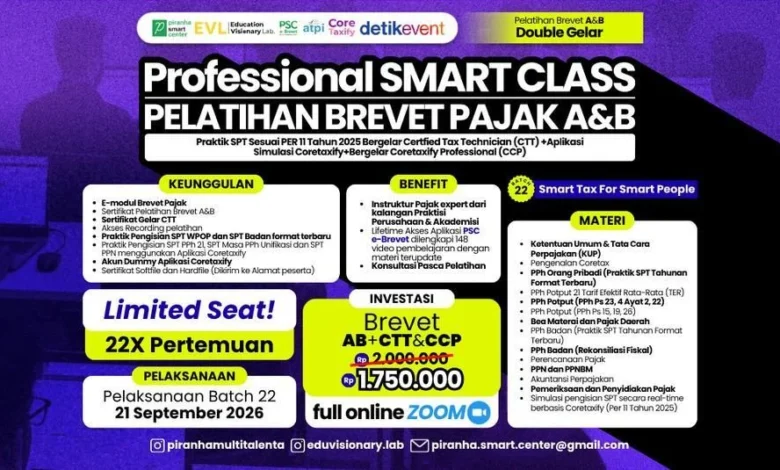
The landscape of Indonesian taxation is undergoing a significant digital and regulatory transformation, creating an urgent demand for accounting professionals, financial officers, and business owners to upgrade their technical competencies. To address the gap between academic knowledge and field requirements, the Smart Class initiative has officially launched its 22nd batch of the Brevet Pajak AB training, integrated with CTT (Certified Tax Technician) and CCP (Certified Compliance Professional) certifications. Unlike conventional short-term workshops that focus primarily on terminology, this comprehensive program is designed to provide hands-on experience, bridging the gap between theoretical tax law and real-world fiscal reporting.
The Evolution of Tax Literacy in Indonesia
Tax compliance in Indonesia has evolved rapidly with the implementation of the Coretax Administration System and the broader digitalization of the Directorate General of Taxes (DGT). Recent data from the Ministry of Finance indicates that the complexity of tax regulations—ranging from the Harmonization of Tax Regulations (HPP) Law to updated VAT and Income Tax (PPh) treatments—has made it increasingly difficult for self-taught practitioners to maintain full compliance.
Industry analysts observe that basic tax seminars often fail to provide the depth required for professional-level execution. Many participants find that after a two-day seminar, they lack the confidence to manage complex tax audits or navigate the nuances of corporate tax planning. The Smart Class program aims to rectify this by offering an extended curriculum that spans over two months, ensuring that learners move beyond superficial understanding to achieve operational proficiency.
Program Structure and Chronology
The 22nd Batch of the Smart Class Brevet Pajak AB is scheduled to run from September 21, 2026, through December 1, 2026. The structured timeline is designed to accommodate working professionals, with sessions held every Monday and Tuesday from 18:30 to 20:30 WIB. The training will be conducted entirely via Zoom, allowing for nationwide accessibility.
The program is broken down into a rigorous schedule:
- Total Sessions: 22 sessions of in-depth theoretical and technical instruction.
- Assessment Phase: The program concludes with 4 distinct practical examinations and 1 comprehensive theory examination to ensure the competency of the graduates.
- Certification: Successful candidates will receive the CTT and CCP certifications, which serve as industry-recognized credentials for those looking to advance their careers in tax consultancy or internal corporate finance.
Curriculum Scope: From Theory to Digital Compliance
The curriculum is meticulously crafted to cover the entire spectrum of Indonesian taxation. By focusing on both local and national tax requirements, the program prepares participants for the realities of the current fiscal environment.
Key modules include:
- Fundamental Tax Law: Ketentuan Umum dan Tata Cara Perpajakan (KUP), which serves as the backbone of all tax administration.
- Income Tax Architecture: Detailed exploration of PPh (Income Tax) regarding withholding and collection (Potongan dan Pemungutan), as well as specific treatments for individuals and corporate entities.
- Consumption Taxes: In-depth coverage of Value Added Tax (VAT/PPN) and the Sales Tax on Luxury Goods (PPnBM).
- Peripheral Taxes: Bea Meterai (Stamp Duty) and various regional tax structures (Pajak Daerah).
- Strategic Finance: Modules on tax accounting, advanced tax planning, and the legal framework surrounding tax audits and investigations.
A standout feature of this batch is the integration of the Coretaxify application. Participants will not merely read about tax reporting; they will engage in direct simulations of SPT (Annual Tax Return) filings for both individuals and companies. This hands-on experience is critical, as it mimics the actual digital interfaces used by the DGT, reducing the learning curve for participants when they return to their professional roles.
Target Demographics and Industry Impact
The program is specifically tailored for those whose roles necessitate a high degree of fiscal accuracy. Primary target groups include:
- Accounting and Finance Officers: Professionals responsible for the monthly and annual reporting of corporate entities.
- Tax Staff: Individuals tasked with managing day-to-day tax compliance and ensuring the company remains within the bounds of the law.
- SME Owners and Business Administrators: Entrepreneurs who need to understand the tax implications of their business growth to avoid administrative penalties.
- Administrative Personnel: Support staff who manage the essential documentation required for audit-ready bookkeeping.
The implications of such intensive training are significant. In an environment where the government is aggressively pursuing tax ratio targets, the cost of non-compliance has never been higher. By equipping human resources with the necessary skills to handle tax planning and reporting accurately, firms can mitigate the risks of administrative sanctions, interest penalties, and the reputational damage associated with tax investigations.
Economic Context and Regulatory Shifts
The Indonesian government’s focus on the "Coretax" system represents a shift toward more transparent and automated tax collection. As the system becomes more sophisticated, the margin for human error in tax reporting is narrowing. Experts note that companies relying on manual processes or outdated tax knowledge are increasingly susceptible to automated discrepancies flagged by the tax authorities’ systems.
"The necessity for professional certification like CTT and CCP is growing," suggests an industry representative familiar with the training market. "The market no longer values certificates of attendance alone; employers are seeking verified competencies in tax software, planning, and audit response. The 22nd Batch of Smart Class addresses this by ensuring that the theory taught is immediately applicable through the Coretaxify platform."
Broader Implications for the Professional Sector
For the individual participant, obtaining certification from a comprehensive program like this can serve as a catalyst for salary increments and career mobility. In the accounting sector, professionals with verified Brevet AB credentials are often positioned for senior roles, as they are capable of navigating the complex regulatory landscape that dictates a company’s financial health.
Moreover, for Small and Medium Enterprises (SMEs), the ability to handle their own tax planning effectively is a competitive advantage. Proper tax planning can legally optimize cash flow, allowing business owners to reinvest in their operations rather than losing capital to avoidable tax inefficiencies. The Smart Class program provides the tools for these owners to become self-reliant, reducing their dependency on expensive external consultants for routine tasks.
Registration and Participation Details
Prospective students and professionals interested in enrolling for the upcoming September intake are encouraged to review the full curriculum details available via the official event portal. Given the intensive nature of the program and the limited capacity required to maintain the quality of the interactive sessions, early registration is recommended.
The registration process is managed through the dedicated detikevent platform, where applicants can find detailed information on the enrollment criteria, fee structures, and the schedule of the upcoming information sessions.
As the Indonesian economic climate continues to mature, the demand for high-caliber tax practitioners will only intensify. Programs like the Smart Class Brevet Pajak AB offer a viable path for individuals to gain the technical rigor required to excel in this specialized field. By prioritizing practical application alongside theoretical mastery, this program positions its participants to contribute effectively to the integrity and efficiency of Indonesia’s tax ecosystem.
Related posts: