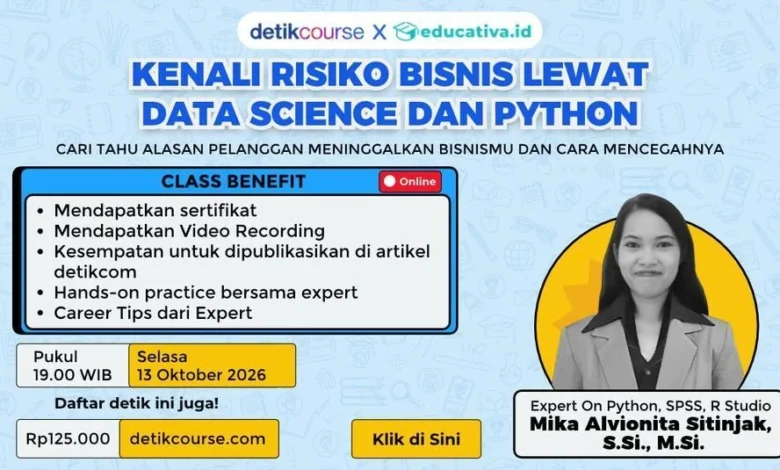
In an era defined by the rapid digitalization of commerce, data has emerged as the most valuable asset for any enterprise. However, the sheer volume of information collected daily—ranging from consumer purchase patterns to interaction logs—often remains underutilized. To bridge the gap between raw data collection and actionable business intelligence, detikcourse has announced an upcoming specialized workshop titled "Kenali Risiko Bisnis Lewat Data Science dan Python." This program is designed to empower professionals with the tools to implement Predictive Analytics, a methodology that leverages historical data to forecast future outcomes, specifically focusing on the critical challenge of customer churn.
The Growing Necessity of Predictive Analytics
The business landscape in Indonesia and globally is undergoing a seismic shift. According to recent industry reports, organizations that utilize predictive analytics are 2.5 times more likely to experience higher growth than their counterparts who rely solely on reactive decision-making. Customer churn—the rate at which customers stop doing business with an entity—remains one of the most significant threats to profitability. The cost of acquiring a new customer is widely estimated to be five to seven times higher than the cost of retaining an existing one.
By applying predictive modeling, businesses can identify "at-risk" customers before they churn, allowing for proactive intervention strategies. The detikcourse workshop focuses on this exact application, providing a hands-on environment where participants transition from theoretical understanding to the practical application of Python-based machine learning models.
Workshop Curriculum and Technical Framework
Scheduled for Tuesday, October 13, 2026, from 19:00 to 21:00 WIB via Zoom Meeting, the session is structured to provide a comprehensive workflow for data scientists and analysts. The curriculum is meticulously designed to cover the entire data science pipeline, ensuring that participants understand not just the "how" but the "why" behind every step.
The workshop begins with the foundational stage of data comprehension. Participants will learn how to clean and prepare data, a phase often cited by industry experts as consuming nearly 80% of a data scientist’s time. This includes identifying target variables—such as whether a customer will churn—and selecting the appropriate features that influence these outcomes. Following this, the session delves into Exploratory Data Analysis (EDA), which allows analysts to visualize trends and identify anomalies within datasets.
The technical core of the program involves the use of Python and Google Colab, a cloud-based environment that facilitates collaborative coding without the need for complex local software installations. Participants will construct two primary classification models: Decision Trees and Random Forest. These models are industry standards for predictive tasks due to their transparency and effectiveness in handling complex, non-linear relationships within datasets.
Evaluating Performance: Beyond the Algorithm
One of the most critical aspects of the workshop is the evaluation of model performance. A model is only as good as its predictive accuracy, and participants will learn to utilize sophisticated metrics to validate their work. The curriculum covers the use of the Confusion Matrix—a fundamental tool for understanding the types of errors a model makes—alongside precision, recall, and the F1-Score.
By mastering these metrics, participants learn to translate mathematical output into business logic. For instance, a model with high recall but low precision might flag many customers as potential churners, leading to excessive marketing spend on retention efforts. Conversely, high precision but low recall might miss significant segments of at-risk customers. The workshop teaches how to balance these tradeoffs, ensuring that business leaders can make informed decisions based on the data’s reliability.
Bridging the Skill Gap in the Digital Workforce
Despite the high demand for data-driven expertise, there remains a significant "digital literacy gap" in the professional market. Many business analysts and entrepreneurs feel intimidated by the prospect of coding, assuming that data science is exclusively the domain of software engineers. The detikcourse initiative explicitly rejects this notion. By removing the barrier to entry, the workshop welcomes a diverse group of participants: data analysts, business analysts, marketers, entrepreneurs, and fresh graduates.
"The goal is to democratize data science skills," notes a spokesperson for the event. "You do not need a background in IT or extensive programming experience to start leveraging data. Our approach focuses on the logic of the workflow, making the Python syntax a tool rather than a hurdle."
Chronology and Event Structure
The session is structured as a high-impact, two-hour intensive module. The timeline is as follows:
- 19:00 – 19:30: Foundational Data Science workflow, data preparation, and feature engineering.
- 19:30 – 20:15: Hands-on technical session using Python and Google Colab to build Decision Tree and Random Forest models.
- 20:15 – 20:45: Model evaluation techniques, interpreting the Confusion Matrix, and translating findings into business strategy.
- 20:45 – 21:00: Career tips, Q&A session, and an introduction to the professional benefits of the program, including e-certification.
Broader Impact and Industry Implications
The implications of this workshop extend far beyond the two-hour Zoom session. In the current economic climate, the ability to predict market shifts is a competitive advantage that can determine a company’s longevity. As businesses across sectors—from banking and telecommunications to e-commerce and retail—increase their investment in data infrastructure, the workforce must adapt accordingly.
By participating in this workshop, individuals are not merely learning to code; they are learning to think critically about business risks. This skill set is increasingly becoming a prerequisite for leadership roles. The integration of data science into marketing and sales departments is no longer a luxury but a strategic necessity. Companies that empower their employees to interpret predictive models are better equipped to navigate market volatility, optimize resource allocation, and improve overall customer experience.
Benefits for Participants
In addition to the technical curriculum, attendees are provided with a robust support ecosystem. This includes:
- Practical Experience: Hands-on training with experts who have real-world experience in deploying models.
- Career Advancement: Access to career tips that bridge the gap between technical proficiency and professional branding.
- Visibility: A unique opportunity to be featured in articles on detikcom, providing participants with professional exposure.
- Continuous Learning: Post-workshop access to video recordings, allowing participants to revisit complex technical concepts as they build their own projects.
Registration and Participation
For those interested in navigating the complexities of data to drive business success, registration is currently open via the official detikevent portal.
As data continues to grow in volume and complexity, the ability to distinguish "noise" from "signal" will define the next generation of business leaders. The "Kenali Risiko Bisnis Lewat Data Science dan Python" workshop serves as a critical entry point for those looking to formalize their data skills and contribute to the data-centric transformation of their respective organizations. Whether one is an entrepreneur seeking to reduce customer churn or an analyst looking to climb the corporate ladder, the insights gained from this session will prove invaluable in an increasingly data-driven economy.
Related posts: