KEI Learning Launches Comprehensive Data Analytics Toolkit Program to Bridge the Growing Digital Skills Gap in Indonesia’s Corporate Sector

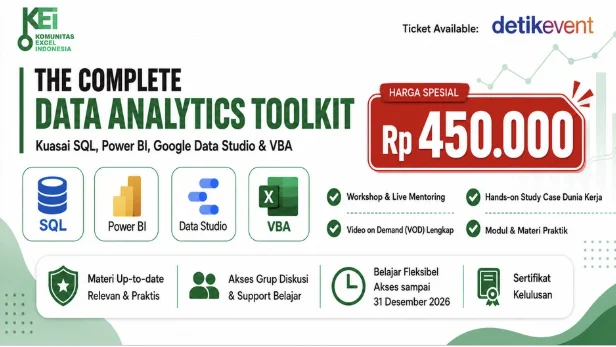
In an era where data has become the primary currency of global business, the ability to transform raw information into actionable insights is no longer a luxury but a necessity for modern professionals. KEI Learning has officially announced the launch of "The Complete Data Analytics Toolkit," a rigorous training program designed to equip the Indonesian workforce with the essential technical skills required to navigate the complexities of modern data environments. Moving beyond basic spreadsheet management, the program offers a holistic curriculum that integrates Structured Query Language (SQL), Microsoft Power BI, Google Data Studio (now known as Looker Studio), and Microsoft Excel Macro VBA, providing a comprehensive solution for professionals who seek to transition from manual data entry to sophisticated automated analytics.
The program arrives at a critical juncture for the Indonesian labor market, where the demand for data-literate professionals continues to outpace the available supply. As companies across the archipelago—from burgeoning startups in Jakarta to established conglomerates—accelerate their digital transformation initiatives, the "The Complete Data Analytics Toolkit" aims to serve as a bridge between theoretical knowledge and practical application. By focusing on real-world case studies rather than abstract concepts, KEI Learning ensures that participants can immediately implement their new skills to improve organizational decision-making and operational efficiency.
Strategic Program Schedule and Delivery Format
The upcoming intensive sessions are scheduled to take place on Tuesday, July 28, 2026, and Thursday, July 30, 2026. Each session will run from 19:00 to 21:00 WIB (Western Indonesia Time), utilizing the Zoom video conferencing platform to ensure accessibility for participants across different geographical regions. This evening schedule is strategically designed to accommodate working professionals, allowing them to upskill without disrupting their daily corporate responsibilities.
In addition to the live interactive sessions, the program offers an extended learning ecosystem. Participants will receive access to more than ten instructional videos, comprehensive e-books, and a structured assessment framework consisting of pre-tests and post-tests. Recognizing that mastery of complex tools like SQL and Power BI requires time and repetition, KEI Learning has extended the learning access period until December 31, 2026. This long-term access allows students to revisit the material, refine their techniques, and stay updated as software versions evolve over the coming months.
A Multi-Layered Curriculum: From Extraction to Automation
The core of "The Complete Data Analytics Toolkit" lies in its multi-tooled approach, which reflects the actual workflow of a professional data analyst. While many introductory courses focus on a single software, this program recognizes that the modern data pipeline often requires the use of multiple platforms in tandem.
The Foundation: SQL for Data Extraction
The curriculum begins with SQL, the standard language for interacting with relational databases. In many corporate settings, data is stored in massive servers that Excel cannot handle directly. By mastering SQL, participants learn how to query, filter, and extract specific datasets directly from the source. This eliminates the dependency on IT departments for data requests, significantly reducing the "time-to-insight" for business units.
Internal Business Intelligence: Power BI and AI Integration
Once data is extracted, the program shifts focus to Microsoft Power BI. As one of the leading Business Intelligence (BI) platforms globally, Power BI allows users to create interactive, real-time dashboards. A unique highlight of the KEI Learning program is the inclusion of a "FREE Workshop Online Power BI With AI." This segment explores how artificial intelligence can be leveraged within Power BI to perform predictive analytics and automated pattern recognition, allowing users to move from descriptive analytics (what happened) to prescriptive analytics (what should we do).
External Reporting: Google Data Studio
For professionals who need to share insights with external stakeholders or clients, the program covers Google Data Studio. Known for its seamless integration with the Google Marketing Platform and its collaborative features, Data Studio is presented as the ideal tool for creating reports that are easy to share and interpret without requiring the recipient to have specialized software licenses.
Efficiency and Customization: Macro VBA
Finally, the toolkit addresses the reality that Microsoft Excel remains a staple in the corporate world. To maximize efficiency within this environment, the program teaches Macro VBA (Visual Basic for Applications). This allows participants to automate repetitive tasks, such as formatting weekly reports or cleaning data, thereby freeing up time for higher-level strategic analysis.
Contextualizing the Need: The Indonesian Digital Talent Gap
The launch of this program is supported by broader economic trends within the Southeast Asian region. According to reports from the World Economic Forum and McKinsey & Company, the "Future of Jobs" will be defined by analytical thinking and technological literacy. In Indonesia, the government has frequently highlighted the need for approximately nine million digital talents by 2030 to support the country’s growing digital economy, which is projected to be the largest in the region.
However, a significant "skills mismatch" remains. Many graduates and mid-career professionals possess basic computer skills but lack the ability to handle large-scale data architecture or advanced visualization. KEI Learning’s initiative addresses this specific gap by moving beyond the "what" of data and focusing on the "how" of data architecture and storytelling.
Industry observers note that the combination of SQL and BI tools is particularly valuable. While SQL is the "engine" that powers the data, Power BI and Google Data Studio are the "steering wheel" and "dashboard" that allow management to navigate the business. By teaching these together, the program mirrors the high-level requirements of roles such as Data Analysts, Business Intelligence Developers, and Data-Driven Marketing Managers.
Participant Benefits and Certification
Beyond technical instruction, KEI Learning emphasizes the importance of professional recognition and community. Upon successful completion of the program and its associated assessments, participants will be awarded two types of certificates: a Certificate of Completion and a Certificate of Excellence for those who demonstrate high proficiency in the post-test evaluations. These credentials serve as verifiable proof of skill for current and future employers.
Furthermore, the program includes access to an "Exclusive Learning Community." This forum serves as a networking hub where participants can discuss challenges, share best practices, and connect with peers across various industries. In the field of data analytics, where problem-solving often involves creative troubleshooting, having access to a community of practitioners is considered a significant asset.
Analytical Perspective: The Impact on Corporate Decision-Making
From a management perspective, the implementation of these tools can lead to a fundamental shift in how Indonesian companies operate. Traditionally, many local firms have relied on "gut feeling" or delayed monthly reports to make strategic decisions. By empowering staff with the Complete Data Analytics Toolkit, organizations can transition toward a "Data-Driven Culture."
The implications are twofold. First, there is an increase in operational transparency. When dashboards are interactive and linked to live data sources via SQL, there is no place for "hidden" errors or outdated information. Second, there is a marked improvement in agility. In a volatile market, the ability to see a sales dip or a supply chain bottleneck in real-time—and to automate the response via VBA—can be the difference between profit and loss.
Registration and Future Outlook
As the July 2026 start date approaches, interest from the corporate sector is expected to be high. Registration is currently being facilitated through the detikevent platform, providing a streamlined process for individuals and corporate HR departments to secure spots.
The long-term outlook for such programs remains positive. As Indonesia continues to integrate with the global digital economy, the standard for "basic office skills" is being redefined. Proficiency in Excel is no longer the ceiling; it is the floor. Programs like "The Complete Data Analytics Toolkit" are setting a new benchmark for what it means to be a competent professional in the 21st century.
By providing a structured path from the fundamentals of database querying to the heights of AI-driven visualization, KEI Learning is not just teaching software; it is fostering a new generation of analytical thinkers who will likely lead Indonesia’s corporate sectors into a more efficient, data-informed future. For those looking to remain competitive in an increasingly automated job market, the acquisition of this toolkit represents a strategic investment in their long-term career trajectory.