History of Las Malvinas and the Argentina-England Sovereignty Dispute Rekindled at the 2026 FIFA World Cup

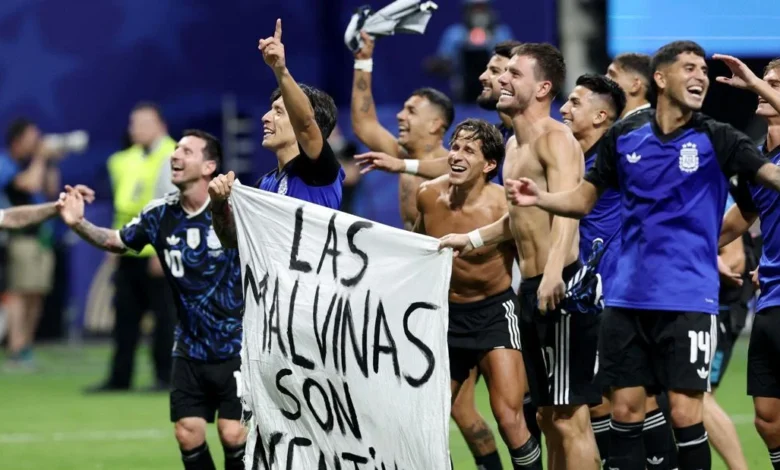
The semi-final clash between Argentina and England at the 2026 FIFA World Cup in Atlanta, Georgia, was anticipated to be a masterclass in modern football, yet the narrative quickly shifted from tactical prowess to deep-seated geopolitical tension. Following a narrow 2-1 victory for the Albiceleste, the celebratory atmosphere took a controversial turn when several Argentine players unfurled a banner that read "Las Malvinas Son Argentinas" (The Malvinas are Argentine). This act, performed on one of the world’s most significant sporting stages, has reignited a century-old sovereignty dispute over the South Atlantic archipelago known to the British as the Falkland Islands and to Argentines as the Islas Malvinas.
The incident has triggered a diplomatic firestorm, highlighting how the ghosts of the 1982 conflict continue to haunt the relationship between the two nations. For Argentina, the claim to the islands is a matter of national identity and constitutional mandate, while for the United Kingdom, the islands represent a territory whose inhabitants have overwhelmingly chosen to remain British. As the football world looks toward the final, the international community is once again forced to reckon with a dispute that remains as volatile today as it was four decades ago.
Diplomatic Fallout and Official Reactions
The response from London was swift and stern. Peter Kyle, the British Secretary of State for Business and Trade, condemned the display, characterizing it as a blatant violation of FIFA’s regulations regarding political messaging during matches. The UK government has formally urged FIFA to launch an investigation into the Argentine Football Association (AFA), arguing that the football pitch should remain a neutral ground free from territorial propaganda. Under FIFA’s Disciplinary Code, players and associations are prohibited from using "political, religious, or personal slogans, statements, or images."
In a surprising turn of events, the United States, acting as the host nation, offered a defense of the Argentine players’ actions. Andrew Giuliani, the White House-appointed head of the FIFA World Cup 2026 Task Force, addressed the media on Friday, July 17, 2026. Giuliani stated that within the borders of the United States, individuals and visiting teams possess the "opportunity and ability" to express their views, citing the protections of the First Amendment of the U.S. Constitution. While this stance does not necessarily reflect a shift in U.S. foreign policy regarding the islands—which has traditionally been one of neutral recognition of the de facto British administration—it highlights a potential friction point between the host nation’s legal culture and FIFA’s strict neutrality mandates.
A Century of Contested Sovereignty
The roots of the Malvinas dispute stretch back to the late 18th century, involving a complex web of claims by France, Spain, and Great Britain. The archipelago, located approximately 300 miles (480 kilometers) off the coast of Patagonia, consists of two main islands—East and West Falkland—and hundreds of smaller outcrops.
Argentina’s claim is rooted in the principle of uti possidetis juris, asserting that it inherited the islands from the Spanish Empire upon gaining independence in 1816. For a brief period in the early 19th century, Argentina (then the United Provinces of the River Plate) maintained a settlement and a penal colony on the islands. However, in January 1833, a British naval task force arrived to assert British sovereignty, expelled the Argentine officials, and established a permanent presence. From that point forward, the United Kingdom has maintained continuous administration, eventually designating the islands as a British Crown Territory (now a British Overseas Territory).
The demographic makeup of the islands is a central point of contention. The current population of approximately 3,600 people is largely of British descent. In a 2013 referendum, 99.8% of voters chose to remain a British Overseas Territory. The UK uses this result to argue for the principle of "self-determination," asserting that the islanders have the right to choose their own destiny. Argentina, conversely, argues that the population is "implanted" and that the principle of self-determination does not apply to a colonial population that replaced the original inhabitants.
The 1982 Conflict: 74 Days of War
The dispute escalated into a full-scale, undeclared war in 1982. At the time, Argentina was ruled by a military junta led by General Leopoldo Galtieri. Facing domestic unrest and economic instability, the junta sought to galvanize nationalistic fervor by "recovering" the Malvinas. On April 2, 1982, Argentine special forces landed on the islands, quickly overwhelming the small garrison of British Royal Marines.
The invasion caught the government of British Prime Minister Margaret Thatcher by surprise, but the response was decisive. Thatcher dispatched a massive naval task force, including aircraft carriers and nuclear submarines, to travel 8,000 miles to the South Atlantic. The conflict that followed was a brutal display of modern naval and aerial warfare.

Chronology of the 1982 War:
- April 2: Argentine forces invade and capture Port Stanley.
- May 2: The British submarine HMS Conqueror sinks the Argentine cruiser General Belgrano outside the total exclusion zone, resulting in the loss of 323 lives. This remains the single deadliest event of the war.
- May 4: An Argentine Exocet missile sinks the British destroyer HMS Sheffield.
- May 21: British forces land at San Carlos Water, establishing a beachhead on East Falkland.
- June 14: Following fierce battles at Goose Green and on the peaks surrounding the capital, Argentine forces surrender.
The war lasted 74 days and claimed the lives of 649 Argentine personnel, 255 British personnel, and three islanders. The defeat led to the collapse of the military junta in Buenos Aires and the restoration of democracy in Argentina, while it cemented Margaret Thatcher’s reputation as the "Iron Lady" and helped her secure a landslide re-election victory in 1983.
National Identity and the "Malvinas Question"
Despite the military defeat, Argentina has never abandoned its claim. In fact, the claim was enshrined in the Argentine Constitution during the 1994 reforms. The "Transitional Provisions" of the Constitution state that the recovery of the islands and the full exercise of sovereignty, respecting the lifestyle of the inhabitants and in accordance with international law, constitute "a permanent and unwaivable objective of the Argentine people."
In Argentina, the Malvinas are more than a territorial dispute; they are a symbol of national unity. Every June 10, the country observes the "Day of Affirmation of Argentine Rights over the Malvinas, South Georgias and South Sandwich Islands, and the Surrounding Maritime Areas." The islands are featured on currency, in school textbooks, and on road signs throughout the country. For many Argentines, the loss of the war was a tragedy caused by an illegitimate military government, but the underlying claim to the land remains just and valid.
The Ministry of Foreign Affairs in Argentina consistently lobbies the United Nations Special Committee on Decolonization (C-24), which has repeatedly called for both governments to resume negotiations to find a peaceful and definitive solution to the sovereignty dispute. However, the UK refuses to negotiate as long as the islanders wish to remain British.
Football as a Mirror of History
The rivalry between Argentina and England on the football pitch has often served as a proxy for the geopolitical tensions between the two nations. The 1986 World Cup quarter-final in Mexico is perhaps the most famous example, occurring just four years after the war. Diego Maradona’s "Hand of God" goal and his subsequent "Goal of the Century" were viewed in Argentina as a form of symbolic revenge for the losses suffered in 1982. Maradona himself later admitted that the match felt like a battle against the "invaders."
Since then, every encounter between the two teams carries an emotional weight that transcends the sport. The 1998 World Cup clash in France, featuring David Beckham’s red card, and the 2002 group stage match in South Korea and Japan, have all been framed through the lens of this historic rivalry. The 2026 incident in Atlanta is simply the latest chapter in a long-standing tradition of using the "beautiful game" to express nationalistic grievances.
Broader Implications and Analysis
The 2026 World Cup controversy poses a significant challenge for FIFA. The organization prides itself on keeping politics out of sport, yet it often finds itself entangled in complex international disputes. If FIFA chooses to sanction the Argentine players, it risks alienating a massive fan base and appearing to take a side in a sovereignty dispute. If it does nothing, it risks undermining its own rules and angering the British government and football association.
Furthermore, the involvement of U.S. officials citing the First Amendment adds a layer of legal complexity. As the World Cup becomes increasingly commercialized and globalized, the friction between local laws (such as free speech protections) and private organizational rules (such as FIFA’s neutrality) will likely become more frequent.
Economically, the dispute remains relevant due to the potential for vast oil and gas reserves in the waters surrounding the islands, as well as lucrative fishing rights. The UK’s control of these resources is a point of contention for Argentina, which views the exploitation of these assets as "illegal" under international law.
In conclusion, the banner raised in Atlanta was not merely a spontaneous act of celebration but a calculated reminder of a wound that has not healed. As long as the fundamental disagreement between "self-determination" and "territorial integrity" remains unresolved, the Malvinas/Falklands issue will continue to surface in every arena where these two nations meet—be it at the United Nations or on the grass of a football stadium. The 2026 World Cup has proven that while 44 years have passed since the guns fell silent in the South Atlantic, the battle for the Malvinas is far from over in the hearts and minds of the Argentine people.