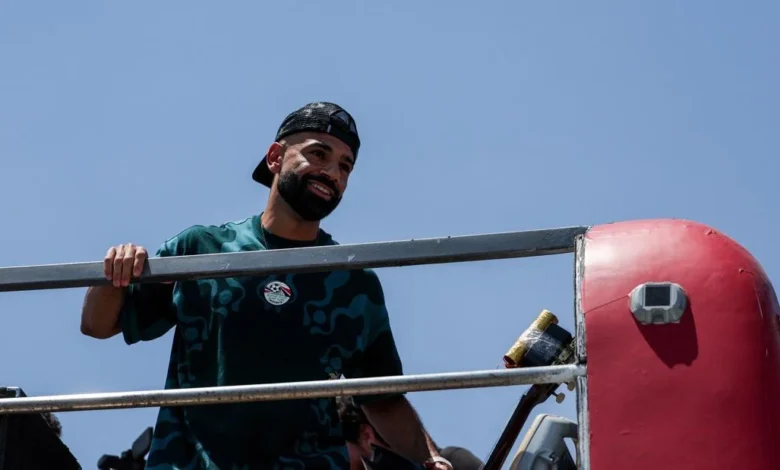
The football world remains in a state of heightened anticipation regarding the future of Egyptian superstar Mohamed Salah, who is currently a free agent following the expiration of his contract. As speculation mounts, with clubs from various leagues vying for his signature, recent reports have strongly linked the prolific forward to Turkish giants Besiktas. This development has been met with a mixture of excitement and cautious optimism, further fueled by a somewhat enigmatic statement from Salah’s long-time agent, Ramy Abbas Isa, who has yet to definitively confirm his client’s next destination. The uncertainty surrounding Salah’s future has become one of the most compelling narratives of the current transfer window, captivating fans and pundits alike.
Salah’s Free Agent Status: A Pivotal Juncture in a Storied Career
Mohamed Salah, widely regarded as one of the finest attackers of his generation, finds himself at a pivotal juncture in his illustrious career. His status as a free agent means that any club wishing to secure his services would not be required to pay a transfer fee, a significant advantage in today’s inflated market. This situation has intensified the competition for his signature, as clubs can allocate more resources towards his salary and signing bonus. For a player who has consistently delivered breathtaking performances, broken numerous scoring records, and achieved legendary status at his previous club, particularly during his tenure at Liverpool where he netted over 180 Premier League goals and secured a Champions League title and a Premier League title, the opportunity to sign him without a transfer fee is exceptionally rare and attractive.
Salah’s career trajectory has been remarkable. After making his senior debut with El Mokawloon in Egypt, he moved to Europe, first with Basel in Switzerland, where he quickly garnered attention for his pace and technical ability. Brief stints at Chelsea, Fiorentina, and Roma further honed his skills before his transformative move to Liverpool in 2017. At Anfield, he blossomed into a global icon, consistently finishing as one of the top scorers in Europe and earning numerous individual accolades, including multiple Golden Boots and the PFA Players’ Player of the Year award. His departure from a club where he reached such heights, now as a free agent, marks a significant shift, prompting widespread speculation about where he intends to continue building his legacy.
The timing of this transfer saga is also noteworthy, coming shortly after Egypt’s unexpected early exit from the Round of 16 in the 2026 FIFA World Cup qualifiers. While Salah himself had a respectable tournament performance, the national team’s overall underperformance means his focus can now entirely shift towards his club career without immediate international distractions. This heightened focus on his club future potentially accelerates his decision-making process, as he seeks a new environment to maintain his elite performance levels.
The Besiktas Proposition: A Deep Dive into Turkish Ambition
Amidst the swirling rumors, Besiktas JK has emerged as a particularly prominent and intriguing suitor for Mohamed Salah. The Istanbul-based club is one of Turkey’s traditional "Big Three," boasting a rich history, a passionate and fervent fanbase, and consistent aspirations for domestic and European success. Besiktas has won the Süper Lig multiple times and regularly participates in UEFA Champions League and Europa League competitions, reflecting their standing in European football.
For Besiktas, securing a player of Salah’s caliber would be nothing short of a monumental coup. A strategic acquisition of this magnitude would not only provide an immediate and significant boost to their on-field performance but also elevate the club’s global brand presence, attract new commercial partnerships, and significantly increase merchandise sales. The signing of a global superstar like Salah would send a powerful statement of intent, signaling Besiktas’s ambition to compete at the highest levels of European football and re-establish their dominance in the Turkish Süper Lig. His arrival could galvanize the team, inspiring existing players and potentially attracting other high-profile talents to join the club.
Reports circulating in the media suggest that Besiktas has offered Salah a lucrative contract: a one-year deal with an option to extend for a further year, commanding an annual salary of approximately €11 million. This financial package, while substantial, represents a calculated investment for Besiktas. While €11 million per season places Salah among the higher earners in European football, it is arguably less than what he might have commanded from clubs in the Saudi Pro League, for example, which have demonstrated a willingness to offer astronomical wages to attract top talent. The relatively short-term nature of the proposed contract (1+1 years) might appeal to Salah, offering flexibility as he approaches the latter stages of his prime playing years, allowing him to reassess his options in the near future. For Besiktas, it minimizes long-term financial risk while maximizing immediate impact.
The enthusiasm surrounding Salah’s potential move to Besiktas has been palpable, particularly among the club’s loyal supporters. A vivid illustration of this fervent anticipation occurred during the recent official unveiling of Leandro Trossard as Besiktas’s newest signing. As Trossard was presented to the crowd, large sections of the Besiktas faithful could be heard chanting Salah’s name, a clear and unambiguous demonstration of their desire to see the Egyptian forward don the black and white stripes. This spontaneous outpouring of support underscores the power of fan influence in modern football transfers and highlights the immense excitement that Salah’s potential arrival has generated within the Besiktas community. Such demonstrations can sometimes sway a player’s decision, creating an emotional connection even before negotiations are finalized.
Beyond Besiktas: The Broader Transfer Landscape and Salah’s European Preference
While Besiktas has emerged as a frontrunner, the initial weeks of Salah’s free agency were dominated by strong links to non-European leagues. Saudi Arabian powerhouse Al Hilal, known for its aggressive recruitment of high-profile European stars, was heavily rumored to be pursuing Salah, offering a potentially record-breaking salary package. Similarly, Major League Soccer (MLS) club Kansas City SC was also mentioned as a possible destination, signaling the growing ambition of American football to attract global icons. These links underscored the worldwide appeal of Salah and the diverse range of opportunities available to him.
However, Salah himself had previously expressed a clear preference for remaining in competitive European football. This stated desire acts as a significant filter for his potential destinations. His commitment to playing at the highest level, where the competition is fiercer and the spotlight more intense, is a testament to his ambition and his drive to maintain his elite status. Remaining in Europe would allow him to continue challenging for major continental honors, such as the Champions League, and to compete in leagues widely considered among the best in the world. This preference likely stems from a desire to preserve his legacy within the traditional footballing powerhouses and to continue testing himself against the very best players and teams. For many players of his stature, the allure of competitive integrity often outweighs purely financial incentives from less competitive leagues.
Given his profile and free agent status, it is reasonable to infer that other top European clubs, even if not publicly named, might also be monitoring Salah’s situation. Clubs in Italy, Spain, or even other English Premier League teams, particularly those looking for an experienced goal-scorer without a transfer fee, could be discreetly assessing their options. However, his significant wage demands would narrow the field to only the wealthiest or most ambitious clubs. The fact that Besiktas, a club with considerable European pedigree but perhaps not in the absolute top tier of European football’s financial elite, is reportedly offering such a substantial package, suggests a strong commitment to securing his services.
Ramy Abbas Isa’s Strategy: The Art of Agent Communication
The role of a high-profile agent like Ramy Abbas Isa in navigating such a complex and high-stakes transfer saga cannot be overstated. Agents are crucial intermediaries, responsible not only for negotiating contracts but also for managing their client’s public image, controlling the flow of information, and maximizing leverage during negotiations. Abbas, known for his close relationship with Salah and his shrewd negotiating skills, has adopted a cautious and somewhat cryptic communication strategy throughout this period of intense speculation.
His recent statements on X (formerly Twitter) have been particularly scrutinized. Abbas posted, "We haven’t known where Mohamed Salah will play next season, but we will know very soon." He then added, "It’s not our style to talk with clubs that are not a choice for Salah, just to make noise." He concluded by reiterating, "I personally don’t know where Mohamed Salah will play next season. Do you?"
These statements, while appearing to convey uncertainty, are meticulously crafted. The phrase "we haven’t known" rather than "we don’t know" subtly hints that a decision might be imminent or that negotiations are in advanced stages, but the final choice is yet to be made public. The assurance that they do not engage with clubs "just to make noise" implies that any club currently in discussions with them is a serious contender, thereby validating the legitimacy of the Besiktas rumors without explicitly confirming them. Furthermore, the playful challenge "Do you?" serves to engage the audience while maintaining a veil of secrecy, creating anticipation and controlling the narrative effectively. By stating that the announcement will come "in the next few weeks," Abbas sets a clear timeframe, managing expectations and preventing prolonged, baseless speculation. This strategic ambiguity is a classic tactic used by agents to maintain leverage with potential suitors and to build excitement around their client’s eventual decision.
A Chronology of Speculation: Tracing Salah’s Transfer Journey
The journey of Mohamed Salah’s current transfer saga can be traced through a series of key events and rumors:
- June 2024: Salah’s contract with his previous club officially expires, making him a free agent.
- Early July 2024: Egypt’s national team is eliminated from the Round of 16 in the World Cup 2026 qualifiers, allowing Salah to fully focus on his club future.
- Mid-July 2024: Initial strong rumors link Salah to lucrative moves to the Saudi Pro League, specifically Al Hilal, and MLS club Kansas City SC, highlighting the global interest in his services.
- Late July 2024: Salah publicly reaffirms his desire to continue playing in competitive European football, seemingly ruling out moves to non-European leagues for now.
- Early August 2024: Reports begin to surface linking Salah with a move to Turkish giants Besiktas, detailing a proposed 1-year contract with a 1-year extension option and an annual salary of €11 million.
- August 4, 2024: During the official unveiling of Leandro Trossard as a new Besiktas player, fans at the stadium are heard chanting Mohamed Salah’s name, demonstrating intense excitement about his potential arrival.
- August 5, 2024: Ramy Abbas Isa, Salah’s agent, posts a series of cryptic messages on X, stating that a decision will be known "very soon" and "in the next few weeks," while maintaining that he personally doesn’t yet know the final destination.
Financial and Commercial Implications of a High-Profile Free Transfer
The financial dynamics of signing a player of Mohamed Salah’s stature as a free agent are unique and profoundly impactful. Without a transfer fee, clubs can channel significant resources directly into his salary and a potential signing bonus, making a high-wage package more feasible even for clubs with more constrained transfer budgets. An €11 million annual salary, while substantial, represents an investment in a player who guarantees goals, assists, and a global marketing presence.
Beyond the immediate financial outlay, Salah’s brand value is immense. As one of the most recognizable athletes globally, particularly across the Middle East and Africa, his arrival at Besiktas would unlock unprecedented commercial opportunities. The club could anticipate a surge in shirt sales, sponsorships, and digital engagement. His presence would attract new investors and increase the club’s appeal to international brands looking to tap into his vast fanbase. For Besiktas, this isn’t just about signing a player; it’s about acquiring a global marketing asset that can significantly boost their revenue streams and expand their reach far beyond Turkey.
Furthermore, such a high-profile signing would undoubtedly elevate the overall profile of the Turkish Süper Lig. Attracting a player of Salah’s caliber would increase the league’s viewership, enhance its competitive standing, and potentially make it a more attractive destination for other international talents. This ripple effect could lead to increased investment in Turkish football as a whole, fostering greater competition and raising the overall standard of play.
Impact and Legacy: What This Move Could Mean
The eventual decision by Mohamed Salah will carry significant weight, impacting his personal legacy, the fortunes of his chosen club, and potentially broader trends in global football.
For Salah himself, a move to Besiktas or another European club would represent a new challenge and an opportunity to prove his enduring quality in a different environment. While he has achieved everything at his previous club, venturing into a new league could showcase his adaptability and extend his peak performance years. It would solidify his reputation as a player willing to embrace new challenges, rather than seeking purely financial solace in a less competitive league. This decision will define the narrative of the latter part of his career.
For Besiktas, securing Salah would be a transformative event. On the pitch, his goal-scoring prowess and creative output would immediately make them stronger contenders for the Süper Lig title and enhance their prospects in European competitions. Off the pitch, the commercial and marketing boost would be invaluable, propelling the club into a new era of global visibility and financial strength. It could serve as a catalyst for future successes, attracting other high-quality players and strengthening their squad depth.
For Turkish football, Salah’s arrival would be a tremendous boon. It would inject a new level of excitement and international attention into the Süper Lig, potentially sparking a new wave of investment and talent acquisition across the league. This could help Turkish clubs to better compete with the financial powerhouses of Western Europe and solidify the league’s position as a significant force in European football.
More broadly, Salah’s decision will contribute to the ongoing debate about the evolving landscape of player movement. His preference for European competition over potentially more lucrative offers from Saudi Arabia or MLS highlights a segment of elite players who prioritize sporting ambition and competitive integrity. This contrasts with the recent trend of numerous stars moving to non-traditional leagues for significant financial incentives, showcasing that for some, the desire to compete at the pinnacle of the sport remains paramount.
Conclusion: The Anticipation Builds
As the "next few weeks" promised by Ramy Abbas Isa draw closer, the football world holds its breath, eagerly awaiting Mohamed Salah’s definitive announcement. His future remains shrouded in tantalizing ambiguity, yet the signs point towards a decision that will undoubtedly be a defining moment in his career and a significant event for whichever club is fortunate enough to secure his services. Whether he ultimately chooses the fervent atmosphere of Istanbul with Besiktas, another European challenge, or a surprise destination, Salah’s next chapter promises to be one of the most compelling stories of the upcoming football season. The anticipation is palpable, and soon, the mystery will be unveiled.