The Faculty of Economics and Business at the University of Indonesia (FEB UI), through its student organization Kanopi, successfully conducted a comprehensive dual-program initiative in Lombok, West Nusa Tenggara, from January 12 to 13, 2026. This initiative combined the annual "Penelitian Besar" (Pensar) field research program with "Kanopi Empower," a corporate social responsibility (CSR) drive. By integrating empirical data collection with direct community action, the program sought to address the complex socioeconomic dynamics surrounding the development of the Mandalika Special Economic Zone (SEZ) while simultaneously promoting environmental conservation and local education.
Bridging the Gap: The "Between Promises and Reality" Research Framework
The centerpiece of the mission was the Penelitian Besar 2026, themed "Between Promises and Reality: Unveiling Socioeconomic Dynamics of Local Communities in the Development of the Mandalika Special Economic Zone." This research aimed to critically evaluate how the massive infrastructure and tourism investment in Mandalika has permeated the grassroots level. While the Indonesian government has positioned Mandalika as one of the "Five Super Priority Destinations" (DSP), the research team sought to uncover whether this national ambition translates into tangible improvements for the people living in its shadow.
The methodology employed a rigorous quasi-experimental design, utilizing a "treatment and control" group strategy. The researchers selected Desa Kuta as the treatment village due to its location directly within the legal boundaries of the Mandalika SEZ. Conversely, Desa Selong Belanak served as the control village; while it shares similar geographic and initial economic characteristics with Kuta, it remains outside the SEZ’s primary development zone. By comparing these two sites, the researchers aimed to isolate the specific impacts of SEZ-related interventions on household welfare.
Over the two-day period, the team surveyed 180 respondents. The data collection focused on the "Six Capitals" of the Sustainable Livelihoods Framework: human, social, natural, physical, financial, and political capital. This multidimensional approach allowed the researchers to capture a holistic view of community life—moving beyond simple income metrics to include access to education, community cohesion, environmental health, and the degree of local participation in decision-making processes.
Chronology of Fieldwork and Data Collection
On the first day of the program, January 12, 2026, the research team focused their efforts on Desa Kuta. As the epicenter of the Mandalika development, Kuta has seen a rapid transformation from a quiet fishing and farming village into a burgeoning hub of international tourism, complete with the Pertamina Mandalika International Circuit. Researchers conducted door-to-door surveys and focused group discussions to understand how the land conversions and the influx of foreign investment have shifted traditional livelihoods.
On the second day, January 13, the focus shifted to Desa Selong Belanak. This provided a necessary baseline to understand the natural progression of Lombok’s coastal economy without the heavy-handed intervention of a Special Economic Zone status. The contrast in infrastructure quality, price inflation, and employment opportunities between the two villages provided fertile ground for comparative analysis.
To conclude the research phase, the team engaged in deep-dive qualitative interviews with local community leaders and village elders. This was followed by a high-level consultative meeting with the Regent (Bupati) of Central Lombok. During this meeting, the researchers presented preliminary observations regarding the challenges faced by local residents, such as the rising cost of living and the mismatch between local skills and the requirements of the high-end hospitality sector. The Regent welcomed the academic contribution, noting that independent, data-driven feedback is essential for refining regional development policies.
Kanopi Empower: Environmental Advocacy and Marine Conservation
Parallel to the academic research, Kanopi FEB UI launched "Kanopi Empower 2026," a CSR initiative designed to foster environmental stewardship in one of Indonesia’s most biodiverse regions. Recognizing that the long-term success of tourism in Lombok depends on the health of its marine ecosystems, the program partnered with the Indonesia Biru Foundation to implement targeted conservation activities.
The first pillar of this initiative was "Shark Education," conducted at the Tanjung Luar Fish Market. Tanjung Luar is historically known as one of the largest shark landing sites in Indonesia. The choice of location was strategic; by engaging with the community at the heart of the trade, the program aimed to provide a nuanced understanding of marine biology. Participants were taught to identify different shark species and were educated on the critical role apex predators play in maintaining the balance of coral reef ecosystems. By demystifying sharks and addressing misconceptions about their danger, the program sought to shift the local perspective from exploitation to conservation.
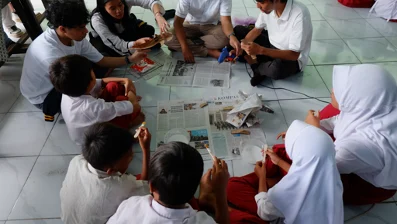
The educational outreach extended to the younger generation at SDN 3 Tanjung Luar. Through the "Shark Conservation Workshop," elementary students participated in interactive sessions that combined science with art. A highlight of the workshop was a "paper mache" activity where students created shark models, a pedagogical tool used to instill a sense of ownership and protection over marine life from an early age.
Rehabilitating the Blue Economy: Coral Transplantation in Kecinan Bay
The second day of Kanopi Empower focused on direct environmental restoration. The team traveled to Kecinan Bay to perform coral transplantation, a vital intervention in an area where reefs have historically suffered from destructive fishing practices and rising sea temperatures.
Before entering the water, participants underwent a technical briefing on the "Spider Frame" and "Fragging" methods of coral restoration. They learned how to carefully attach coral fragments to artificial structures designed to stabilize the seabed and encourage new growth. Under the guidance of experts from the Indonesia Biru Foundation, students and volunteers successfully transplanted dozens of coral fragments. This activity served as a practical application of the "Blue Economy" concept—the idea that economic growth must be decoupled from environmental degradation.
Contextual Background: The Evolution of Mandalika
The significance of this program is underscored by the broader national context of the Mandalika SEZ. Spanning over 1,100 hectares, the zone was established to diversify Indonesia’s tourism portfolio beyond Bali. Since its inauguration, it has attracted billions of dollars in investment. However, such rapid development often brings "growing pains," including land disputes and the marginalization of local residents who may lack the formal training to participate in a globalized economy.
The research by Kanopi FEB UI arrives at a critical juncture. As the "promises" of the SEZ—such as job creation and infrastructure development—begin to meet the "reality" of local implementation, empirical data is needed to ensure that the development is inclusive. Previous independent studies in the region have suggested that while the macro-economic indicators of the province are rising, the "trickle-down" effect to the poorest households remains inconsistent. By focusing on the "Six Capitals," the FEB UI researchers are providing a roadmap for more equitable growth.
Analytical Implications and Future Outlook
The Pensar-Kanopi Empower 2026 program represents a modern evolution of student activism and academic duty. Rather than remaining confined to the lecture halls of Jakarta, these students have taken a proactive role in national development. The implications of their findings are expected to be twofold.
First, the research report will serve as a valuable resource for policymakers. By highlighting the gaps in the "natural" and "social" capitals of the local communities, the study identifies specific areas where the government and the Mandalika Grand Prix Association (MGPA) can improve their community outreach and CSR programs. For instance, if the data shows a decline in "natural capital" due to restricted beach access for local fishermen, policy adjustments can be made to ensure shared usage of coastal resources.
Second, the environmental actions in Tanjung Luar and Kecinan Bay set a precedent for sustainable tourism. As Lombok continues to grow as a global destination, the preservation of its natural assets—its sharks and its reefs—is not just an environmental necessity but an economic one. The "Blue Economy" approach championed by Kanopi Empower suggests that the future of Lombok’s tourism lies in "high-value, low-impact" models that prioritize ecological health.
In conclusion, the dual mission of Kanopi FEB UI in Lombok serves as a powerful reminder of the synergy between data and action. By providing a voice to the local communities of Kuta and Selong Belanak through rigorous research, and by contributing to the restoration of the marine environment, the students of FEB UI have contributed to a more sustainable and just development narrative for Indonesia. The findings from this 2026 expedition are expected to be published and presented in academic forums, ensuring that the lessons learned in Lombok reach a national audience.