PP Muhammadiyah Sets 1 Ramadan 1448 Hijriah on February 8, 2027, Using the Global Islamic Calendar

The Central Leadership of Muhammadiyah, one of Indonesia’s largest Islamic mass organizations, has officially determined the start of Ramadan 1448 Hijriah utilizing the Unified Global Islamic Calendar, commonly known as the Kalender Hijriah Global Tunggal (KHGT). According to this advanced computational framework, the first day of the fasting month for the year 1448 Hijriah will fall on Monday, February 8, 2027. This proactive announcement provides early clarity for millions of Muhammadiyah adherents worldwide and across the archipelago who rely on the global calendar system to plan their religious observances well in advance.
While this determination offers a definitive timeline for the organization’s followers, the broader Indonesian public awaits formal confirmation from the central government. The Ministry of Religious Affairs of the Republic of Indonesia has not yet established the official date for the commencement of Ramadan 1448 H. Government authorities continue to adhere to the traditional combined methodology of astronomical calculation, known as hisab, and actual visual observation of the lunar crescent, known as rukyatul hilal. These findings are subsequently debated and ratified during a formal national Isbat Session convened by the Ministry closer to the time.
Methodology and Chronological Breakdown of Ramadan 1448 H
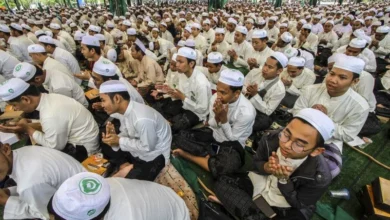
The official KHGT calendar published by Muhammadiyah maps out the lunar month with precise mathematical predictability. Based on these calculations, Ramadan 1448 H will span a duration of 29 days. The final day of fasting, corresponding to the 29th of Ramadan 1448 H, is projected to fall on Monday, March 8, 2027. Consequently, the sacred eve preceding the first day of fasting—marking the commencement of the holy month—will begin on Sunday night, February 7, 2027. On this evening, faithful Muslims who align with the Muhammadiyah calendar will gather in mosques to perform their first evening Tarawih prayers, officially inaugurating the spiritual season.
Furthermore, the KHGT framework identifies other critical milestones within the lunar month. Notably, the 17th day of Ramadan 1448 H, traditionally commemorated by Muslims globally as Nuzulul Quran to mark the historical revelation of the Holy Quran, is slated for Wednesday, February 24, 2027. Looking slightly beyond the fasting period, the same global calendar system has pre-calculated the culmination of the fasting month. The celebration of Eid al-Fitr, marking 1 Syawal 1448 H, is scheduled for Tuesday, March 9, 2027.
The underlying strength of the KHGT system lies in its standardization and forward-looking capability. By applying strict astronomical criteria that seek to unify the global Muslim ummah under a single calendar day—similar to the standard Gregorian calendar—Muhammadiyah is able to fix religious dates years in advance. This eliminates the annual ambiguity and localized discrepancies that often characterize traditional moon-sighting methodologies, offering logistical predictability for travel, commerce, and institutional planning.
Government Stance and the Isbat Session Mechanism
Despite the precision offered by Muhammadiyah’s global calendar, the government of Indonesia maintains its longstanding pluralistic approach to religious date-setting. The Ministry of Religious Affairs acts as the ultimate arbiter for national administrative purposes, coordinating closely with prominent Islamic organizations, astronomical experts, and judiciary bodies during the annual Isbat Session. Because Ramadan 1448 H remains several years away from the perspective of current administrative timelines, state officials have emphasized that no final decree has been issued.
The Indonesian state framework relies heavily on the criteria established by the Ministers of Religion of Brunei Darussalam, Indonesia, Malaysia, and Singapore (MABIMS). These criteria evaluate the altitude of the lunar crescent and its angular separation from the sun at sunset. When the parameters meet the established thresholds, the following day is declared the new month. Because weather conditions, atmospheric refraction, and slight variations in sighting criteria can influence the outcome of rukyatul hilal, government-sanctioned dates occasionally diverge from those calculated strictly through preliminary astronomical algorithms.
Implications of Calendar Variations in Indonesia
The coexistence of different calendar systems within the same national territory is a well-established reality in Indonesia. Historically, variations in the onset of Ramadan and Eid al-Fitr between Muhammadiyah, Nahdlatul Ulama (NU), and the government have occurred without disrupting societal harmony. Indonesian society has cultivated a high degree of religious tolerance, viewing these methodological differences as a reflection of the rich diversity of Islamic jurisprudence (fiqh) regarding astronomical calculations and sighting reports.
Societal implications of these calculated calendars extend into economic, educational, and operational spheres. For instance, businesses, schools, and transportation networks benefit immensely from early projections, even if subject to government ratification. Knowing that Ramadan 2027 will unfold in the late winter and early spring months allows logistics and supply chain managers to prepare for shifts in consumer demand, dietary habits, and working hours across public and private sectors.
Moreover, civil authorities and interfaith organizations frequently monitor these overlapping calendars to manage large-scale societal events. A notable historical precedent includes overlapping dates with other national or religious holidays—such as the Hindu Day of Silence (Nyepi)—which require careful coordination by security forces and community leaders to ensure that celebrations of the breaking of the fast harmonize smoothly with periods of solemn local observance.
Broader Context of the Global Islamic Calendar Initiative
The adoption of the Kalender Hijriah Global Tunggal by Muhammadiyah is part of a broader, international movement among Islamic scholars and scientists to rectify the longstanding fragmentation of the Islamic calendar. Traditionally, different regions of the world rely on local or regional sightings of the new moon, leading to situations where neighboring countries celebrate religious holidays on entirely different days. Proponents of a unified global calendar argue that modern globalization, rapid international communication, and advanced astrophysics necessitate a unified standard that treats the Earth as a single horizon zone under specific parameters.
By pioneering the implementation of KHGT within the Indonesian context, Muhammadiyah positions itself at the forefront of Islamic calendar reform. The organization consistently advocates for a scientific approach that bridges classical jurisprudence with contemporary astronomical science, aiming to provide certainty to the global ummah. However, transitioning the entire Muslim population—both domestically and internationally—to a single calendar remains a gradual diplomatic and theological endeavor, requiring continuous dialogue among global fatwa authorities, astronomers, and Islamic institutions.
Looking Ahead to 2027 and Community Guidance
As the year 2027 approaches, religious authorities and community leaders across Indonesia are expected to maintain public outreach campaigns to educate citizens on the nuances of calendar harmonization. While Muhammadiyah members will confidently structure their fasting schedules around the February 8, 2027 start date, the wider public is consistently advised to remain attentive to announcements from the Ministry of Religious Affairs following the formal Isbat Session.
Ultimately, the early release of the 1448 H calendar by Muhammadiyah serves as a reminder of the meticulous planning embedded within Islamic jurisprudence regarding timekeeping. Whether individuals choose to follow the calculated global standard or await the traditional national consensus, the shared spiritual objective remains the peaceful and devout observance of the holy month. As preparation begins years in advance, the overarching message from community leaders emphasizes mutual respect, spiritual readiness, and the preservation of national unity amidst methodological pluralism.