Medan City Government Targets December 2026 Completion for Glugur Darat Public Health Center as Part of Major Healthcare Infrastructure Overhaul

The municipal administration of Medan, located in North Sumatra, has officially set a strict operational deadline for the construction of the Glugur Darat Public Health Center, locally known as Puskesmas Glugur Darat. Situated in the East Medan sub-district, the healthcare facility is slated for full completion by the third week of December 2026. This ambitious infrastructure project forms a cornerstone of the city government’s broader strategy to radically transform and elevate the standard of public health services available to urban residents.
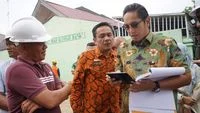
The announcement was made by the Acting Mayor of Medan, Rico Tri Putra Bayu Waas, during an intensive field inspection conducted on Thursday, September 24. Mayor Rico personally visited the project site located on Jalan Pendidikan to evaluate the current progress of the civil works. According to project updates provided at the site, the legacy structure that previously occupied the plot has been entirely demolished, and construction crews have successfully transitioned into the critical foundation-laying phase.
Strategic Expansion of Primary Healthcare Facilities
Puskesmas Glugur Darat represents one of three brand-new primary healthcare facilities currently being constructed simultaneously by the Medan City Government. This tier of municipal development aims to bridge historical gaps in healthcare accessibility across different corners of the sprawling metropolitan area. Alongside the Glugur Darat project, the municipal administration is spearheading the construction of Puskesmas Jalan Bunga Melati, situated in the Medan Tuntungan sub-district, and Puskesmas Jalan Rengas Pulau, located in the Medan Marelan sub-district.
All three medical facilities have been conceptualized under a standardized, modern architectural blueprint. Each facility is being built as a two-story complex encompassing a total building footprint of approximately 1,200 square meters. Crucially, these new centers are designed to operate beyond standard daytime business hours by incorporating fully equipped, 24-hour Emergency Departments (IGD). This structural upgrade is intended to alleviate the immense patient influx traditionally experienced by major regional hospitals, allowing emergency cases to receive immediate stabilization at the neighborhood level.
During the prolonged construction phase, local health authorities have taken proactive measures to ensure that public health services for the residents of East Medan experience minimal disruption. Administrative and clinical operations for Puskesmas Glugur Darat have been temporarily relocated to an alternative site situated at Jalan Mustafa No. 4, Medan. City officials have urged local residents to utilize this interim location for routine check-ups, maternal care, and general outpatient consultations while heavy construction continues at the original site.
Holistic Vision: Infrastructure Meets Human Capital
Speaking directly to stakeholders and media personnel during his site inspection, Mayor Rico emphasized that the ongoing municipal push toward comprehensive healthcare reform extends far beyond mere physical construction and aesthetic modernization.
"The rehabilitation and construction of public health centers is not solely about the physical buildings, but fundamentally about the quality of the services they deliver," Rico stated. "We want to elevate the overall landscape and face of the healthcare sector in Medan City so that every citizen feels the tangible benefits of improved medical governance."
This sentiment underscores a growing recognition among Indonesian municipal leaders that capital investments in concrete and steel must be tightly coupled with investments in human resources. To realize this vision, the Medan City Government has outlined a parallel initiative focused on the rigorous training, capacity building, and competency evaluation of medical personnel deployed across all public health facilities.
Furthermore, the revitalization agenda is not limited to the construction of the three new flagship centers. In tandem with these large-scale projects, the Medan City Government is actively executing rehabilitation and upgrade works on 28 existing public health centers scattered throughout various sub-districts. This massive pipeline of renovations aims to bring legacy facilities up to contemporary standards of infection control, patient privacy, and operational efficiency.
Phased Implementation of 24-Hour Emergency Services
While the physical blueprints guarantee the spatial capacity for round-the-clock emergency care, operationalizing 24-hour Emergency Departments across newly constructed health centers requires meticulous logistical planning, particularly concerning human resources.
Addressing the implementation timeline for these emergency units, the Acting Head of the Medan City Health Office, Surya Syahputra Pulungan, elaborated on the phased rollout strategy. According to Surya, the transition toward a continuous 24-hour operational model will not happen overnight. Instead, the deployment of emergency services will be executed progressively, strictly calibrated against the readiness of human resources on the ground.
This phased approach involves a comprehensive recruitment and credentialing process for general practitioners, emergency nurses, pharmacists, laboratory technicians, and essential administrative support staff. Ensuring an adequate, well-rested, and highly skilled workforce is deemed paramount to avoid operational bottlenecks and to guarantee that emergency patients receive prompt, high-standard triage and treatment regardless of the hour.
Public Accountability and Quality Control
In a notable move toward democratic oversight and public accountability, the municipal administration has explicitly invited local communities to act as active watchdogs over the performance of medical and administrative staff. Mayor Rico asserted that administrative restructuring and infrastructural development must be sustained by direct feedback loops from the beneficiaries of the public healthcare system.
The mayor urged citizens not to hesitate in reporting instances of substandard service, unprofessional behavior, or administrative negligence displayed by healthcare workers within city-managed facilities. By channeling public grievances directly to municipal oversight bodies, the local government aims to swiftly identify systemic weaknesses, penalize chronic underperformance, and enforce corrective measures.
"If the medical personnel or staff do not perform adequately, simply report it directly to us. We will swiftly evaluate and address the issue," Rico concluded firmly. This open-door policy for public complaints is expected to create a self-correcting ecosystem where institutional responsiveness matches the scale of physical modernization.
Broader Socio-Economic Implications for Medan
The comprehensive overhaul of Medan’s primary healthcare infrastructure carries profound socio-economic implications for the region. As Indonesia’s third-largest city, Medan faces persistent urban health challenges, including high population density, traffic congestion that complicates emergency transit to central hospitals, and socio-economic disparities in health literacy and access.
By decentralizing emergency care through the establishment of 24-hour facilities like the upcoming Puskesmas Glugur Darat, the city administration is effectively reducing the golden hour response time for acute trauma and medical emergencies. Furthermore, upgrading neighborhood-level health centers helps intercept chronic illnesses—such as hypertension and diabetes—at an earlier stage, thereby reducing the long-term financial burden on the national health insurance scheme (BPJS Kesehatan) and improving the overall productivity of the urban workforce.
As December 2026 approaches, the pressure remains high on contractors, municipal planners, and health officials to maintain strict adherence to timelines and budgetary frameworks. The successful delivery of Puskesmas Glugur Darat, alongside its sister facilities, will serve as a vital benchmark for urban healthcare governance in North Sumatra for years to come.