Navigating Indonesia’s Evolving Tax Landscape: The Certified CoreTaxify Professional Program Addresses Critical Competency Gaps

The introduction of the CoreTax system by the Directorate General of Taxes (DGT) in Indonesia represents a monumental shift in the nation’s tax administration, fundamentally altering how corporations and tax consultants manage their compliance obligations. This digital transformation, while aimed at enhancing efficiency and transparency, simultaneously creates a significant competency gap for practitioners unfamiliar with its intricacies. In response to this critical need, Piranha Smart Center (PSC), in collaboration with SET Academy, has meticulously designed the Certified CoreTaxify Professional (CCP) training and certification program, specifically engineered to equip tax professionals with the essential skills to navigate this new era of digital taxation.
The Dawn of CoreTax: A Paradigm Shift in Indonesian Taxation
Indonesia’s journey towards a more modern and integrated tax administration system reached a pivotal milestone with the rollout of CoreTax. This ambitious initiative is part of a broader government strategy to digitalize public services, streamline bureaucratic processes, and ultimately bolster national revenue collection. Historically, Indonesia’s tax system, while robust in its legal framework, often grappled with fragmentation, manual processes, and disparate data sources, leading to potential inefficiencies, increased compliance burdens for taxpayers, and challenges in oversight for the DGT. CoreTax aims to consolidate various tax services and data points into a unified, digital platform, promising greater accuracy, reduced processing times, and enhanced transparency for all stakeholders.
The DGT’s vision for CoreTax is to create an integrated ecosystem that encompasses all aspects of tax administration, from registration and reporting to payment and audit. This involves moving away from multiple legacy systems to a single, comprehensive digital backbone. For businesses, this translates into a standardized, electronic method for fulfilling tax obligations, including the submission of various tax returns (SPT), withholding and collection statements, and value-added tax (PPN) reports. The long-term objective is not merely automation but a profound transformation that fosters a more compliant and digitally savvy taxpayer base, thereby reducing the scope for errors and improving the overall ease of doing business in Indonesia.
Addressing the Competency Chasm: Beyond Theoretical Understanding
While the strategic rationale behind CoreTax is clear, its implementation presents immediate operational challenges for the thousands of tax professionals across Indonesia. The transition from established, often manual or semi-digital, workflows to a fully integrated digital system like CoreTax demands more than just a theoretical understanding of tax laws. It requires practical proficiency in operating the new platform, interpreting system-generated data, and adapting existing processes to align with CoreTax functionalities. This is precisely where the "competency gap" emerges – a chasm between traditional tax knowledge and the specific technical skills required to effectively utilize the CoreTax system.
Failure to bridge this gap can have significant repercussions. For individual practitioners, it can lead to reduced efficiency, increased stress, and the risk of errors in reporting, which in turn can trigger penalties, audits, and reputational damage for their employers or clients. For corporations, inaccurate or delayed tax filings due to a lack of CoreTax proficiency can result in substantial financial penalties, legal complications, and disruptions to financial operations. Industry analysts frequently highlight that digital transformation initiatives, while essential, often falter if not accompanied by robust training and upskilling programs for the affected workforce. The CCP program directly confronts this challenge by offering a solution that is both comprehensive in its tax scope and deeply practical in its digital application.
The Certified CoreTaxify Professional (CCP) Program: A Holistic Approach to Digital Tax Mastery
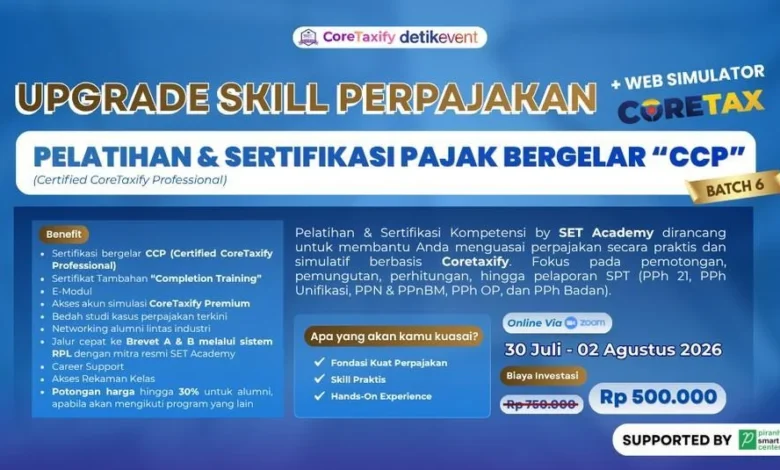
The Certified CoreTaxify Professional (CCP) program, a collaborative initiative by Piranha Smart Center (PSC) and SET Academy, is meticulously structured to provide an immersive and practical learning experience. Its curriculum is designed to cover the full spectrum of Indonesian taxation, ensuring participants gain a profound understanding of the legal frameworks underpinning each tax type, alongside hands-on mastery of the CoreTaxify application.
The program’s extensive module list includes:
- PPh 21 (Income Tax Article 21): Focusing on income tax withheld from employment, services, and other activities. Participants learn how CoreTaxify streamlines the calculation, reporting, and submission of PPh 21, a critical component for almost every employer in Indonesia.
- PPh Unifikasi (Unified Income Tax): Addressing the complexities of income tax on various types of income (e.g., final income tax, PPh 23, PPh 26) that are consolidated under a unified reporting mechanism in CoreTax. This module is vital for managing diverse withholding tax obligations efficiently.
- PPN and PPnBM (Value Added Tax and Luxury Goods Sales Tax): Delving into the intricacies of VAT and LSST, including input and output tax calculations, crediting mechanisms, and the electronic submission of VAT returns (e-Faktur) within the CoreTaxify environment. This is particularly crucial for businesses engaged in the sale of goods and services.
- PPh Orang Pribadi (Individual Income Tax): Covering the principles and practicalities of individual income tax, including the calculation of taxable income, allowable deductions, and the electronic filing of Annual Individual Income Tax Returns (SPT Tahunan PPh Orang Pribadi) through CoreTaxify.
- PPh Badan (Corporate Income Tax): A cornerstone module that addresses the comprehensive aspects of corporate income tax, including financial statement adjustments for tax purposes, calculation of corporate taxable income, and the preparation and submission of Annual Corporate Income Tax Returns (SPT Tahunan PPh Badan) using the CoreTaxify system.
The pedagogical approach of the CCP program is a significant differentiator. It moves beyond traditional theoretical lectures by integrating expert presentations from seasoned tax practitioners with live demonstrations of the CoreTaxify application. This dual approach ensures that participants not only grasp the regulatory nuances but also witness, in real-time, how these regulations are translated into actionable steps within the digital system. This is further cemented through practical, case-study-based exercises that mirror real-world scenarios. Participants are challenged to apply their knowledge and system proficiency to solve complex tax problems, thereby building confidence and competence in a controlled learning environment. This blended methodology ensures that graduates are not just conceptually aware but are also operationally capable, ready to hit the ground running in their respective roles.
The Urgency of Upskilling: Timeline and Target Audience
The imperative for tax professionals to adapt to CoreTax is not a distant future concern but an immediate necessity. While the full phased rollout of CoreTax across all taxpayer segments continues, the DGT’s commitment to its complete implementation signals an irreversible shift. The CCP program is strategically scheduled to prepare professionals well in advance, ensuring they are proficient by the time CoreTax becomes fully mandatory for their specific tax obligations.
The upcoming online training session is scheduled as follows:
- Days: Thursday to Sunday
- Dates: July 30 to August 2, 2026
- Platform: Zoom Meeting, allowing for flexible participation from various locations.
This four-day intensive program is specifically designed for a broad spectrum of professionals and academics who are either directly involved in tax administration or require a deep understanding of Indonesia’s digital tax landscape:
- Staff Accounting and Tax: Essential for internal finance and tax departments of companies, ensuring accurate and efficient compliance.
- Konsultan Pajak (Tax Consultants): Crucial for those advising multiple clients, as they must be proficient in the system to provide effective counsel and services.
- Praktisi Perpajakan (Tax Practitioners): A general category encompassing anyone actively involved in tax-related activities, from compliance officers to tax managers.
- Mahasiswa Akuntansi dan Perpajakan (Accounting and Taxation Students): Providing a vital head start for future professionals, making them more marketable upon graduation.
- Dosen (Lecturers): Enabling educators to update their curriculum and provide students with current, relevant knowledge based on the latest tax administration systems.
Tangible Benefits for CCP Graduates: A Gateway to Enhanced Career Trajectories
Completing the CCP program offers a suite of tangible benefits that significantly enhance a participant’s professional standing and career prospects:
-
Certified CoreTaxify Professional (CCP) Certification: This official certification validates a participant’s expertise in navigating and utilizing the CoreTaxify system for various tax obligations. It serves as a credible credential, demonstrating a commitment to professional development and mastery of modern tax administration tools. In an increasingly competitive job market, a specialized certification like CCP can set professionals apart, signaling to employers their readiness for the digital tax era.
-
Access to CoreTaxify Premium Simulation Account: Practical application is key to true mastery. Graduates gain access to a premium simulation account, allowing them to practice CoreTaxify operations in a realistic, risk-free environment. This continuous access facilitates ongoing skill refinement and allows participants to experiment with different scenarios, reinforcing their learning beyond the structured training period. This hands-on experience is invaluable for building confidence and troubleshooting capabilities.
-
E-Modul: Comprehensive electronic modules provide a valuable resource for future reference. These digital materials contain detailed explanations, case studies, and practical guides, serving as an enduring knowledge base for graduates to consult whenever they encounter complex tax scenarios or need to refresh their understanding of specific CoreTaxify functionalities.
-
Fast Track to Brevet A and B through RPL System with SET Academy’s Official Partners: This is a particularly attractive benefit, offering an accelerated pathway to the prestigious Brevet A and B certifications. Brevet A and B are foundational qualifications for tax consultants in Indonesia, signifying a deep understanding of individual and corporate taxation, respectively. Through the Recognition of Prior Learning (RPL) system, the CCP certification and acquired competencies can count towards fulfilling requirements for Brevet A and B, significantly reducing the time and effort typically required to obtain these credentials. This strategic partnership with SET Academy’s official partners underscores the program’s commitment to fostering long-term career growth for its graduates.
Statements from Related Parties: Endorsing the Imperative for Digital Tax Literacy
"The introduction of CoreTax is not merely a technological upgrade; it’s a fundamental reshaping of Indonesia’s tax ecosystem," stated a spokesperson for Piranha Smart Center. "Our collaboration with SET Academy to develop the CCP program stems from a clear recognition that technology must be complemented by human expertise. We are committed to empowering professionals with the practical skills needed to not just comply with the new system but to leverage it for greater efficiency and accuracy. The CCP certification is designed to be a benchmark for digital tax literacy in Indonesia."
An industry analyst specializing in financial technology and taxation further elaborated, "The DGT’s move towards CoreTax aligns Indonesia with global trends in tax digitalization, seen in countries like Singapore, Australia, and parts of Europe. While the benefits of such systems—enhanced data analytics, reduced fraud, and streamlined processes—are immense, the initial transition period is often fraught with challenges related to user adoption and competency. Programs like CCP are absolutely vital in mitigating these risks, ensuring a smoother transition for businesses and contributing to the overall success of the digital transformation agenda."
A hypothetical Corporate Finance Manager from a prominent Jakarta-based manufacturing firm echoed the sentiment from a practical standpoint. "Keeping our finance and tax teams up-to-date with regulatory changes is a constant challenge, and CoreTax represents a major one. The prospect of our staff not being fully proficient could lead to significant operational bottlenecks and potential non-compliance issues. A program that offers hands-on training and a recognized certification like CCP is exactly what we need to ensure our teams are not just prepared but are capable of optimizing our tax processes within the new system. The Brevet A and B fast track is an added bonus for our team’s professional development."
Broader Impact and Implications: A Catalyst for National Tax Compliance
The widespread adoption of CoreTax and the subsequent upskilling of tax professionals through programs like CCP carry significant broader implications for Indonesia’s economic landscape and national tax compliance:
- Enhanced Tax Revenue Collection: A more efficient and accurate tax administration system, coupled with a digitally competent taxpayer base, is expected to lead to improved tax compliance rates. This, in turn, can contribute to higher and more stable national tax revenue, providing the government with greater resources for infrastructure development, public services, and social programs.
- Improved Ease of Doing Business: By standardizing and simplifying tax reporting processes through a unified digital platform, CoreTax can significantly reduce the administrative burden on businesses. This improved efficiency, supported by trained professionals, contributes to a more favorable business environment, attracting foreign investment and fostering domestic economic growth.
- Reduced Tax Disputes and Penalties: A higher level of accuracy in tax filings, facilitated by CoreTax and competent practitioners, can lead to a reduction in errors, discrepancies, and ultimately, fewer tax audits and disputes. This saves both taxpayers and the DGT valuable time and resources, while also mitigating the financial risks associated with penalties.
- Professional Development and Modernization of the Tax Profession: The shift to CoreTax necessitates a modernization of the tax profession itself. Professionals who embrace digital tools and continuous learning will thrive, while those who resist may find their skills becoming obsolete. Programs like CCP are instrumental in fostering a culture of continuous professional development, ensuring Indonesia’s tax workforce remains competitive and globally relevant.
- Greater Transparency and Accountability: The integrated nature of CoreTax provides the DGT with better data analytics capabilities, enabling more effective oversight and identification of potential compliance issues. For taxpayers, the digital trail ensures greater transparency in their interactions with the tax authority, fostering a more accountable system.
Securing Your Future in Digital Taxation: A Call to Action
The transition to CoreTax is not merely a procedural change; it is an evolution in Indonesia’s tax philosophy, demanding a new level of digital fluency from its tax professionals. The Certified CoreTaxify Professional (CCP) program offered by Piranha Smart Center and SET Academy stands as a vital resource for those committed to excellence and compliance in this transforming environment. It offers a unique blend of theoretical knowledge and practical application, ensuring graduates are not just aware of the new system but are masters of its operation.
With the training scheduled for July 30 to August 2, 2026, aspiring CCPs and organizations looking to future-proof their tax compliance efforts are strongly encouraged to secure their participation. The benefits, ranging from a prestigious certification to a fast track for Brevet A and B, represent a significant investment in one’s professional future. As Indonesia moves further into its digital tax era, competency in systems like CoreTaxify will no longer be an advantage but a fundamental requirement for effective and compliant tax administration. Ample opportunities exist for those who are prepared, and the CCP program provides the essential tools to seize them. Secure your slot for this pivotal training at detikevent before the limited quota is filled, and position yourself at the forefront of Indonesia’s digital tax revolution.