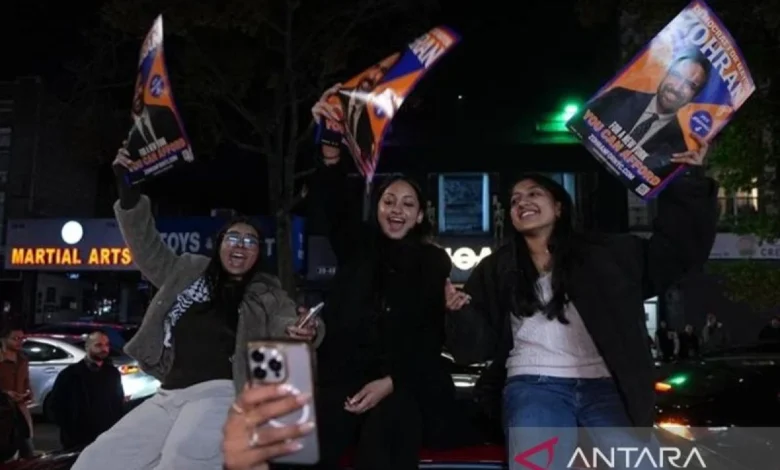
The political landscape of New York City underwent a seismic shift on Tuesday night, November 4, as Zohran Mamdani was declared the winner of the mayoral race, marking a series of historic firsts for the United States’ most populous metropolis. At 34 years old, Mamdani has become the first Muslim, the first person of Indian descent, and the first African-born individual to be elected as the Mayor of New York City. However, as the dust settles on a hard-fought campaign, public attention has increasingly turned toward the woman standing beside him: his wife, Rama Duwaji. A prolific artist, illustrator, and animator, Duwaji is set to become the youngest "First Lady" in the history of the "Big Apple," representing a new generation of political partners who blend professional independent careers with high-stakes campaign strategy.
The victory, which will see Mamdani inaugurated on January 1, 2026, was not merely a win for the progressive wing of the Democratic party but also a testament to a modern, digitally-driven campaign apparatus. Insiders and political analysts have noted that Duwaji, despite her preference for staying out of the immediate glare of the paparazzi, was a central figure in the architectural design of Mamdani’s digital outreach. Her influence helped bridge the gap between traditional grassroots organizing and the aesthetic demands of a Gen Z and Millennial electorate.
A New Era for the Gracie Mansion
When Zohran Mamdani takes the oath of office in early 2026, the transition will signal more than just a change in policy; it will represent a demographic revolution. New York City, a global hub of finance, culture, and diversity, has long been a bastion of traditional political dynasties. Mamdani’s rise—fueled by a platform of housing reform, public transit expansion, and social justice—was bolstered by a sophisticated communication strategy that many attribute to Duwaji’s creative eye.
Rama Duwaji, born in Houston, Texas, in 1997, represents the quintessential "Gen Z" professional. Her background is a tapestry of international experiences that mirror the multicultural fabric of New York itself. Of Syrian descent, she spent her formative years in Texas before her family relocated to Dubai when she was nine. This upbringing provided her with a global perspective that is frequently reflected in her artistic output, which often explores themes of displacement, identity, and the intersection of Eastern and Western cultures.
Her academic pedigree is equally impressive. Duwaji attended the Virginia Commonwealth University School of the Arts (VCUarts) in Qatar before transferring to the university’s main campus in Richmond, Virginia, to complete her undergraduate studies. Seeking to further refine her craft in the heart of the global art world, she moved to New York City in 2021. In 2024, she earned her Master of Fine Arts (MFA) from the prestigious School of Visual Arts (SVA), specializing in the "Illustration as Visual Essay" program.
The Artistic Vision of Rama Duwaji
While she is now recognized as a political figure, Duwaji’s primary identity remains rooted in her work as an illustrator and animator. Her portfolio is a testament to her versatility and skill, featuring collaborations with global giants such as Apple, Spotify, and Instagram. Her illustrations have graced the pages of esteemed publications, including The New Yorker, The Washington Post, BBC, and Vogue.
Her artistic style is characterized by a poignant use of black-and-white imagery, often utilizing stark contrasts to convey deep emotional and social narratives. Unlike many contemporary artists who lean into digital maximalism, Duwaji’s work frequently returns to the tactile—she is known for her hand-built ceramics and traditional drawing techniques. Her art is rarely "art for art’s sake"; instead, it serves as a vehicle for advocacy. Much of her recent work has focused on themes of resistance and the human cost of conflict, particularly through a pro-Palestinian lens. This commitment to social justice aligned seamlessly with Mamdani’s political platform, which often emphasized international human rights alongside local municipal issues.
Before her move to New York, Duwaji participated in several prestigious artist residency programs, including stints in Lebanon and France. These experiences allowed her to document the lives of marginalized communities, further honing her ability to tell complex stories through simple, evocative visuals. It is this ability to distill complex messaging into relatable visual content that proved invaluable during her husband’s mayoral bid.
Chronology of a Political and Personal Union
The story of Rama Duwaji and Zohran Mamdani is one that resonates with the modern New Yorker. The couple met in 2021 through the dating application Hinge, shortly after Duwaji moved to the city to pursue her graduate studies. At the time, Mamdani was already making waves as a member of the New York State Assembly, representing the 36th District in Queens.
The timeline of their relationship coincided with Mamdani’s rapid political ascent:
- 2021: Rama Duwaji moves to New York City and meets Zohran Mamdani.
- 2022-2023: While Duwaji pursues her MFA at the School of Visual Arts, Mamdani consolidates his base in Queens, advocating for "Tax the Rich" initiatives and public power.
- Early 2024: Duwaji graduates from SVA and the couple marries in a private ceremony, blending their Syrian and Indian-Ugandan heritages.
- June 24, 2024: During the primary season, Duwaji makes a rare but significant public appearance, standing by Mamdani as the campaign gains momentum against more established centrist candidates.
- November 4, 2024: Election night. Mamdani secures a decisive victory. Duwaji joins him on stage after his victory speech, marking her transition from a private artist to a public figure.
In his victory speech, Mamdani was vocal about the role his wife played in his life and career. He described her as an "extraordinary partner" and emphasized that her support was the foundation upon which his campaign was built. "There is no one I would rather have by my side in every moment than Rama," he told a cheering crowd of supporters.
Strategic Digital Influence and Campaign Dynamics
Though Duwaji did not hold an official title within the campaign hierarchy for most of the race, her influence was visible in the campaign’s branding. Political strategists have noted that Mamdani’s social media presence—often characterized by high-quality graphics, clear typography, and a cohesive visual narrative—bore the hallmarks of Duwaji’s professional aesthetic.
In an era where political battles are fought as much on TikTok and Instagram as they are on the streets, having a world-class illustrator as a close advisor provided Mamdani with a distinct advantage. The campaign was able to translate dense policy proposals regarding rent control and MTA funding into digestible, shareable content that resonated with younger voters. This "aesthetic of the movement" helped Mamdani mobilize a demographic that had previously felt alienated by the polished, corporate look of traditional New York politics.
Furthermore, Duwaji’s own professional network in the New York creative scene helped Mamdani tap into a community of artists and influencers who became vocal advocates for his platform. This grassroots cultural support was crucial in a city where the "creative class" holds significant social capital.
Reactions and Broader Implications
The election of Zohran Mamdani and the rise of Rama Duwaji have sent ripples through the international political community. Sadiq Khan, the Mayor of London and the first Muslim to lead a major Western capital, was among the first to offer congratulations. Khan noted that Mamdani’s victory represents a "beacon of hope" for inclusive governance and proves that progressive, diverse leadership is the future of global cities.
Locally, the reaction has been a mix of excitement and curiosity. Political analysts suggest that Duwaji will redefine the role of the First Lady of New York City. Unlike her predecessors, who often focused on traditional philanthropic causes or social hosting, Duwaji is expected to maintain her independent career while using her platform to highlight the arts and social justice.
As a Gen Z woman of Syrian descent, her presence in Gracie Mansion (the traditional residence of the NYC Mayor) is a powerful symbol. It reflects the changing face of the American electorate—one that is younger, more diverse, and unapologetic about its global connections.
Analysis: The Future of the "Big Apple"
The Mamdani-Duwaji era begins at a critical juncture for New York City. The city is currently grappling with an affordable housing crisis, a strained public transportation system, and the ongoing challenges of post-pandemic economic recovery. Mamdani’s socialist-leaning policies will face significant scrutiny from the city’s financial sector and more conservative elements of the state government.
However, the "soft power" of the mayor’s office, often channeled through the First Lady, will be a key tool in navigating these challenges. Duwaji’s focus on identity and injustice suggests that her tenure will likely involve a strong emphasis on the city’s cultural and immigrant communities. Her background as an educator—having taught illustration and animation workshops—may also translate into initiatives aimed at youth engagement and the democratization of the arts.
The fact that Duwaji is a working artist with a Master’s degree from a New York institution also aligns her with the millions of New Yorkers who come to the city to build careers in the creative industries. Her story is one of migration, education, and professional success, providing a narrative that is both aspirational and grounded.
Conclusion
As January 1, 2026, approaches, New Yorkers are preparing for a Mayoralty unlike any they have seen before. Zohran Mamdani’s victory is a milestone for representation and progressive politics, but the presence of Rama Duwaji adds a layer of modern sophistication to the administration. Together, they represent a shift toward a more transparent, digitally savvy, and culturally attuned form of leadership.
For Rama Duwaji, the transition from the quiet focus of an artist’s studio to the intense scrutiny of the New York political stage will be a significant challenge. Yet, if her past work is any indication, she will likely meet this new role with the same blend of creativity, resilience, and commitment to justice that has defined her career thus far. As the youngest First Lady in the city’s history, she is not just witnessing history—she is actively drawing the blueprint for its future.
Related posts: