Prancis dilanda gelombang demonstrasi besar-besaran yang berujung kerusuhan di sejumlah kota pada pertengahan Oktober 2026

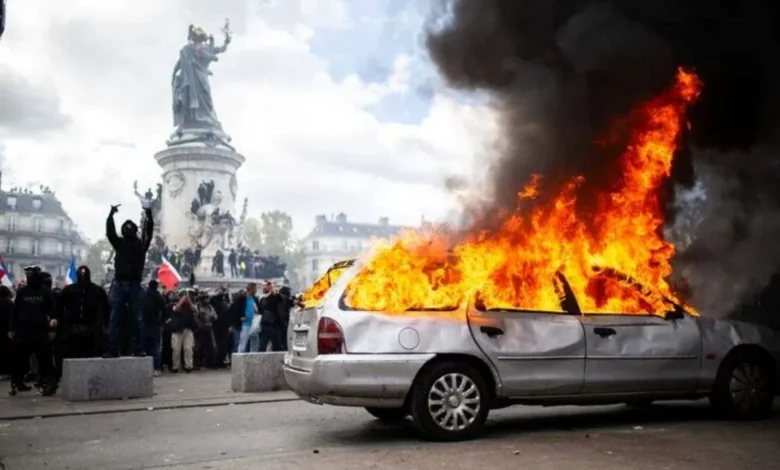
The French Republic, a nation currently grappling with the cumulative pressures of economic instability and systemic social fragmentation, faced one of its most volatile weekends in recent history on October 17–18, 2026. What began as localized, sector-specific grievances regarding the crumbling state of the national education system rapidly metastasized into a nationwide upheaval. As hundreds of thousands of citizens—ranging from students and teachers to disillusioned middle-class workers—poured into the streets, the veneer of civil discourse was fractured by outbreaks of arson, looting, and violent clashes with law enforcement.
The sheer scale of the mobilization, which saw between 550,000 and 800,000 participants across major urban centers, has placed the administration of President Emmanuel Macron under unprecedented pressure. With the 2027 presidential election looming on the horizon, the events of mid-October serve as a stark indicator of a deep-seated disconnect between the Élysée Palace and the everyday struggles of the French populace.
A Chronology of Escalation
The trajectory of the current unrest did not emerge in a vacuum. It was the result of a month-long build-up of tension that began in mid-September 2026. The initial catalyst was a series of localized strikes centered at the Lycée Saint-Exupéry in Créteil. Educators and students alike voiced grievances regarding a severe shortage of teaching staff, decaying physical infrastructure, and a lack of essential learning resources.
By early October, the movement had transcended the classroom. Teachers’ unions, frustrated by stagnant wages and the increasing burden of administrative tasks, began coordinating with broader labor groups. The tipping point occurred on the weekend of October 17, when a national call for protest brought massive crowds to Paris, Marseille, Lyon, Lille, and Bordeaux.
While the morning of October 17 saw largely peaceful marches, the atmosphere shifted drastically as night fell. By the early hours of October 18, reports from major news agencies, including Reuters and the Associated Press, confirmed that the protests had devolved into rioting. In Limoges, the City Hall was set ablaze; in Marseille and Lyon, public buildings and retail hubs—including major outlets like Carrefour—were subjected to systematic vandalism and looting.
The Economic Catalyst: Beyond the Classroom
The transformation of an education-focused protest into a wider socio-economic uprising is rooted in the "cost-of-living crisis" that has plagued the Eurozone throughout 2026. Inflationary pressures on essential goods, particularly energy and food, have eroded the purchasing power of the average French household.
Sociologists have noted a clear parallel between the current unrest and the 2018 Gilets Jaunes (Yellow Vests) movement. Just as the 2018 movement was sparked by fuel tax hikes, the 2026 protests reflect a wider resentment toward fiscal policies perceived as favoring the elite while placing the brunt of austerity on the working and middle classes. This time, however, the coalition is broader. The inclusion of the academic sector—students and educators—has provided the movement with a level of intellectual and organizational momentum that previous, more fragmented protests lacked.
The intersection of these issues is clear: if the state cannot provide basic public services like safe, well-staffed schools, and if the household budget cannot cover basic utilities, the social contract is perceived as broken.
Government Response and Institutional Crisis
President Emmanuel Macron, addressing the nation in the wake of the violence, attempted to delineate between legitimate grievance and criminal behavior. "The voice of the people is to be heard," Macron stated in a press briefing, "but the destruction of public property and attacks on our law enforcement officers are not acts of protest—they are acts of criminality."
The Ministry of the Interior, led by Laurent Nuñez, reported that by Sunday, October 18, approximately 2,400 individuals had been taken into custody. The human cost of the unrest has been significant: nearly 1,000 police officers sustained injuries during the weekend’s clashes. Tragically, the protests were also marked by a fatality, as one demonstrator died of cardiac arrest during the chaotic events in Paris.
The government has characterized the violence as the work of "extremist elements" and opportunists from both the far-left and criminal factions. However, critics argue that by focusing heavily on the security response—including the deployment of tear gas and the potential for restricted protest zones—the government risks ignoring the root causes that brought half a million people to the streets in the first place.
Statistical Context and Comparative Analysis
The data surrounding the October 2026 riots highlights a nation in flux. While estimates of participant numbers vary—with some sources citing 500,000 and others pushing toward 800,000—the consistency in the reports confirms that this is the most widespread civil unrest since the post-pandemic recovery era.
The economic fallout is also beginning to materialize. Beyond the direct damage to retail outlets and public infrastructure, the disruption to supply chains and local commerce in major cities like Lyon and Marseille will likely result in millions of euros in economic losses. Furthermore, the reliance on police force to quell the riots has raised questions about the state of civil liberties and the government’s ability to maintain order without further alienating the youth demographic.
Long-Term Implications for the French Republic
As the dust settles, the question remains whether this is a transient outburst or the beginning of a prolonged political crisis. The timing is critical; with the 2027 presidential election cycle approaching, political parties are already maneuvering to frame these events. Opposition parties are positioning themselves to capitalize on the government’s perceived inability to manage the economy, while the current administration is struggling to find a balance between restoring order and addressing the structural inequality that has fueled the anger.
The failure to adequately fund the education system has become a symbolic focal point for a government that many believe has lost touch with the "everyday France." If the administration continues to view these protests purely through a lens of public security, it may fail to prevent future, potentially more volatile, outbursts.
The history of French social movements—from the student protests of 1968 to the recent pension reform strikes—shows that when the government fails to address the underlying economic anxiety of the middle class, the street becomes the primary forum for political expression. The current challenge for the French government is not just the repair of burned buildings, but the restoration of institutional trust.
Conclusion
The events of mid-October 2026 serve as a sobering reminder of the fragility of social stability in an era of global economic uncertainty. The combination of educational decline, the rising cost of living, and deep-seated political disillusionment has created a powder keg that requires more than just administrative rhetoric to defuse.
Moving forward, the government’s ability to initiate a meaningful dialogue with teachers’ unions, student organizations, and labor leaders will be the true test of its resilience. If the state continues to focus on punitive measures while ignoring the systemic economic pressures, it risks a cycle of protest that could severely undermine the political stability of France in the lead-up to the 2027 polls. The nation now stands at a crossroads: it must choose between a path of deep, structural reform or a continued reliance on security-heavy containment—a path that has historically proven to be unsustainable in the French context.