Indian Education Minister Dharmendra Pradhan Resigns Amid Nationwide Protests Over Examination Scandals and Systemic Academic Failures

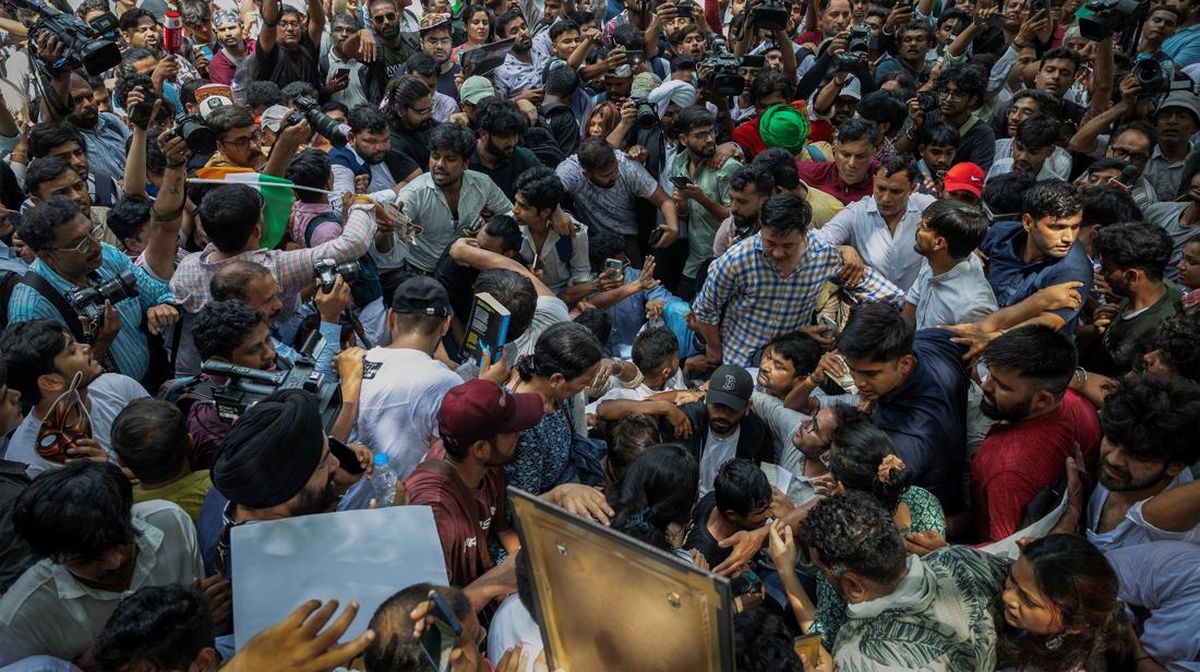
The Indian political landscape has been rocked by the sudden resignation of Union Education Minister Dharmendra Pradhan, who stepped down from his post on Saturday, July 25, following weeks of escalating student-led demonstrations and public outcry. The departure of one of the senior-most figures in Prime Minister Narendra Modi’s cabinet comes as the government struggles to contain a massive crisis surrounding the integrity of national-level examinations. The resignation was announced via the social media platform X, formerly Twitter, at a moment when New Delhi was engulfed in chaos, with security forces deploying tear gas and batons to disperse thousands of protesters marching toward the heart of the capital’s administrative district.
In his official statement, Pradhan cited the need to maintain national stability and prevent "anti-national forces" from exploiting the grievances of the youth. "Observing the situation unfolding at Jantar Mantar and across the country, and to ensure that anti-national elements do not take advantage of this atmosphere, I have submitted my resignation to Prime Minister Narendra Modi," Pradhan wrote. His decision marks a significant blow to the Bharatiya Janata Party (BJP)-led administration, which is currently navigating the early stages of its third consecutive term under the shadow of what critics call the worst academic crisis in India’s modern history.
The resignation is the culmination of a month-long saga involving high-profile leaks of question papers, technical failures in digital testing centers, and the eleventh-hour cancellation of several major competitive exams. These incidents have affected millions of students who compete for limited seats in medical, engineering, and civil service programs—exams that are often seen as the only pathway to socio-economic mobility for India’s middle and lower classes.
The Catalyst: A Summer of Academic Scandals
The unrest began in late May when reports surfaced regarding irregularities in the National Eligibility cum Entrance Test (NEET), the primary gateway for medical aspirants in India. Allegations of "grace marks" being awarded unfairly, coupled with evidence of leaked papers being sold on the dark web and messaging apps like Telegram, triggered initial protests. This was followed by the cancellation of the University Grants Commission-National Eligibility Test (UGC-NET), an exam critical for teaching positions and research fellowships, just 24 hours after it was conducted, due to "compromised integrity."
For the Indian youth, these were not merely administrative errors but a betrayal of their hard work and future prospects. The scale of the failure is immense; in 2024 alone, over 2.4 million students appeared for the NEET-UG exam, while hundreds of thousands more participated in various NET and CSIR-conducted assessments. The recurring nature of these leaks suggests a deep-seated vulnerability within the National Testing Agency (NTA), the autonomous body responsible for conducting these high-stakes exams.
The Rise of the Cockroach Janta Party (CJP)
What distinguishes this wave of protests from previous student movements is the emergence of the "Cockroach Janta Party" (CJP). Originally conceived as a satirical social media campaign in May, the CJP quickly transformed into a legitimate political and social force. The name "Cockroach" was adopted by students as a symbol of their resilience and their feeling of being treated as pests by the bureaucratic elite. The movement used memes, viral videos, and dark humor to highlight the absurdity of the education system’s failures, eventually mobilizing tens of thousands of students across major cities like Delhi, Mumbai, Kolkata, and Hyderabad.
The CJP’s demands extend beyond the resignation of the Education Minister. They are calling for a complete overhaul of the NTA, the implementation of a decentralized testing system to prevent single points of failure, and the enactment of a "Student Rights Charter" that would provide legal recourse and financial compensation for candidates affected by exam cancellations.
Chronology of the Crisis: From Leaks to Resignation
The timeline of events leading to Dharmendra Pradhan’s resignation illustrates a rapidly deteriorating situation that the government was unable to de-escalate through standard political rhetoric:
- May 15 – June 4: Initial reports of NEET paper leaks emerge. The NTA denies any systemic failure, attributing high scores to "easier papers" and "grace marks."
- June 18: The UGC-NET exam is conducted across India.
- June 19: The Ministry of Education cancels the UGC-NET, citing inputs from the Ministry of Home Affairs regarding a potential breach of security. Protests begin in New Delhi.
- June 25 – July 10: Protests spread to state capitals. The "Cockroach Janta Party" goes viral, organizing "Thali Bajao" (plate banging) protests to gain the government’s attention.
- July 15: Sonam Wangchuk, a prominent education reformer and activist, begins a hunger strike in solidarity with the students, demanding transparency and accountability.
- July 20: Prime Minister Narendra Modi breaks his silence, promising "fast-track courts" to prosecute those involved in the paper leak mafia.
- July 22: Clashes erupt at Jantar Mantar as students attempt to breach police barricades to reach the Parliament House. Internet services are suspended in parts of Central Delhi.
- July 25: Following a 26-day fast, Sonam Wangchuk ends his hunger strike after receiving assurances of a legislative review. Simultaneously, the police use force to quell a massive march on Parliament Street.
- July 25 (Evening): Dharmendra Pradhan announces his resignation on X.
Government Response and Legal Measures
In the wake of the resignation, the Prime Minister’s Office (PMO) has moved into damage-control mode. Prime Minister Modi, in a recorded message addressed to the nation’s youth, emphasized that the government would not tolerate "merit-theft." The promised fast-track courts are expected to be established under a new ordinance aimed at curbing "organized cheating" and paper leaks. This legislation would reportedly include provisions for life imprisonment and massive fines for coaching centers and officials found complicit in such activities.
However, the opposition parties have criticized the resignation as "too little, too late." Leaders from the Congress and other regional parties have demanded a Supreme Court-monitored probe into the NTA’s functioning over the last five years. They argue that Pradhan’s resignation is a tactical move to shield the higher echelons of the government from direct accountability as the Monsoon Session of Parliament approaches.
International Human Rights and Civil Society Concerns
The heavy-handed response of the Delhi Police has drawn sharp criticism from international observers. Human Rights Watch (HRW) and Amnesty International issued statements condemning the use of "excessive force" and the suspension of mobile internet services. "The Indian government’s reliance on internet shutdowns and baton charges to silence students demanding academic integrity is a violation of the right to peaceful assembly," stated an HRW representative.
The role of Sonam Wangchuk was also pivotal. Known for his work in sustainable education in Ladakh, Wangchuk’s participation lent the movement a moral weight that transcended partisan politics. While he ended his hunger strike on the same day Pradhan resigned, he cautioned that the "battle for India’s intellectual future is far from over."
Systemic Failures and the Need for Reform
Analytical perspectives on the crisis suggest that the problem is not merely one of security, but of an overburdened and hyper-centralized system. India’s reliance on a few "mega-exams" creates a high-pressure environment where the incentive for corruption is immense. With millions of candidates vying for a few thousand seats, the "paper leak mafia" has become a multi-million dollar industry, often operating with the tacit protection of local officials.
Education experts suggest that the NTA, which was established in 2017 to bring transparency and standardization, has instead become a "black box" with little public oversight. The reliance on external vendors for digital testing centers and the lack of a robust audit trail for question paper distribution have been identified as primary technical flaws.
Broader Political and Social Implications
The resignation of Dharmendra Pradhan is likely to have long-term repercussions for the BJP’s relationship with the youth vote—a demographic that was instrumental in the party’s rise to power. The perception of a "broken system" where merit is secondary to money could alienate millions of first-time voters.
Furthermore, the "anti-national" rhetoric used by Pradhan in his resignation letter has sparked a fresh debate about the government’s tendency to label dissent as a threat to the state. By framing the student protests as a target for "anti-national exploitation," the outgoing minister has signaled that the administration may continue to view the movement through a security lens rather than a purely educational one.
As the government looks for a successor to take over the Ministry of Education, the immediate challenge will be to restore the credibility of the upcoming examination cycle. For the students still occupying Parliament Street and Jantar Mantar, the resignation is only the first step. They have made it clear that their tents will remain and their voices will stay loud until a comprehensive, transparent, and leak-proof system is codified into law. The "Cockroach" movement, it seems, has no intention of scurrying back into the shadows.
Related posts: