KPK Backs National Police Investigation into High-Level Illegal Wiretapping Scandal Involving Former Chief Listyo Sigit Prabowo

The Corruption Eradication Commission has officially expressed its full support for the Indonesian National Police in pursuing a comprehensive and transparent legal process regarding a massive illegal wiretapping and electronic data tampering scandal. The high-profile case implicates former National Police Chief General Listyo Sigit Prabowo alongside three other high-ranking senior officers. This institutional backing follows a recent disclosure by current National Police Chief General Suyudi Ario Seto during a parliamentary hearing, where he formally identified the anti-graft agency as one of the direct victims targeted by the illicit surveillance operation.
The unfolding scandal has sent shockwaves through Indonesia’s political and law enforcement landscapes, raising critical questions regarding institutional boundaries, cyber governance, privacy rights, and the abuse of state intelligence apparatuses. As investigators delve deeper into the mechanics of the operation, the implications of widespread clandestine surveillance on national governance are coming under intense public and legislative scrutiny.
Investigation Origins and the Scope of Surveillance
The depth of the illicit wiretapping operation only began to surface publicly in early November 2026, when the National Police Headquarters officially announced the criminal naming of four prime suspects. According to official police briefings, the sophisticated surveillance network went far beyond standard law enforcement parameters, systematically capturing communications across a remarkably broad cross-section of Indonesian society.
During a crucial working meeting with Commission III of the House of Representatives on November 12, 2026, National Police Chief General Suyudi Ario Seto detailed the expansive reach of the targeted individuals and entities. Investigators discovered that the wiretapping targets included the President of the Republic of Indonesia, members of the presidential palace inner circle, various government ministries and state agencies, executive branch officials, members of the House of Representatives, political party leaders, and prominent political figures. Furthermore, the net of surveillance extended to regional leaders including governors and provincial police chiefs, judicial oversight bodies such as the Attorney General’s Office, the Corruption Eradication Commission itself, internal elements of the National Police, civil society organizations, activists, and university student leaders.
Despite the vast volume of intercepted communications, investigators have stressed that these targets were not selected due to active involvement in criminal investigations. Instead, the wiretapping operation functioned as a blanket intelligence-gathering exercise directed at figures of strategic influence across the country.
Chronology of Legal Actions
and Disciplinary Proceedings
The swift progression of the investigation highlights the gravity with which the current police leadership is treating the internal security breach. The timeline of events underscores an aggressive institutional purge aimed at restoring public trust.
On November 3, 2026, and November 5, 2026, the National Police formally announced the criminal charges against four high-ranking officials. The primary suspect is former National Police Chief General Listyo Sigit Prabowo. He is joined by Inspector General AS, who served as the Head of the National Police Legal Division; Inspector General EH, a senior lecturer at the National Police Education and Training Institution; and Inspector General SU, the former Head of the National Police Information and Communications Technology Division.
While the legal proceedings moved swiftly, logistical adjustments were required regarding detentions. Out of the four primary suspects, Inspector General SU remains the sole individual who has not been detained due to serious medical complications stemming from a post-stroke condition.
Institutional accountability measures ran parallel to the criminal investigations. On November 10, 2026, the National Police convened a rigorous internal ethics tribunal specifically addressing the conduct of Inspector General AS. Following deliberations, the ethics panel handed down the maximum possible administrative penalty: dishonorable discharge from the police institution, known locally as Pemberhentian Tidak Dengan Hormat. This decisive disciplinary action signaled a zero-tolerance policy toward abuses of power that undermine the integrity of the state’s security apparatus.
Corruption Eradication Commission Response and Stance
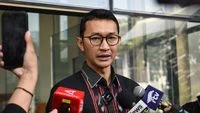
Speaking from the Merah Putih Building in Jakarta on November 12, 2026, Corruption Eradication Commission Spokesperson Budi Prasetyo articulated the agency’s official position. Addressing members of the press, Budi confirmed that the anti-graft body stands firmly behind the National Police’s ongoing criminal inquiry.
"The KPK certainly respects and supports the ongoing law enforcement process being conducted by the National Police," Budi stated, referencing initial findings from the police investigation.
Budi clarified that any surveillance or interception directed at personnel within the Corruption Eradication Commission had no connection to legitimate criminal investigations or anti-corruption probes. He reiterated explanations provided by the National Police Chief, emphasizing that the targeted individuals were chosen strictly as objects of surveillance rather than as subjects of lawful evidentiary inquiry.
Regarding the specific identities of KPK officials, leaders, or investigators who may have been compromised by the illegal wiretapping, Budi noted that the anti-graft agency has not yet received a detailed breakdown from investigators. He acknowledged that such information remains tightly held within the material scope of the active police investigation.
"We have not yet received information regarding that because, naturally, the objects allegedly subjected to wiretapping by the relevant parties fall under the realm of the investigative material," Budi explained.
Nevertheless, the Corruption Eradication Commission has expressed full confidence that the National Police will ultimately disclose the full extent of the findings to the broader public, ensuring complete transparency as the judicial process advances. Budi underscored that the agency respects the procedural authority of the police and views regular, transparent communication as vital for maintaining public confidence.
Broader Implications for National Security and Governance
The revelation that former top-tier law enforcement officials orchestrated an extensive domestic surveillance network targeting the nation’s highest-ranking leaders, lawmakers, and independent oversight bodies marks an unprecedented governance crisis in modern Indonesian history.
From an analytical perspective, the scandal underscores critical vulnerabilities in the oversight of state intelligence and telecommunications technology. The capability of senior officials to deploy clandestine wiretapping infrastructure against institutional peers and political leadership highlights potential gaps in statutory checks and balances. Effective democratic governance relies on strict institutional firewalls separating intelligence gathering from political leverage or unauthorized domestic surveillance.
Furthermore, the involvement of key pillars of the state—including the executive branch, legislative representatives, the judiciary, and anti-corruption watchdogs—creates a complex web of conflicts of interest that demands absolute independence in the judicial proceedings. The National Police’s proactive stance in exposing and prosecuting its own former leadership serves as a crucial test of institutional self-correction.
As the legal proceedings continue to unfold, experts note that the ultimate impact of the scandal will depend heavily on the transparency of the subsequent trials. Public expectations remain high for comprehensive accountability, institutional reform, and enhanced safeguards to prevent the misuse of technological surveillance capabilities by state actors in the future. The cooperative synergy currently displayed between the Corruption Eradication Commission and the National Police offers a promising framework for restoring systemic integrity as the judicial system works to deliver justice.
Related posts: