Hyundai Ioniq 6 Electric Vehicle Consumed by Fire Following High-Impact Collision in West Jakarta

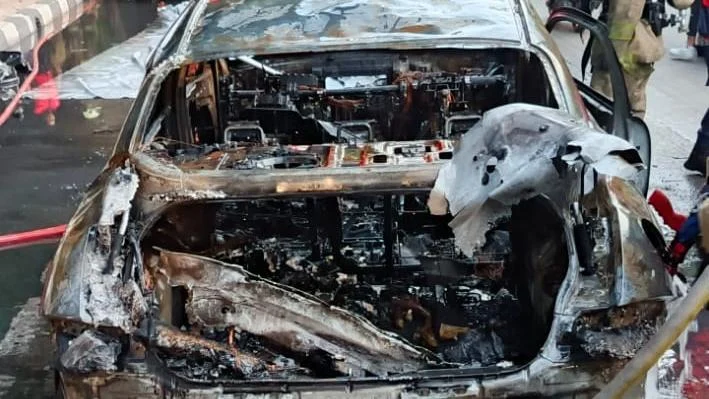
The automotive landscape in Jakarta witnessed a significant incident on Friday, September 11, when a premium electric vehicle (EV), the Hyundai Ioniq 6, was completely engulfed in flames following a high-speed collision in the Slipi district of West Jakarta. The vehicle, valued at approximately IDR 1.2 billion, reportedly struck a concrete busway separator, triggering an immediate fire that drew widespread attention to the safety profiles of modern electric mobility. While authorities confirmed that the incident resulted in no casualties, the event has reignited public discourse regarding the safety of lithium-ion battery technology in the event of severe physical impact.
Chronology of the Incident
The sequence of events began in the early hours of Friday, September 11. According to official reports from the Jakarta Barat Fire and Rescue Department (Gulkarmat), the incident occurred on Jalan Letjen S. Parman. At approximately 05:04 WIB (Western Indonesian Time), emergency dispatchers received reports of a vehicle fire involving a high-end electric sedan.
Preliminary findings by the authorities suggest that the driver lost control of the Hyundai Ioniq 6 while navigating the arterial road. The vehicle subsequently collided with the concrete busway divider at a significant velocity. It is hypothesized that the force of the impact compromised the structural integrity of the battery pack housing located beneath the chassis, leading to a short circuit and the subsequent rapid ignition of the high-voltage cells.
Emergency response teams were deployed immediately, arriving at the scene by 05:18 WIB. The operation involved three fire pump units and a team of 15 personnel. The intensity of the fire, typical of thermal runaway scenarios involving high-capacity batteries, required specialized cooling techniques to ensure full suppression. By 06:18 WIB, the fire was declared extinguished, though the vehicle itself sustained catastrophic damage, rendering it a total loss.
Driver Safety and Immediate Response
One of the most critical aspects of the incident is the survival of the occupant. According to witnesses and reports from the scene, the driver was able to evacuate the vehicle moments after the initial collision, as smoke began to billow from the undercarriage. The quick thinking of the driver prevented what could have been a tragic loss of life.
The incident caused significant logistical disruption in the West Jakarta area. Traffic flow from Slipi toward Tomang experienced severe congestion, with the NTMC (National Traffic Management Center) of the Indonesian National Police reporting persistent delays until 07:25 WIB. The presence of emergency vehicles and the need for a thorough forensic scene analysis further hindered the morning commute, underscoring the secondary impacts that such accidents have on metropolitan infrastructure.
Hyundai Indonesia’s Official Stance
PT Hyundai Motors Indonesia (HMID), the local subsidiary of the South Korean automotive giant, has moved quickly to address the incident. As the manufacturer of the vehicle, HMID is currently conducting a comprehensive internal investigation to determine the exact cause of the fire and whether any component failure contributed to the severity of the blaze.
Rouli Sijabat, the General Manager of Brand Interactive at PT HMID, confirmed on Saturday, September 12, that the investigation remains in the information-gathering phase. "There is no update yet regarding the investigation results. We are currently consolidating data and information from various stakeholders involved in the incident," Sijabat stated. The company has maintained a professional and cautious approach, refusing to speculate on the cause until a formal forensic report is finalized. This measured response is standard practice for automotive manufacturers, as they must balance transparency with the need for data-backed accuracy.
Understanding EV Battery Safety and Thermal Runaway
The incident in Slipi brings to the forefront the technical complexities of electric vehicle safety. Unlike internal combustion engine (ICE) vehicles, where fuel fires are often contained in the engine bay or fuel tank, electric vehicles utilize large lithium-ion battery packs that store significant amounts of chemical energy.

When a battery pack is physically breached during a high-speed collision, it can lead to "thermal runaway." This is a phenomenon where the internal temperature of a battery cell rises rapidly, causing the electrolyte to vaporize and combust, which then spreads heat to adjacent cells. Once a chain reaction of thermal runaway begins, it is notoriously difficult to extinguish, as the batteries carry their own oxidizer and can reignite even after the external flames appear to be suppressed.
Industry standards for EVs, such as the Hyundai Ioniq 6, include rigorous safety features, including reinforced battery casings, automatic high-voltage disconnects, and liquid cooling systems designed to prevent thermal spread. However, no vehicle is immune to the laws of physics when subjected to severe, high-velocity impact against rigid structures like concrete separators.
Broader Implications for Indonesia’s EV Adoption
Indonesia has been aggressively promoting the adoption of electric vehicles as part of its national energy transition and industrial strategy. The government has offered tax incentives, infrastructure subsidies, and development grants to boost EV ownership. However, public perception remains sensitive to reports of vehicle fires.
The fact that this incident involved a flagship model—the Ioniq 6, which is known for its aerodynamic design and advanced safety suite—serves as a reminder that the transition to sustainable transport must be accompanied by robust safety training and emergency response protocols.
- Emergency Responder Training: Fire departments worldwide are increasingly updating their training to specifically handle lithium-ion battery fires, which require significantly more water and cooling time than traditional vehicle fires. The swift response in Slipi demonstrates that local agencies are becoming more adept at managing these complex scenarios.
- Infrastructure and Safety Design: The incident also highlights the importance of road safety infrastructure. The collision with the busway separator serves as a grim case study for city planners regarding the design and placement of road barriers in high-speed lanes.
- Manufacturer Responsibility: The outcome of Hyundai’s investigation will be closely watched by consumers and regulators alike. If the investigation reveals that the vehicle’s safety systems performed as designed, it may help maintain public confidence. If, conversely, the investigation uncovers a latent defect, it could trigger a recall and necessitate a shift in how EVs are tested for crash-related battery integrity.
Data Analysis and Context
While the sight of a burning EV is alarming, statistical data suggests that electric vehicles are not inherently more fire-prone than their gasoline-powered counterparts. According to various global safety studies, the rate of fire incidents in EVs is significantly lower per capita than in ICE vehicles. However, the unique nature of lithium-ion fires—specifically the duration of the blaze and the difficulty of suppression—makes them more "visible" in the media landscape.
The Ioniq 6, which features an E-GMP (Electric-Global Modular Platform), is designed with a low center of gravity and high-strength steel reinforcements to protect the battery. The incident in Slipi serves as a baseline for understanding how these specific platforms handle extreme real-world stress. The lack of injuries in this specific instance is a testament to the safety features that allow for occupant egress during the initial stages of an emergency.
Future Outlook and Conclusion
As investigations continue, the automotive community awaits the final report from both the police and Hyundai. The focus will likely remain on whether the battery protection systems were overwhelmed by the speed of the impact or if the accident was simply a result of the extreme physical forces involved in hitting a concrete barrier at speed.
For the Indonesian market, this event serves as a pivotal moment for consumer education. It highlights the necessity for drivers to understand the specific safety profiles of their vehicles and underscores the need for continued investment in the capabilities of the Gulkarmat (Fire and Rescue Department). As Indonesia moves toward a greener future, the integration of advanced technology must be matched by a deep commitment to safety, data transparency, and proactive emergency preparedness.
The burning of the Ioniq 6 in Slipi is a sobering event, but it is also a data point that will contribute to the ongoing refinement of EV safety standards globally. As Hyundai continues its analysis, the company’s commitment to public safety and its ability to provide a clear, evidence-based explanation will be critical in maintaining the trust of the Indonesian public in the ongoing shift toward electric mobility. For now, the site of the accident has been cleared, traffic has resumed, and the industry watches closely as the investigation moves toward its conclusion.