Hajime Moriyasu Confirms Departure from Japan National Team After 2027 AFC Asian Cup, Paving Way for New Era

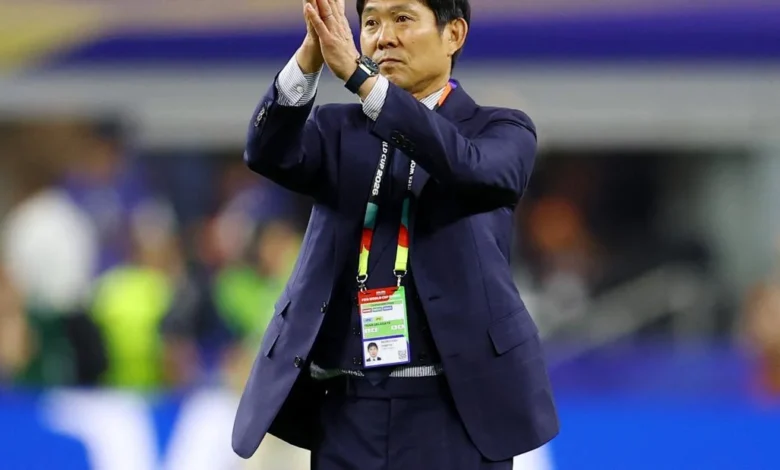
Jakarta, Indonesia – Hajime Moriyasu, the esteemed head coach of the Japan National Football Team, commonly known as the Samurai Blue, is set to conclude his tenure following the conclusion of the AFC Asian Cup in 2027. The announcement marks a significant juncture for Japanese football, initiating a carefully planned transition after nearly a decade under Moriyasu’s leadership, a period characterized by remarkable highs on the global stage and persistent challenges within continental competition. His departure is anticipated to usher in a new era, with U-23 national team coach Go Oiwa widely tipped as his successor, indicating a strategic continuity within the Japan Football Association’s (JFA) long-term vision.
Moriyasu, who assumed the helm after the 2018 FIFA World Cup, has overseen a transformative period for Japanese football, guiding the Samurai Blue through 108 international matches and cementing their status as a formidable force both in Asia and on the world stage. His legacy will be defined by an impressive record of tactical innovation, player development, and memorable victories, particularly at the 2022 FIFA World Cup in Qatar.
A Tenure Defined by Resilience and Global Recognition
Hajime Moriyasu’s journey with the Samurai Blue began in July 2018, following the resignation of Akira Nishino, who had led Japan to the Round of 16 at the World Cup in Russia. Moriyasu, a former national team player and successful club coach with Sanfrecce Hiroshima, was appointed with a clear mandate: to build on the existing foundation, integrate new talent, and elevate Japan’s competitiveness globally. His appointment was a testament to the JFA’s philosophy of promoting coaches who understand the unique dynamics and development pathways of Japanese football.
One of his immediate challenges was the AFC Asian Cup 2019, held just months into his tenure. Despite assembling a relatively young squad, Moriyasu guided Japan to the final, demonstrating his ability to quickly instill his tactical principles. The team displayed defensive solidity and clinical counter-attacking, overcoming strong opponents before ultimately falling to a formidable Qatar side 1-3 in the championship match. While a defeat, the run to the final signaled a promising start and validated the JFA’s faith in Moriyasu’s vision.
The subsequent period saw Moriyasu meticulously preparing the team for the arduous 2022 FIFA World Cup qualification campaign. Navigating the challenging AFC qualifiers, Japan showcased consistency and depth, securing their spot in Qatar with relative ease. This qualification was a crucial milestone, maintaining Japan’s unbroken streak of World Cup appearances since 1998.
The Qatar 2022 Odyssey: Triumphs and Heartbreak
The 2022 FIFA World Cup in Qatar stands as the pinnacle of Moriyasu’s coaching career to date. Placed in a daunting "Group of Death" alongside football giants Germany and Spain, expectations for Japan were modest outside their home nation. However, under Moriyasu’s astute guidance, the Samurai Blue delivered two of the tournament’s most stunning upsets. Employing a disciplined defensive structure and lethal counter-attacks, Japan sensationally defeated four-time champions Germany 2-1 in their opening match, followed by an equally historic 2-1 victory over 2010 champions Spain. These victories, both achieved after falling behind, showcased the team’s mental fortitude, tactical flexibility, and Moriyasu’s ability to motivate his players to perform against the world’s elite.
The dramatic group stage performance saw Japan top Group E, setting up a Round of 16 clash against Croatia, the 2018 World Cup finalists. In a tightly contested match, Japan took the lead but were eventually pegged back, with the game going to extra time and ultimately a penalty shootout. Despite a valiant effort, Japan succumbed to Croatia, exiting the tournament at the Round of 16 stage for the second consecutive time. While the exit was heartbreaking, the team’s performance captivated the world and earned unprecedented praise, solidifying Moriyasu’s reputation as a coach capable of extracting peak performances from his squad on the biggest stage. The campaign also saw the emergence of several Japanese talents onto the global stage, including Kaoru Mitoma, Takefusa Kubo, Ritsu Doan, and Wataru Endo, whose development Moriyasu meticulously fostered.
Post-World Cup Momentum and Continental Setbacks
Following the 2022 World Cup, Moriyasu committed to leading Japan through the 2026 World Cup cycle. The team entered a period of exceptional form in friendly matches, particularly against European opposition. Since 2022, Japan has maintained an impressive unbeaten streak against European teams, including commanding victories over Germany (4-1 in September 2023), Turkey (4-2 in September 2023), and a draw against Spain (in the World Cup). This run highlighted Japan’s continued growth and their ability to compete consistently at the highest level, fostering genuine excitement for future tournaments. Victories against South American powerhouses like Peru (4-1) and Canada (4-1) further underscored their dominant form.
However, the 2023 AFC Asian Cup (held in early 2024) presented a different narrative. Entering the tournament as overwhelming favorites and the highest-ranked Asian team, Japan was widely expected to reclaim the continental crown. Despite a strong start, their campaign was marred by defensive vulnerabilities and a surprising loss to Iraq in the group stage. They progressed to the knockout rounds but ultimately crashed out in the quarterfinals, losing 1-2 to arch-rivals Iran. This early exit was a significant disappointment and drew considerable criticism, contrasting sharply with the euphoria of the World Cup just over a year prior. It exposed a perceived tactical rigidity and an inability to adapt when facing robust, physical opponents within Asia, raising questions about Moriyasu’s continental tournament strategy.
The Road Ahead: 2026 World Cup and 2027 Asian Cup
Moriyasu’s contract extension through the 2026 FIFA World Cup qualification campaign and the 2027 AFC Asian Cup signifies the JFA’s commitment to a structured transition. Japan is currently navigating the second round of the AFC qualifiers for the 2026 World Cup, where they are placed in Group B alongside North Korea, Syria, and Myanmar. Their strong start has positioned them favorably for progression to the next stage. The 2027 AFC Asian Cup, for which qualification is integrated with the World Cup qualifiers, will be held in Saudi Arabia. Moriyasu’s final tournament will be an opportunity for him to leave on a high note, aiming to secure the continental title that has eluded him.
Succession Planning: The Rise of Go Oiwa
The JFA’s proactive announcement of Moriyasu’s departure timeline allows for a seamless leadership transition, a hallmark of Japanese football’s meticulous planning. Go Oiwa, the current head coach of Japan’s U-23 national team, has been identified as the leading candidate to succeed Moriyasu. Oiwa, who has been at the helm of the U-23 squad since 2021, brings a wealth of experience within the JFA’s coaching structure. His work with the youth teams has been instrumental in nurturing the next generation of Japanese talent, and his promotion would align perfectly with the JFA’s strategy of developing and promoting coaches from within its ranks.
Oiwa’s tenure with the U-23 team has been marked by a focus on technical proficiency, tactical discipline, and a strong understanding of the JFA’s overarching football philosophy. His potential appointment signals a desire for continuity in playing style and developmental pathways, ensuring that the senior national team benefits from a consistent flow of talent and a coherent tactical identity. His experience in preparing young players for international competition will be invaluable as he steps into the demanding role of national team head coach.
Broader Implications for Japanese Football
The impending coaching change carries significant implications for Japanese football. On one hand, it represents a natural progression and an opportunity for fresh ideas and renewed impetus. A new coach like Go Oiwa could bring different tactical nuances and player selections, potentially unlocking new dimensions for the Samurai Blue. This strategic shift could re-energize the squad and provide a new perspective for the challenges ahead, particularly as Japan seeks to break through the Round of 16 barrier at the World Cup and reclaim Asian dominance.
On the other hand, Moriyasu’s departure will leave a significant void. His deep understanding of Japanese football culture, his ability to manage a diverse squad of domestic and European-based players, and his proven track record of delivering historic World Cup performances will be difficult to replicate. The transition period will undoubtedly bring its own set of challenges, including adapting to a new coaching philosophy and maintaining the team’s high performance standards. The JFA’s decision to announce the timeline well in advance suggests a desire to minimize disruption and allow for a smooth handover, ensuring that the team’s preparations for critical tournaments remain on track.
The legacy of Hajime Moriyasu will be a complex but ultimately positive one. He will be remembered as the coach who orchestrated Japan’s most celebrated World Cup campaign, delivering stunning victories over footballing giants and showcasing the technical prowess and tactical intelligence of Japanese players to a global audience. While the Asian Cup titles eluded him, his tenure established Japan as a consistent presence in the global top 20 and a formidable opponent for any nation. His impact on player development and the strategic direction of the national team will resonate for years to come. As the Samurai Blue prepare for the final chapters of the Moriyasu era, the focus remains firmly on the immediate objectives: securing qualification for the 2026 World Cup and striving for continental glory at the 2027 AFC Asian Cup, before a new leader steps forward to guide Japan into its next exciting chapter.
Related posts: