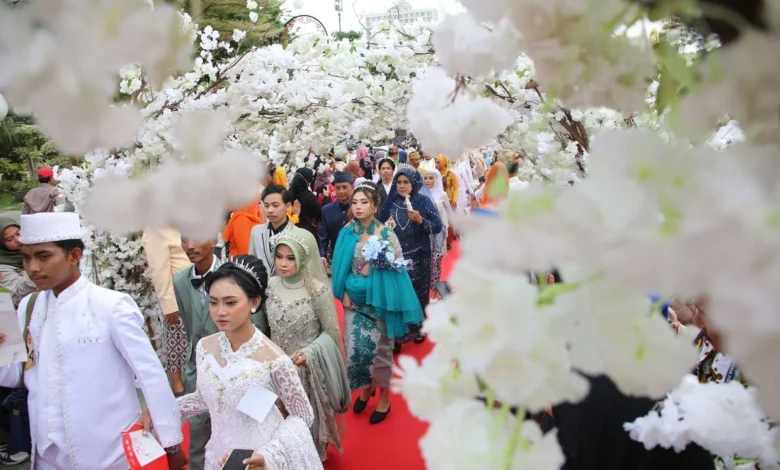
In the Indonesian context, where marriage is both a profound religious milestone and a significant civil event overseen by the Ministry of Religious Affairs, these prayers are often recited by the penghulu (marriage official), family members, and invited guests. The act of praying for the couple is considered a highly recommended Sunnah of Prophet Muhammad SAW. It serves as a collective expression of hope that the husband and wife will achieve a state of sakinah (tranquility), mawaddah (love), and warahmah (mercy)—the three core tenets of a successful Islamic marriage.
The Prophetic Foundation of Post-Marriage Supplication
The most widely recognized and authentic prayer for the newlyweds, as derived from the Hadith of Prophet Muhammad SAW, is a concise yet comprehensive invocation for divine favor. The prayer, which has been passed down through generations of scholars, is: Bārakallāhu laka wa bāraka ‘alaika wa jama’a bainakumā fī khair. This translates to: "May Allah provide blessings to you, bestow blessings upon you, and gather both of you in goodness."
The theological weight of this specific prayer is immense. According to historical records and the narrations of Abu Hurairah RA, whenever the Prophet SAW offered congratulations to someone who had just married, he would unfailingly recite these words. This tradition is documented in several major collections of Hadith, including Abu Dawud (No. 2130), At-Tirmidzi (No. 1091), and Ibnu Majah (No. 1905). Imam At-Tirmidzi categorized this Hadith as hasan sahih (good and authentic), solidifying its status as the primary recommendation for Muslims when greeting a new couple.
Linguistically, the prayer covers two distinct types of blessings. The phrase "Bārakallāhu laka" refers to blessings in moments of ease and happiness, while "wa bāraka ‘alaika" refers to blessings during times of hardship or challenge. By reciting this, the community asks God to ensure that the couple remains blessed regardless of the external circumstances they may face, emphasizing that "goodness" (khair) is the ultimate goal of their union.
The Husband’s First Spiritual Act: A Prayer for the Wife
Beyond the communal prayers offered by guests, Islam prescribes a specific spiritual protocol for the husband immediately following the akad nikah. This act symbolizes the husband’s role as the spiritual protector and leader of the household. It is highly recommended for the husband to place his hand gently upon his wife’s forehead (the ubun-ubun) and recite a specific supplication.
The prayer is as follows: Allāhumma innī as’aluka min khairihā wa khairi mā jabaltahā ‘alaihi, wa a’ūdzu bika min syarriha wa syarri mā jabaltahā ‘alaihi. This translates to: "O Allah, I ask You for her goodness and the goodness of the nature upon which You created her. And I seek refuge in You from her evil and the evil of the nature upon which You created her."
This prayer, sourced from a Hadith narrated by Abu Dawud, is often misunderstood by those unfamiliar with Islamic semantics. Scholars clarify that "evil" in this context does not imply that the wife is inherently bad; rather, it refers to the human frailties, temperaments, or trials that can arise in any interpersonal relationship. By reciting this, the husband acknowledges that both the strengths and weaknesses of his partner are within God’s decree, and he asks for the wisdom to navigate the complexities of marriage with patience and grace.
Historical Evolution: From Jahiliyyah Greetings to Islamic Blessings
The introduction of these specific prayers by Prophet Muhammad SAW represented a significant cultural and theological shift in the Arabian Peninsula. Prior to the advent of Islam, during the era of Jahiliyyah (the Age of Ignorance), the common greeting for newlyweds was "May you live in harmony and have many sons."
While seemingly well-intentioned, Islamic scholars point out that the Jahiliyyah greeting was limited to worldly desires and patriarchal preferences. It focused solely on the absence of conflict and the production of male heirs. In contrast, the Prophetic prayers introduced the concept of Barakah (divine blessing). Barakah is defined as the "attachment of divine goodness to a thing," meaning that even a small amount of wealth or a simple life can bring immense satisfaction and spiritual growth if it is blessed by God. By replacing the old greetings with these prayers, Islam shifted the focus of marriage from a mere social contract to a spiritual journey aimed at the hereafter.
The Administrative and Social Context in Modern Indonesia
In Indonesia, the marriage process is deeply integrated with the state apparatus through the Office of Religious Affairs (KUA). Data from the Central Bureau of Statistics (BPS) indicates that while marriage rates have seen a slight fluctuation in recent years—averaging between 1.5 million to 1.8 million marriages annually—the cultural importance of the akad nikah remains unwavering.
The Ministry of Religious Affairs (Kemenag) has recently placed a renewed emphasis on the role of the penghulu. Traditionally seen as mere administrative officials who record the marriage, penghulu are now being trained to act as marriage counselors and spiritual guides. This initiative aims to strengthen "Family Resilience" (Ketahanan Keluarga) across the archipelago. The recitation of post-marriage prayers is a standard part of the official ceremony conducted by the KUA, serving as a moment of solemnity that bridges the gap between the legal signing of documents and the beginning of a shared life.
Furthermore, the Kemenag has streamlined the process for akad nikah, allowing couples to hold ceremonies outside of the KUA office and outside of standard working hours, provided they follow specific administrative protocols. This flexibility has ensured that the spiritual traditions of the marriage contract can be observed in various settings, from humble homes to large traditional halls, without losing their religious essence.
Analysis of Implications: Prayer as a Foundation for Family Resilience
The emphasis on prayer after the akad nikah has profound implications for the stability of the family unit. In a modern era characterized by high divorce rates and social pressures, these prayers serve as a psychological and spiritual anchor.
- Psychological Preparation: The prayers remind the couple that they are not alone in their journey. By invoking the Divine, they acknowledge that the success of their marriage depends on factors beyond their control, fostering a sense of humility and mutual reliance.
- Conflict Resolution: The phrase "gather both of you in goodness" acts as a perpetual reminder for couples during disputes. It encourages them to return to the "goodness" that was prayed for at the start of their union.
- Community Support: When guests recite these prayers, it reinforces the social contract. The community is not just witnessing a legal event; they are actively petitioning for the success of the new family, which strengthens the social fabric of the Ummah (community).
The Ministry of Religious Affairs continues to advocate for the KUA to become the "main node" for family resilience. By integrating these spiritual practices with pre-marriage counseling (Bimwin), the state hopes to reduce domestic issues and promote the formation of households that are not only legally valid but also spiritually robust.
Conclusion: The Holistic View of Marriage in Islam
The prayers following the akad nikah are far more than ceremonial utterances; they are a distillation of the Islamic philosophy of life. They emphasize that marriage is a multi-dimensional union—legal, social, and, most importantly, spiritual. By seeking Barakah, the couple is asking for a quality of life that transcends material wealth or fleeting emotions.
As couples move forward from their wedding day, they are encouraged to maintain the spirit of these prayers through daily gratitude, effective communication, and the fulfillment of their respective rights and obligations. In doing so, the goal of creating a family that is sakinah, mawaddah, wa rahmah becomes a tangible reality rather than just a traditional aspiration. Through the preservation of these Prophetic traditions, the modern Indonesian Muslim community continues to uphold the sanctity of marriage as a cornerstone of a healthy and virtuous society.