Kawasaki Expands Personal Mobility Frontiers with Hydrogen-Powered Robotic Quadruped Corleo Set for EICMA 2026 Debut

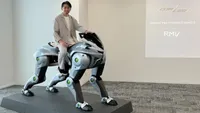
The global automotive and motorcycle landscape is on the brink of a profound paradigm shift, and heavy industry giants are increasingly looking beyond traditional internal combustion engines and conventional wheels. Japanese engineering conglomerate Kawasaki Heavy Industries has announced a groundbreaking addition to its upcoming showcase at the Esposizione Internazionale Ciclo Motociclo e Accessori (EICMA) 2026 in Milan, Italy. The manufacturer is set to present a full-scale replica of the Corleo, an ambitious, four-legged robotic personal mobility vehicle that riders mount and control in a manner akin to horseback riding.
This futuristic machine represents a bold intersection of advanced quadruped robotics, sustainable hydrogen power, and recreational mobility. Positioned inside Hall 11 at booth N46 during the prestigious six-day exhibition running from November 3 to November 8, 2026, at the Fiera Milano Rho complex, the Corleo exhibition will feature dedicated staff dispatched directly from Japan to engage with international media, industry analysts, and curious enthusiasts. While the model on display will be a meticulously crafted full-scale replica rather than a functional prototype unit, its presence signals a strategic pivot in how Kawasaki envisions the future of off-road and personal transportation.
Beyond the robotic quadruped, Kawasaki’s expansive exhibition space will house a comprehensive lineup of its latest motorcycle releases and established production models for the 2027 market year. However, industry observers note that the Corleo has effortlessly stolen the pre-show spotlight, serving as a physical manifestation of Kawasaki’s aggressive strategy to diversify personal mobility solutions far beyond traditional two-wheeled gasoline-powered motorcycles.
Engineering and Mechanical Mechanics of the Corleo
To understand the engineering marvel behind the Corleo, one must examine how Kawasaki has managed to merge two vastly different technological domains: multi-legged robotic platforms designed for complex, unstructured terrains and the ergonomic control principles refined through decades of motorcycle development.
Industry reports and official corporate disclosures outline that the Corleo is classified as a multi-legged robotic personal mobility vehicle. Unlike traditional wheeled or tracked vehicles that struggle with extreme gradients, loose debris, or delicate natural topographies, a quadruped architecture offers unmatched off-road adaptability. The vehicle mimics the biological agility of four-legged animals, allowing it to navigate boulder fields, steep inclines, and dense forested paths with minimal ecological disruption.
Operating the Corleo departs entirely from traditional throttle-and-handlebar configurations. Instead, the rider mounts the robotic chassis and steers the vehicle through body weight distribution—shifting center of gravity left, right, forward, or backward—closely mirroring the nuanced synergy required when horseback riding or executing precise motorcycle body-steering maneuvers.
Powering this mechanical beast is an innovative 150 cc hydrogen internal combustion engine functioning as an onboard generator. Rather than driving the legs mechanically through a conventional transmission, the compact hydrogen engine generates electrical energy to power the sophisticated actuators of the robotic limbs. Hydrogen fuel is safely pressurized and stored within specialized storage tanks integrated into the rear section of the chassis. This configuration allows Kawasaki to leverage zero-emission technology while maintaining the high power density required for demanding off-road excursions.
Adding to its high-tech capabilities, Kawasaki is engineering a specialized navigation and environmental monitoring system tailored specifically for the Corleo. The integrated software suite is designed to detect real-time meteorological shifts, ambient temperature fluctuations, surface terrain conditions, and the presence of regional wildlife. Vital telemetry and environmental warnings will be seamlessly projected onto a clean instrument panel as well as synchronized smart devices carried by the rider, ensuring a harmonious balance between human exploration and environmental awareness.
The Genesis of the Project and the Safe Adventure Vision
The inception of the Corleo is not merely a styling exercise or a futuristic concept born from a speculative design studio; it is the culmination of a deliberate corporate venture. The project is spearheaded by Kawasaki’s dedicated Safe Adventure Business Development team—a specialized internal division that reports directly to the highest levels of corporate leadership, specifically to the President of Kawasaki Heavy Industries.
The overarching philosophy of the Safe Adventure initiative is to pioneer technologies that enable outdoor enthusiasts to safely access and enjoy mountainous and remote regions while maintaining a posture of profound respect for nature. This niche yet vital concept directly supports the three foundational pillars of the expansive Kawasaki Group Vision 2030:
- Establishing a safe, secure, and remotely connected society through technological integration.
- Pioneering next-generation personal and industrial mobility solutions.
- Delivering sustainable energy and environmental solutions that accelerate global decarbonization.
By introducing the Corleo, Kawasaki aims to demonstrate a tangible blueprint for a future where hydrogen-powered personal mobility seamlessly integrates into daily recreational life, transforming how humanity interacts with untamed wilderness.
Chronology of the EICMA 2026 Exhibition and Corporate Rollout
The timeline leading up to the EICMA 2026 debut highlights the calculated, long-term trajectory of Kawasaki’s advanced mobility strategy:
- Late October 2026: Kawasaki releases preliminary technical disclosures regarding the Corleo project, detailing its hydrogen power source, quadruped locomotion, and body-steering control dynamics. Simultaneously, automotive and motorcycle trade publications, including Visordown, break comprehensive analytical pieces on October 28 and 29, introducing the global public to the robotic mount.
- November 3, 2026: EICMA 2026 officially opens its doors to press and trade professionals at the Fiera Milano Rho exhibition center in Milan. Kawasaki welcomes global media to Hall 11, booth N46, where Japanese engineering specialists stand ready to field inquiries about the Corleo replica and the brand’s 2027 motorcycle catalog.
- November 3 – 8, 2026: The six-day public exhibition runs in Milan, serving as the primary global testing ground for public reception and industry critique of Kawasaki’s radical mobility concept.
- Horizon 2035: Kawasaki targets full commercialization and market-ready deployment of the Corleo ecosystem, allowing nearly a decade for hydrogen infrastructure maturation, regulatory framework adaptation, and rigorous safety testing in harsh alpine environments.
Leadership Perspectives and Industry Implications
The unveiling of a hydrogen-powered robotic horse has generated intense discussion among automotive analysts, environmental scientists, and powersports enthusiasts alike. As traditional automotive markets face stringent emission regulations and a consumer base increasingly demanding sustainable alternatives, legacy manufacturers are under immense pressure to innovate beyond conventional electric battery vehicles (BEVs).
Shigemi Tanaka, Managing Director of Kawasaki Motors Europe, emphasized the profound significance of the project in official corporate statements. "Corleo is a prime example not only of the depth of our unique technical, industrial, and environmental experience across the entire company, but also of our drive toward a carbon-neutral future—a future that embraces personal freedom through the concept of Safe Adventure," Tanaka stated. He further expressed high enthusiasm for the upcoming Milan showcase, noting, "We hope that, in addition to viewing all of our 2027 motorcycle models and our current range, visitors will be as fascinated and excited by Corleo as we are."
The broader implications of the Corleo project extend far beyond recreational tourism. From an engineering standpoint, the fusion of hydrogen generation with multi-legged robotics paves the way for industrial applications in sectors such as search and rescue, remote geological surveying, forestry management, and agricultural monitoring in rugged terrains where wheeled vehicles fail.
Furthermore, by championing hydrogen internal combustion technology rather than relying exclusively on battery-electric systems, Kawasaki is making a calculated bet on the versatility of hydrogen. Hydrogen fuel cells and internal combustion engines offer rapid refueling capabilities and consistent performance in extreme sub-zero temperatures—two critical challenges that continue to plague conventional lithium-ion battery packs in high-altitude, remote environments.
As the doors of EICMA 2026 prepare to swing open in Milan, the automotive world will be watching closely. While full commercial realization remains slated for the mid-2030s, the Corleo stands as a testament to human ingenuity, proving that the future of mobility does not have to abandon the emotional connection of riding; rather, it can evolve to conquer new frontiers while respecting the delicate balance of the natural world.