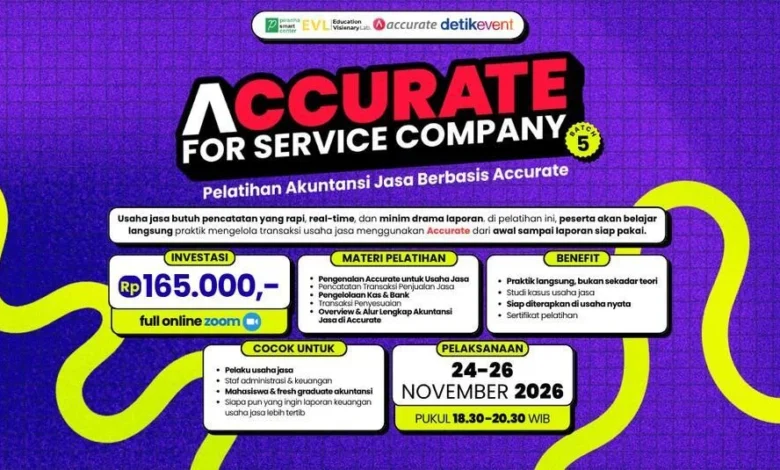
As the Indonesian business landscape becomes increasingly digitized, the demand for streamlined, automated accounting systems has surged. Accurate, a widely utilized accounting software in the region, serves as the backbone for many small-to-medium enterprises (SMEs) looking to modernize their financial reporting. The upcoming fifth batch of the training program, titled ACCURATE FOR SERVICE COMPANY, is designed to address the specific complexities inherent in service accounting, offering participants a hands-on approach to managing everything from client invoicing to complex bank reconciliations.
The Critical Role of Financial Transparency in Service Businesses
In the service sector, profitability is inextricably linked to the efficiency of time and resource allocation. A consultancy, a law firm, or a creative agency does not sell physical inventory; they sell expertise and time. Consequently, the primary "cost of goods sold" is often labor. Effective financial management in this context requires the ability to map revenue to specific projects and correlate operational expenses with service delivery milestones.
Financial experts emphasize that the primary pitfall for service businesses is the commingling of personal and professional expenses or the failure to track accounts receivable effectively. In a fast-paced market, a company that cannot generate an accurate profit-and-loss statement in real-time risks making strategic decisions based on incomplete data. By leveraging software like Accurate, business owners can move away from manual spreadsheets—which are prone to human error—toward a cloud-based or integrated system that provides real-time visibility into the firm’s liquidity.
Curriculum Overview: From Basic Transactions to Strategic Reporting
The Batch 5 training program is structured to guide participants through a logical progression of financial tasks. The curriculum begins with the fundamental setup of the software, tailored specifically for service-based workflows. This includes configuring the chart of accounts to reflect service categories, setting up customer databases, and establishing tax compliance protocols.
Following the initial setup, the training transitions into the operational phase, covering:
- Revenue Recognition: How to correctly log service sales and manage recurring invoices.
- Expense Management: Techniques for tracking operational costs, including employee payroll, utility overheads, and third-party service provider payments.
- Bank and Cash Reconciliation: Ensuring that every transaction logged in the software aligns perfectly with the physical bank statements to prevent discrepancies.
- Adjusting Entries: Addressing accruals, prepayments, and depreciation, which are vital for maintaining an accurate financial position at the end of every quarter.
The ultimate objective of the program is to empower attendees to generate standardized financial reports, including balance sheets, income statements, and cash flow analysis. These documents are not merely regulatory requirements; they are essential tools for securing bank loans, attracting investors, and planning for organizational growth.
Data and Trends in Digital Accounting Adoption
The shift toward accounting automation is supported by significant industry trends. According to various fintech reports, businesses that transition from manual bookkeeping to automated accounting software observe a 30% to 50% reduction in time spent on administrative tasks. In Indonesia, the digital transformation of SMEs has been a priority for the government, aimed at increasing the survival rate of new businesses.
Research indicates that nearly 60% of small business failures are linked to poor financial management. By implementing professional-grade tools like Accurate, companies are better positioned to monitor their "burn rate" and manage working capital. The Batch 5 training serves as a critical bridge, helping professionals bridge the gap between theoretical accounting knowledge and practical, software-based execution.
Professional Perspectives and Industry Impact
Industry observers and accounting professionals have noted that the adoption of standardized software significantly improves audit readiness. When a company uses a system like Accurate, the trail of financial data is transparent and traceable. This is particularly important for service companies that may be subject to tax audits or those seeking certification for international quality standards.
"The primary value of such training programs is the standardization of financial language," says a representative familiar with the program’s development. "When a company adopts a systematic approach to accounting, it creates a common ground for stakeholders, from the accountant to the CEO, to discuss the company’s trajectory."
Furthermore, as the service industry continues to evolve with remote work and gig-economy integration, the need for robust financial tracking has never been higher. The ability to generate reports that detail revenue per project or service line allows business owners to identify which services are the most profitable and which might be draining resources unnecessarily.
Chronology and Event Structure
The "Accurate for Service Company" program is conducted in a series of batches, ensuring that each group of participants receives personalized attention. The Batch 5 iteration focuses on:
- Pre-Training Assessment: Participants are invited to identify their current pain points in financial management.
- Intensive Workshop Sessions: A multi-day format where theory is immediately followed by software simulation.
- Simulation Exercises: Using real-world scenarios, attendees process a month’s worth of financial data, culminating in the closing of the books.
- Post-Training Support: Access to resources and community networks to troubleshoot implementation challenges once the participant returns to their respective organizations.
This structured timeline ensures that the learning process is not overwhelming and that the knowledge is retained and applied immediately upon the completion of the program.
Broader Implications for the Business Ecosystem
The broader impact of these training initiatives extends beyond individual companies. As more businesses adopt disciplined accounting practices, the overall financial health of the sector improves. Accurate financial reporting contributes to a more transparent economy, where data-driven decision-making becomes the standard rather than the exception.
For professionals, completing this training represents a significant enhancement in their skill set. In an era where data literacy is a key competency, the ability to operate sophisticated accounting software is a highly sought-after skill. Whether for a small business owner aiming to gain autonomy over their firm’s finances or an accounting staffer looking to specialize in the service sector, this training provides tangible, career-enhancing benefits.
Preparing for the Future of Financial Management
As the regulatory environment in Indonesia continues to refine tax laws and financial reporting requirements, the reliance on reliable, updated software becomes mandatory. The Batch 5 training does not only cover software mechanics but also touches upon the importance of compliance, ensuring that participants understand the tax implications of the transactions they record.
Participants interested in joining the Batch 5 program are encouraged to review the official syllabus and register through the designated portal at detikevent.com. The registration process is designed to accommodate various levels of expertise, from beginners with limited accounting backgrounds to professionals looking to refine their skills in digital financial management.
By investing time in mastering these tools, businesses are essentially purchasing insurance against the volatility of the market. A clear, accurate, and organized set of books is the first step toward long-term sustainability and growth. In the competitive landscape of modern services, where speed and precision are the primary drivers of success, the mastery of accounting software is no longer a luxury—it is a fundamental business necessity.
In conclusion, the ACCURATE FOR SERVICE COMPANY training represents a concerted effort to professionalize financial management within the service sector. By providing a comprehensive curriculum that covers both the "why" and the "how" of financial reporting, the program ensures that attendees leave with the confidence and the competence to handle their firm’s finances with accuracy and strategic foresight. As digital transformation continues to reshape industries, those who master these tools will undoubtedly lead the way in operational efficiency and economic resilience.