Pertamina Patra Niaga and BYD Motor Indonesia Collaborate to Pilot Flash Charging Technology at Green Energy Stations

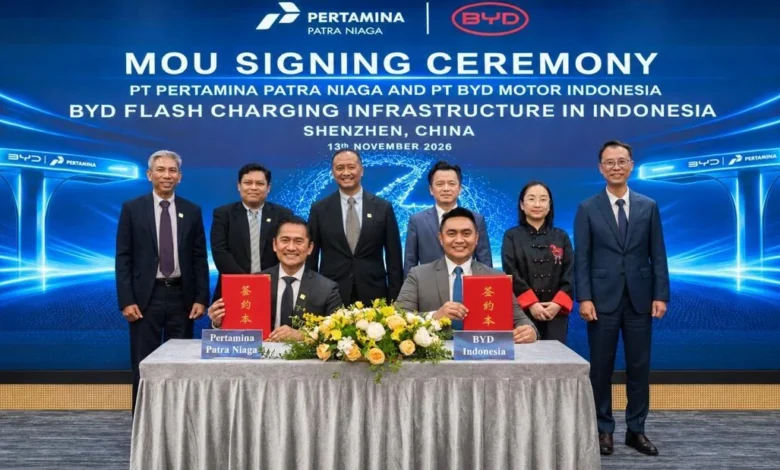
In a significant move to accelerate the electrification of Indonesia’s transportation sector, PT Pertamina Patra Niaga has officially entered into a strategic Memorandum of Understanding (MoU) with BYD Motor Indonesia. The agreement, signed on November 13, 2026, in Shenzhen, China, signals a collaborative effort to explore the integration of BYD’s proprietary "Flash Charger" technology into Pertamina’s existing network of Green Energy Stations (GES). This partnership marks a pivotal shift in how the state-owned energy giant plans to scale its electric vehicle (EV) infrastructure, focusing on rapid charging capabilities to address one of the primary consumer pain points in the transition to sustainable mobility.
The delegation, which included senior representatives from both organizations, visited the BYD facility in Shenzhen to conduct technical evaluations of the Flash Charger technology. This site visit served as a precursor to the formal signing ceremony, providing the Pertamina team with firsthand insights into the efficacy, safety standards, and operational scalability of BYD’s high-speed charging infrastructure.
Chronology of the Strategic Partnership
The collaboration between these two industry titans did not occur in a vacuum; it is the culmination of months of behind-the-scenes discussions aimed at aligning Pertamina’s infrastructure capabilities with BYD’s advanced hardware. The timeline of this initiative reflects a deliberate approach to market entry and technological validation:
- Early 2026: Preliminary discussions regarding infrastructure gaps in Indonesia’s EV ecosystem were held between industry stakeholders and the Ministry of Energy and Mineral Resources.
- Q2 2026: Pertamina identified the need for "Flash" or ultra-fast charging technology to complement its existing network of standard and fast-charging points at Green Energy Stations.
- Q3 2026: Formal negotiations between Pertamina Patra Niaga and BYD Motor Indonesia commenced, focusing on technical feasibility and the potential for a pilot project.
- November 13, 2026: The official MoU was signed in Shenzhen, China, solidifying the commitment to a pilot project.
- November 14, 2026: Public announcement of the partnership, outlining the vision for an integrated, low-carbon mobility network.
The Role of Green Energy Stations (GES)
Pertamina’s Green Energy Station (GES) initiative is the backbone of the company’s energy transition strategy. Unlike traditional gas stations, GES locations are designed to provide a hybrid energy experience, incorporating solar power, battery swapping stations for electric two-wheelers, and charging infrastructure for four-wheeled electric vehicles.
Currently, the challenge for most EV owners in Indonesia remains the "range anxiety" and the time required for a full charge. Conventional DC fast chargers often take between 45 minutes to an hour to reach an 80% charge. BYD’s Flash Charging technology aims to significantly reduce this downtime. By integrating these units into the high-traffic GES locations, Pertamina intends to transform the user experience, making the transition from internal combustion engines to electric powertrains seamless and efficient.
Official Perspectives and Strategic Objectives
Agung Wicaksono, Director of Business Transformation and Sustainability at PT Pertamina (Persero), emphasized that the collaboration is not merely about installing hardware but about building a robust ecosystem. "The pilot project for Flash Charging is a critical first step. Our objective is to prove that this technology can handle the specific demands of the Indonesian climate and traffic patterns while providing a reliable service to our customers," Agung stated during the announcement.
From the perspective of BYD, the partnership is a strategic maneuver to cement its position in the Indonesian market. Eagle Zhao, President Director of PT BYD Motor Indonesia, noted that the company’s expertise in EV technology is perfectly complemented by Pertamina’s extensive geographical reach. "By leveraging our Flash Charging technology within the Pertamina network, we are effectively removing one of the biggest hurdles to EV adoption in Indonesia. We are looking to create a future where charging an EV is as quick and convenient as refueling a petrol-powered vehicle," Zhao remarked.
Kitty Andhora, VP of Corporate Communication at Pertamina Patra Niaga, highlighted the operational side of the agreement. She indicated that the company is currently evaluating several strategic locations for the initial pilot launch, with a focus on high-traffic urban centers where the demand for fast charging is most acute. "We are committed to data-driven growth. This pilot project will provide us with the metrics necessary to determine the long-term feasibility of expanding this technology nationwide," she added.
Technical Implications of Flash Charging
The term "Flash Charging" generally refers to high-voltage, high-amperage direct current charging that can deliver a significant amount of energy in a fraction of the time required by standard Level 3 chargers. For electric vehicles, this means a shorter "dwell time" at the station, which increases the station’s throughput—the number of vehicles that can be serviced per day.
For Pertamina, the implications are two-fold:
- Operational Efficiency: Higher turnover at charging bays translates to better revenue potential for the GES network.
- Customer Satisfaction: By reducing the time a driver spends at a station, Pertamina improves the overall ownership experience for EV users, which in turn accelerates market penetration for electric vehicles.
However, the implementation of such technology requires a significant upgrade to the local power grid, including the installation of high-capacity transformers and potentially on-site battery energy storage systems (BESS) to manage peak loads. The pilot project will be tasked with identifying these technical challenges and developing mitigation strategies.
Broader Impact on the Indonesian EV Ecosystem
The Indonesian government has set ambitious targets for the electrification of its vehicle fleet, aiming for millions of EVs on the road by 2030 to meet its net-zero emissions commitments. The Pertamina-BYD partnership serves as a validation of these goals.
By aligning a state-owned energy entity with a global leader in EV manufacturing, the project bypasses the fragmentation often seen in emerging EV markets. This move creates a standard-bearer for charging infrastructure that others in the industry may follow. Furthermore, the collaboration may influence future regulatory frameworks, as the government observes how public-private partnerships can successfully deploy advanced energy infrastructure.
Analysis: Challenges and Future Outlook
While the partnership is promising, it is not without challenges. The primary hurdle remains the cost of energy infrastructure deployment. Installing high-speed chargers is significantly more expensive than standard hardware, requiring substantial upfront investment. Additionally, the grid stability in certain parts of Indonesia may require further investment by PLN (the state electricity provider) to ensure that high-speed charging does not compromise local power quality.
Nevertheless, the strategic importance of this collaboration cannot be overstated. By focusing on the "experience" of the user—namely, speed and accessibility—Pertamina and BYD are targeting the psychological barrier to EV adoption. If the pilot project proves successful, it could trigger a rapid expansion phase, with the potential for the Flash Charging network to become a ubiquitous feature of the Indonesian landscape within the next five years.
As the energy landscape continues to shift, the focus will increasingly move from the vehicles themselves to the supporting infrastructure. Pertamina’s proactive stance, backed by the technological prowess of BYD, positions the company to maintain its role as a key energy provider in an era where electricity, rather than gasoline, drives the nation’s mobility. The upcoming months of the pilot project will be closely watched by investors, policymakers, and consumers alike, as they will serve as the litmus test for the future of the nation’s energy transition.