Mass Walkout and Defiant Rhetoric Mark Benjamin Netanyahu Address at UN General Assembly Amid Global Isolation

The United Nations General Assembly hall witnessed an extraordinary diplomatic snub on Thursday, September 25, as numerous delegates from around the globe staged a mass walkout moments before Israeli Prime Minister Benjamin Netanyahu took the podium to deliver his scheduled address. The dramatic protest underscored the deepening international isolation of Israel, driven by its ongoing military campaigns in the Middle East and the soaring human toll in the Gaza Strip. The incident immediately transformed the high-level diplomatic gathering into a scene of palpable tension, reflecting the profound geopolitical rifts that continue to paralyze international consensus on the Israeli-Palestinian conflict and broader regional hostilities.
Chronology of the Assembly Hall Protests
The sequence of events began unfolding inside the iconic United Nations General Assembly hall in New York as Prime Minister Benjamin Netanyahu’s name was announced. As the Israeli leader stepped away from his delegation’s seating area and walked briskly toward the central rostrum, a sharp juxtaposition of reactions echoed through the chamber. A chorus of loud boos and jeers erupted from various sections of the audience, countered by isolated pockets of applause originating primarily from the Israeli delegation and a handful of supportive allies.
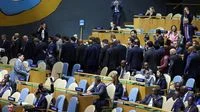
As Netanyahu approached the podium, representatives from dozens of member states stood up en masse and began filing out of the aisles toward the exit doors. The swift and coordinated departure left wide swaths of the sprawling auditorium visibly vacant, stripping the room of the bustling atmosphere that typically characterizes addresses by heads of state and government.
For several moments, Netanyahu stood in silence behind the bulletproof glass of the podium, observing the sea of empty seats and the steady stream of diplomats abandoning the chamber. The visible disruption prompted the President of the General Assembly, Khalilur Rahman, to intervene to restore order. Recognizing the breach of standard diplomatic decorum, Rahman repeatedly rapped his gavel and called for calm.
"Please, order in the assembly hall," Rahman urged into the microphone as the shuffling of feet and murmurs reverberated through the acoustics of the room. When the noise persisted, he issued a firmer directive: "I order order in the assembly hall."
After several repeated appeals and mounting tension, the room eventually settled into a tense quiet, though a significant portion of the diplomatic corps had successfully vacated the premises. Acknowledging the chaotic prelude, Netanyahu addressed the remaining audience and launched a fiery verbal counterattack against those who had departed. Expressing brief gratitude to Assembly President Rahman for attempting to maintain order, the Israeli Prime Minister pivoted to attack the protesting diplomats, branding them with severe rhetoric.
"If there are still moral cowards who have not yet left this room, please do so now," Netanyahu declared from the podium, before offering a sarcastic expression of gratitude: "Thank you very much."
Background Context and Humanitarian Toll
The hostile reception inside the United Nations headquarters did not occur in a vacuum; it was the direct culmination of years of escalating violence and, more acutely, the devastating military offensives launched by Israel following the events of October 2023. The subsequent military campaigns in the Gaza Strip have drawn universal condemnation from human rights organizations, international legal bodies, and a growing number of sovereign governments.
The humanitarian consequences of the ongoing conflict have reached catastrophic proportions. According to updated figures cited in international reports, the death toll among Palestinians in Gaza has surpassed 75,000 lives, encompassing a devastatingly high proportion of women and children. Furthermore, the infrastructure of the enclave has been nearly obliterated. Hundreds of thousands of residential homes, schools, hospitals, water sanitation plants, and vital civilian facilities have been reduced to rubble. The blockade and relentless bombardment have displaced the vast majority of Gaza’s population—estimated in the millions—forcing civilians to repeatedly flee into shrinking, overcrowded zones lacking adequate food, clean water, medical supplies, and shelter.
Compounding the crisis in Gaza, regional tensions escalated exponentially following military engagements involving Iran and its allied regional networks. Joint military maneuvers and operations conducted by Israel, alongside strategic backing and participation from the United States, saw heavy bombardments targeting Iranian positions and infrastructure late in February. This expansion of the theater of war has transformed a localized territorial dispute into a broader, volatile confrontation involving multiple regional powers, raising the specter of a wider Middle Eastern war that has alarmed global capitals from Washington to Beijing.
International Reactions and Legal Ramifications
The diplomatic fallout from Israel’s military strategies extends far beyond the floor of the United Nations General Assembly. In recent months, an increasing number of national governments have moved past traditional diplomatic reprimands, openly labeling Israeli military actions in Gaza as acts of genocide. Legal challenges have been lodged at international judicial bodies, including the International Court of Justice (ICJ) and the International Criminal Court (ICC), where prosecutors and member states have sought accountability for alleged war crimes and crimes against humanity committed during the hostilities.
While traditional allies of Israel, led by the United States, maintain their commitment to Israel’s right to self-defense and continue to provide substantial military and diplomatic support, the coalition of nations willing to openly challenge Israeli policies at the UN has expanded significantly. Developing nations across the Global South, alongside several European states, have increasingly utilized multilateral platforms to voice outrage over the humanitarian crisis, resulting in unprecedented diplomatic isolation for the Israeli government on the world stage.
Fact-Based Analysis of Implications
The walkout during Netanyahu’s UN address carries profound implications for the future of international diplomacy and the efficacy of multilateral institutions like the United Nations.
First, the incident highlights a deepening erosion of diplomatic norms. While protests, silent demonstrations, and occasional walkouts have historically occurred during speeches by leaders deemed controversial, the scale and coordination of the September 25 walkout signal a breakdown in the basic framework of mutual respect that underpins the UN as a forum for dialogue. When member states refuse to remain in the same room as a democratically elected head of government, the prospect of negotiated political settlements diminishes significantly.
Second, the polarization witnessed inside the General Assembly reflects a broader fracture in the international order. The divide between Western nations and the Global South regarding the application of international humanitarian law has widened. Developing nations frequently accuse Western powers of applying double standards, pointing to the swift imposition of sanctions and condemnation in other global conflicts contrasted with the prolonged diplomatic shield provided to Israel. This perception threatens to undermine the legitimacy of international institutions, making consensus on pressing global issues—ranging from climate change to nuclear non-proliferation—even more difficult to achieve.
Finally, for domestic politics within Israel, the event is likely to be interpreted through contrasting lenses. Critics of Prime Minister Netanyahu will view the empty seats and hostile international reception as undeniable proof of failed foreign policy and catastrophic damage to Israel’s global standing. Conversely, Netanyahu’s political base and supporters may interpret the defiance and sharp rhetoric against international critics as a demonstration of strength and steadfastness in the face of what they perceive as systemic international bias and antisemitism.
As the geopolitical landscape remains gridlocked, the dramatic scenes from the UN General Assembly serve as a stark reminder of the immense chasm dividing international actors, leaving humanitarian organizations and diplomats searching for viable pathways toward conflict resolution in an increasingly fractured world.