Jakarta (ANTARA) – The pursuit of a healthy and fit body no longer necessitates expensive gym memberships or specialized equipment. A growing body of evidence and expert opinion underscores the profound benefits of regular physical activity, and for many, the most accessible and sustainable path lies in simple, yet effective, bodyweight exercises performed in the comfort of one’s home. These fundamental movements, combining cardiovascular and strength training elements, are instrumental in elevating heart rate, engaging major muscle groups, and fostering overall well-being. Their practicality makes them an ideal starting point for beginners and a valuable addition to the routines of individuals with demanding schedules. This comprehensive guide delves into seven such exercises, detailing their mechanics, benefits, and the scientific backing that supports their efficacy in calorie burning, muscle strengthening, and cardiovascular health improvement, all without requiring any external aids.
The Growing Imperative for Accessible Fitness Solutions
In an era where sedentary lifestyles are increasingly prevalent, the global health landscape is grappling with a surge in non-communicable diseases, many of which are directly linked to physical inactivity. The World Health Organization (WHO) consistently highlights that insufficient physical activity is a leading risk factor for global mortality, contributing to an estimated 1.9 million deaths annually. This stark reality has amplified the urgency for accessible and sustainable fitness solutions. The COVID-19 pandemic further accelerated this trend, with lockdowns and restrictions limiting access to traditional fitness facilities. This period saw a significant global shift towards home-based workouts, prompting a renewed appreciation for the effectiveness and convenience of bodyweight training. Data from fitness tracking apps and online search trends during 2020 and 2021 indicated a substantial increase in searches for terms like "home workouts," "bodyweight exercises," and "no-equipment fitness." This surge reflects a fundamental realization: effective fitness is not contingent on location or expensive gear, but rather on consistent engagement and intelligent exercise selection.
Seven Foundational Bodyweight Exercises for a Healthier You
The following exercises represent a cornerstone of any effective home-based fitness regimen, offering a holistic approach to physical conditioning:
1. Jumping Jacks: The Cardiovascular Catalyst
Jumping jacks are a universally recognized and remarkably efficient cardiovascular exercise. The fundamental motion involves a synchronized jump where the legs spread wide apart while the arms extend overhead, followed by a return to the starting position with feet together and arms at the sides. This dynamic movement significantly elevates heart rate within a short timeframe, making it an excellent calorie-burning activity.
Scientific Rationale: Jumping jacks engage multiple muscle groups simultaneously, including the quadriceps, hamstrings, glutes, calves, shoulders, and core. The explosive nature of the jump requires the cardiovascular system to work harder to supply oxygenated blood to these active muscles, thereby improving aerobic capacity. Studies have shown that a 10-minute session of moderate-intensity jumping jacks can burn approximately 100 calories, with the exact number depending on individual weight and intensity. Furthermore, this exercise enhances body coordination and proprioception – the body’s awareness of its position in space – which is crucial for overall functional movement.
2. Marching in Place: Building the Foundation
Marching in place is an accessible exercise, particularly beneficial for individuals new to fitness or those with limited space. It involves simulating a marching motion by lifting one knee towards the chest, then returning it to the ground while simultaneously lifting the other.
Enhancing Intensity for Greater Impact: To maximize the benefits, participants can increase the intensity by elevating their knees to hip height, transforming the exercise into high knees. This modification intensifies the engagement of the leg muscles, particularly the hip flexors and quadriceps, leading to a more significant calorie expenditure. Consistent marching in place, even at a moderate pace, contributes to maintaining cardiovascular health and promoting improved blood circulation throughout the body. This is vital for delivering nutrients and oxygen to cells and removing waste products.
3. Squats: The Lower Body Powerhouse
Squats are a compound exercise that primarily targets the muscles of the lower body, including the quadriceps, hamstrings, glutes, and erector spinae (lower back muscles). The movement involves standing with feet shoulder-width apart, then lowering the hips as if to sit in a chair, ensuring the back remains straight and the knees do not extend beyond the toes. The body then returns to the upright position.
Biomechanics and Benefits: Proper squat form is critical to prevent injury. Maintaining a neutral spine and ensuring knees track over the toes helps to distribute the load effectively. Beyond muscle development, regular squats significantly improve balance and enhance overall body strength. They mimic natural human movements like sitting and standing, making them a functional exercise that translates to improved daily activities. Research published in the Journal of Strength and Conditioning Research has demonstrated that squat training can lead to substantial gains in lower body muscle mass and strength, even when performed with bodyweight alone.
4. Lunges: Enhancing Balance and Leg Strength
Lunges are another fundamental lower body exercise that effectively targets the quadriceps, hamstrings, glutes, and core muscles. The motion involves stepping forward with one leg and lowering the body until both knees are bent at approximately 90-degree angles. The body then returns to the starting position, and the exercise is repeated with the other leg.
Targeted Muscle Activation: This exercise requires significant engagement of stabilizing muscles, particularly in the core and hips, contributing to improved balance and coordination. Lunges effectively isolate and strengthen each leg independently, helping to address any muscle imbalances. The variation in lunge types, such as forward, backward, and lateral lunges, allows for a comprehensive workout of the lower body and hip complex.
5. Plank: The Core Stability Essential
The plank is an isometric exercise that challenges the body’s core stability. It involves holding a position similar to the beginning of a push-up, but resting on the forearms instead of the hands, with the body forming a straight line from head to heels.
The Power of Isometric Contraction: Despite the lack of dynamic movement, the plank is highly effective in strengthening the deep core muscles, including the transverse abdominis, obliques, and rectus abdominis, as well as the muscles of the back and glutes. Maintaining proper form – avoiding hip sagging or excessive hip elevation – is paramount. Regular planking not only builds core strength but also significantly improves posture, enhances spinal stability, and can help alleviate lower back pain by strengthening the supporting musculature. Studies have indicated that consistent planking can lead to a notable increase in core endurance and strength.
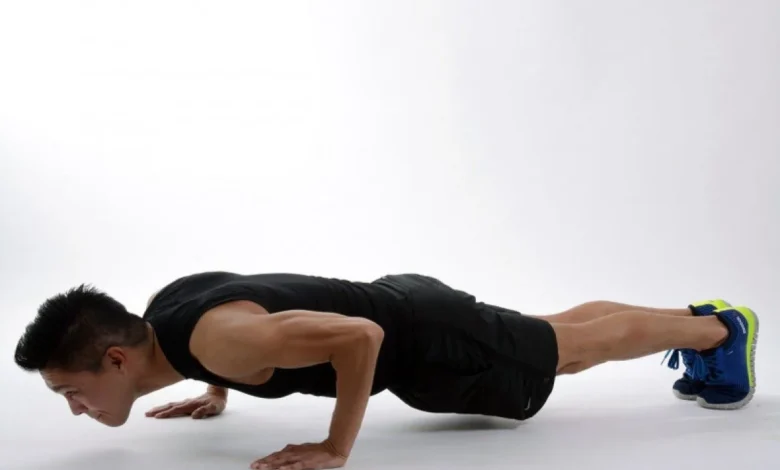
6. Push-ups: A Full-Body Strength Builder
Push-ups are a classic strength-training exercise that engages a wide array of upper body and core muscles. The movement involves lowering the chest towards the floor from a plank position and then pushing back up.
Adaptable and Effective: This exercise primarily targets the pectorals (chest muscles), deltoids (shoulders), and triceps (back of the upper arm), while also requiring significant engagement of the core for stabilization. For individuals who find standard push-ups challenging, modifications are readily available. Performing push-ups on the knees or against a wall significantly reduces the resistance, allowing beginners to build strength progressively before attempting the full version. The ability to adapt push-ups to varying fitness levels makes them an indispensable exercise for building upper body strength and power.
7. Burpees: The High-Intensity Calorie Torcher
Burpees are a full-body, high-intensity exercise that combines several movements into a single, fluid sequence: a squat, a push-up (often modified or omitted in beginner versions), and a jump. The exercise begins with a squat, followed by placing hands on the floor and kicking the feet back into a plank position. From the plank, the feet are then brought back towards the hands, and the individual jumps upwards with arms extended.
Metabolic Maximization: Due to its comprehensive muscle engagement and explosive nature, the burpee is exceptionally effective at burning calories in a short period. It significantly elevates the heart rate, boosts metabolism, and enhances both muscular strength and cardiovascular endurance. While demanding, the consistent practice of burpees can lead to substantial improvements in overall fitness, power, and coordination. The perceived exertion is high, but the physiological benefits, including improved VO2 max (maximal oxygen uptake), are significant.
The Science of Consistent Calorie Burning and Muscle Maintenance
The effectiveness of these bodyweight exercises in burning calories is rooted in fundamental physiological principles. Cardiovascular exercises, like jumping jacks and marching in place, increase the heart rate and oxygen consumption, leading to a higher metabolic rate during and after the exercise session (the "afterburn effect" or EPOC – Excess Post-exercise Oxygen Consumption). Strength-training exercises, such as squats, lunges, planks, push-ups, and burpees, contribute to building lean muscle mass. Muscle tissue is metabolically more active than fat tissue, meaning that a higher muscle mass leads to a greater resting metabolic rate, contributing to sustained calorie expenditure even when at rest.
A meta-analysis published in the British Journal of Sports Medicine reviewed numerous studies on bodyweight training and found significant improvements in muscular strength, endurance, and power across various populations. The research highlighted that when performed with sufficient intensity and volume, bodyweight exercises can be as effective as resistance training with weights for many fitness goals.
Integrating Bodyweight Training into Daily Life
The key to realizing the full benefits of these exercises lies in consistency. The WHO recommends at least 150 minutes of moderate-intensity aerobic activity or 75 minutes of vigorous-intensity aerobic activity per week, along with muscle-strengthening activities at least two days a week. A practical approach involves dedicating 20 to 30 minutes each day to a circuit of these bodyweight exercises. This can be structured as follows:
- Warm-up: 5 minutes of light cardio (e.g., marching in place, arm circles) and dynamic stretching.
- Workout Circuit: Perform each of the seven exercises for a set duration (e.g., 30-60 seconds) or number of repetitions, with short rest periods (e.g., 15-30 seconds) between exercises. Complete 2-3 rounds of the circuit.
- Cool-down: 5 minutes of static stretching, holding each stretch for 30 seconds.
Broader Implications and Expert Endorsements
The growing emphasis on accessible fitness solutions is not merely a trend but a response to public health imperatives. Health organizations worldwide are actively promoting such initiatives. For instance, public health campaigns often feature simple exercise routines that can be performed at home to combat rising rates of obesity and related chronic conditions.
Dr. Anya Sharma, a sports physiologist at the Indonesian Institute of Sports Science, commented on the growing accessibility of fitness: "The beauty of bodyweight training lies in its inherent scalability and universality. It democratizes fitness, making it available to virtually everyone, regardless of their socioeconomic status or geographical location. The focus shifts from the ‘how’ – the equipment – to the ‘what’ – the movement itself and the discipline to perform it consistently."
The implications of widespread adoption of these home-based exercises are far-reaching. They can contribute to reduced healthcare burdens associated with lifestyle-related diseases, improved overall public health, and enhanced individual quality of life. Furthermore, for individuals with limited mobility or chronic conditions, these exercises, when adapted and performed under guidance, can offer a safe and effective way to maintain physical function and independence.
Conclusion: A Sustainable Path to Well-being
In conclusion, the seven bodyweight exercises outlined – jumping jacks, marching in place, squats, lunges, planks, push-ups, and burpees – offer a powerful and accessible pathway to improved health and fitness. They demonstrate that achieving significant physical gains does not require elaborate gyms or expensive gear. By incorporating these movements into a consistent routine, individuals can effectively burn calories, build muscle, enhance cardiovascular health, and improve their overall well-being. Coupled with a balanced diet, adequate rest, and proper hydration, these simple yet profound exercises form the bedrock of a sustainable and effective approach to lifelong fitness, proving that the journey to a healthier body can indeed begin at home.
Related posts: