The Evolution of Web Development: How Artificial Intelligence is Democratizing Digital Creation through Website Mastery

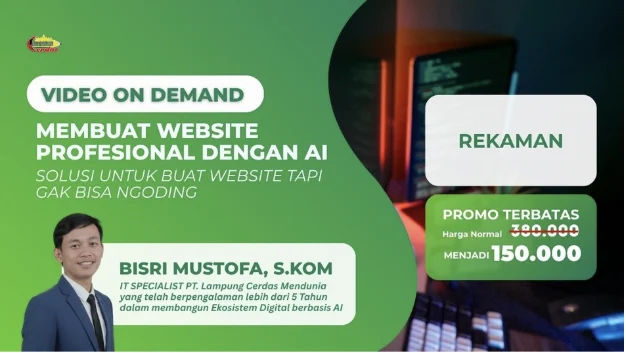
The landscape of digital infrastructure is undergoing a radical transformation as the barriers to entry for professional web development continue to crumble. Historically, the creation of a functional, responsive, and secure website required a deep understanding of complex programming languages such as HTML, CSS, and JavaScript, often necessitating years of formal education or rigorous self-study. Today, the integration of generative Artificial Intelligence (AI) has shifted the paradigm, enabling non-technical users and budding entrepreneurs to build sophisticated digital environments through natural language processing and prompt engineering. This technological shift is the central focus of the newly launched Video-on-Demand (VOD) course, Website Mastery, which seeks to equip participants with the skills necessary to leverage advanced AI agents in modern web production.
The Democratization of Web Development
The transition from manual coding to AI-assisted development marks one of the most significant changes in the tech sector over the past decade. According to industry reports from platforms like GitHub and Stack Overflow, AI-powered coding assistants have increased developer productivity by as much as 55% in specific workflows. By delegating the rote tasks of syntax generation to AI models, human developers can focus on architecture, user experience (UX) design, and business logic.
The Website Mastery curriculum is designed to capitalize on this efficiency. It introduces students to a suite of next-generation tools—specifically Lovable, v0 by Vercel, and Bolt—which serve as the cornerstone of the modern AI-assisted development stack. These platforms allow users to describe their requirements in plain English, after which the AI generates the underlying code, manages responsive layouts, and suggests design iterations. The course underscores the necessity of a structured approach to instruction, teaching participants how to craft "prompts" that yield precise, production-ready code.
Curricular Framework and Technical Infrastructure
The VOD program is structured into a logical progression, starting from the foundational setup of a development environment and culminating in the deployment of a live, public-facing website. The syllabus is categorized into three primary phases:
Phase I: Toolchain and Environment Setup
Before a single line of code is generated, students must establish a professional-grade technical environment. This involves the creation and configuration of a GitHub account, which serves as the primary version control system. Understanding version control is a critical step in the curriculum, as it ensures that students can track changes, collaborate with others, and revert to previous iterations of their work should an error occur.
Phase II: The AI Generation Process
The core of the instruction revolves around the practical application of AI agents. Participants are tasked with creating a website from scratch, utilizing the generative capabilities of v0 and Bolt. The course emphasizes that while the AI acts as the "writer," the human user must remain the "architect." This phase focuses on:
- Design Iteration: Learning how to refine layouts through continuous feedback loops with the AI.
- Prompt Engineering: Refining the specificity of instructions to ensure the generated code meets professional standards.
- Integration: Incorporating external assets and third-party APIs into the generated framework.
Phase III: Deployment and Lifecycle Management
The final stage of the course addresses the "last mile" of development: moving a project from a local or cloud-based sandbox to the global web. Using Vercel as the hosting platform, students learn the intricacies of continuous deployment. By connecting their GitHub repositories to Vercel, participants gain an understanding of how code updates can be automatically pushed to the live site, a standard practice in the industry known as CI/CD (Continuous Integration and Continuous Deployment).
The Economic and Professional Implications
The implications of this shift are profound for both the gig economy and small-to-medium enterprises (SMEs). For small business owners, the ability to build and maintain a professional web presence without the significant overhead of hiring a full-stack developer represents a major reduction in operational costs. For aspiring tech professionals, these AI-driven tools serve as an accelerated gateway into the industry, allowing them to build portfolios and gain familiarity with modern development workflows.
Industry analysts suggest that this trend is not replacing developers, but rather evolving the definition of what a developer does. The focus is shifting from "how to write code" to "how to build solutions." As AI handles the implementation, the value of the human contributor moves toward strategic thinking, design sensibility, and the ability to troubleshoot complex systems.
Chronology of Digital Transformation
The emergence of these tools follows a clear trajectory of technological maturity:
- 2015–2018: The rise of "No-Code" platforms (e.g., Wix, Squarespace) that allowed drag-and-drop website creation but limited flexibility.
- 2019–2022: The expansion of low-code environments and sophisticated IDEs that reduced friction but still required significant manual coding.
- 2023–Present: The advent of Generative AI integration, where Large Language Models (LLMs) act as co-pilots capable of writing, debugging, and deploying entire web architectures based on user prompts.
The Website Mastery course arrives at a time when the demand for digital literacy is at an all-time high. With global e-commerce and digital services continuing to expand, the necessity for accessible, high-quality web development education has never been greater.
Industry Expert Perspectives
While the course provides a practical roadmap, industry experts warn that AI-assisted development still requires a baseline of "digital literacy." Without an understanding of how web servers, databases, and version control work, users may struggle to maintain their sites when problems arise that the AI cannot automatically resolve.
"The AI is a force multiplier, not a replacement for fundamental logic," notes a representative associated with the educational initiative. "By teaching students not just to use the tools, but to understand the environment—such as the role of GitHub and the deployment cycle on Vercel—we are ensuring that they are building sustainable, professional projects rather than disposable prototypes."
Future Outlook
As these AI tools continue to improve, the industry expects to see a surge in independent web development. The barrier to launching a SaaS (Software as a Service) platform or a professional portfolio site is effectively being lowered to the speed of thought. The Website Mastery VOD course is positioned as a timely intervention for those looking to stay ahead of this curve.
For those interested in navigating this new landscape, the platform provides a structured path to mastering these tools. By combining technical theory with practical, hands-on experience, participants are positioned to transition from passive consumers of web technology to active creators. Detailed information regarding the curriculum, the tools utilized, and enrollment procedures for the Website Mastery VOD can be found via the official event portal at detikevent.
As technology continues to advance, the ability to effectively communicate with AI agents will likely become as essential as reading and writing. This program represents a critical step in formalizing the skills required to thrive in this new digital economy, ensuring that the next generation of web developers is equipped not only with the latest tools but with the foundational knowledge required to wield them effectively. In a rapidly digitizing world, the mastery of these AI-driven workflows is not merely an advantage; it is becoming a fundamental requirement for professional viability.