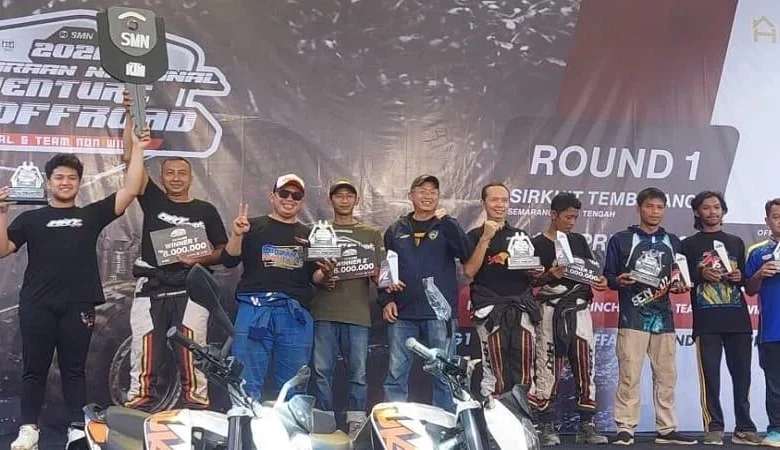
Semarang, Central Java – The Halo Dayak HRX team, representing Central Kalimantan (Kalteng), made a resounding statement at the Kejurnas Adventure Offroad Putaran 1, held at the demanding Sirkuit Tembalang in Semarang, Central Java, on April 18-19, 2026. Despite fierce competition from seasoned off-roaders across Indonesia, the Palangka Raya-based team demonstrated exceptional skill and vehicle performance, securing an impressive double podium finish by clinching second place in both the G3 and G4 classes. This remarkable achievement not only underscores the team’s burgeoning talent but also significantly boosts Central Kalimantan’s profile within the national off-road racing arena.
Dominant Performance in Semarang
The Kejurnas Adventure Offroad Putaran 1 served as the curtain-raiser for the 2026 national championship series, attracting a formidable roster of drivers and teams eager to establish early dominance. The Sirkuit Tembalang, known for its diverse and challenging terrain, featuring steep ascents, muddy descents, rocky sections, and technical obstacles, provided a true test of man and machine. Over the two-day event, competitors navigated a series of Special Stages (SS), each designed to push the limits of vehicle capability and driver-navigator synergy.
Halo Dayak HRX, a relatively new force with ambitious goals, entered the competition with two meticulously prepared vehicles. The team’s strategy, focused on consistency and calculated aggression, paid dividends. In the highly competitive G3 class, the formidable pairing of driver Agan Fauzi and navigator Yayi expertly piloted their custom-built off-roader through every obstacle, showcasing precision and teamwork to secure a well-deserved second-place finish. Simultaneously, in the equally challenging G4 class, veteran driver Hendrik Sumantri, a national champion from 2025, reaffirmed his prowess by also guiding his vehicle to the runner-up position. This synchronized success across two distinct categories highlighted the depth of talent and the robust engineering within the Halo Dayak HRX camp.
The Kejurnas Adventure Offroad: A National Challenge
The Kejurnas Adventure Offroad, organized under the auspices of the Indonesia Off Road Federation (IOF), stands as the pinnacle of off-road racing in Indonesia. It is a multi-round national championship designed to test the endurance, skill, and technical prowess of participants across various classes, typically categorized by vehicle modifications and engine capacity. The championship plays a crucial role in fostering motorsport talent, promoting vehicle engineering innovation, and elevating the profile of off-road sports throughout the archipelago. Each round is a points-scoring event, with accumulated points determining the national champions at the end of the season. The series often travels to different regions, showcasing diverse landscapes and presenting unique challenges to competitors, while also stimulating local economies and promoting regional tourism. The IOF, as the governing body, sets strict regulations for vehicle specifications, safety standards, and competition formats, ensuring fair play and participant safety. The national championship not only serves as a platform for competition but also as a hub for the off-road community, facilitating knowledge exchange and camaraderie among enthusiasts.
Rigorous Preparation and Strategic Execution
The path to the podium was paved with months of dedicated effort and strategic planning, as revealed by Sigit Widodo (SW), Chairman of the IOF Palangka Raya Branch and owner of the Halo Dayak HRX team. SW emphasized that the preparation for the 2026 racing season, particularly for the vehicles deployed in Semarang, was an extensive process. "I spent over four months preparing this car in Subang, West Java, specifically for the 2026 racing season," SW stated. This intensive development period involved significant modifications to the vehicles, enhancing their suspension systems, chassis strength, engine performance, and overall durability to withstand the extreme conditions of adventure off-roading. The team’s technical crew worked tirelessly to ensure every component was optimized for performance and reliability, a critical factor in a sport where mechanical failures can quickly end a race.
Initially, the team approached the Semarang round with tempered expectations, viewing it primarily as a shakedown for the newly prepared cars. "Initially, I didn’t set high targets because the car had just been completed; it was more about testing its capabilities," SW explained. This cautious approach allowed the drivers and navigators to familiarize themselves with the new setups without the immense pressure of demanding a win. However, the unexpected stellar performance underscored not only the quality of the preparation but also the inherent talent within the team. The ability to secure two podiums in a highly competitive field, without explicitly targeting such an outcome, speaks volumes about the team’s underlying strength and the effectiveness of their methodical approach.
The Drivers Behind the Success: Agan Fauzi and Hendrik Sumantri
The success of Halo Dayak HRX is inextricably linked to the exceptional skills and teamwork of its drivers and navigators. In the G3 class, Agan Fauzi, accompanied by navigator Yayi, demonstrated remarkable composure and agility. Their ability to read the terrain, make split-second decisions, and maintain consistent pace across challenging stages was instrumental in their second-place finish. Agan’s driving style, characterized by a blend of calculated risk-taking and technical precision, proved highly effective against experienced rivals.
Meanwhile, Hendrik Sumantri, the reigning national champion of 2025, brought his wealth of experience and championship pedigree to the G4 class. His deep understanding of vehicle dynamics and track conditions allowed him to push the limits while maintaining control, ultimately securing another crucial second-place for the team. Sumantri’s ability to perform under pressure and extract maximum performance from his vehicle is a testament to his status as one of Indonesia’s top off-road drivers. Both drivers expressed immense satisfaction with their results. "Alhamdulillah, at the Kejurnas offroader Individual Seri I in Semarang, we both from the Halo Dayak team managed to achieve maximum results. It met our targets and expectations, and we could podium in classes G3 and G4," jointly stated Agan Fauzi and Hendrik Sumantri after receiving their trophies. Their collective sentiment reflected not just personal achievement but a shared pride in elevating Central Kalimantan’s name on the national stage.
A Testament to Perseverance: Sigit Widodo’s Vision
Sigit Widodo’s role extends beyond that of a team owner; as Chairman of the IOF Palangka Raya Branch and an active member of the Palangka Raya Regional House of Representatives (DPRD), he is a fervent advocate for motorsport development in Central Kalimantan. His personal investment in the team, both financially and through his time overseeing vehicle preparation, reflects a deep commitment to the sport. "Of course, I am very happy because I prepared this car for more than 4 months in Subang, West Java, for this 2026 racing season. Initially, I didn’t set a target because the car was just finished, it was more for testing. It turns out the result is extraordinary, we managed to be second in series 1 in Semarang, even though the competition was very tight," he reiterated, highlighting the unexpected joy of the achievement.
SW’s vision is not merely about winning races but about fostering a vibrant off-road community in Kalteng and providing a platform for local talent to shine. He expressed profound gratitude to his drivers, Agan Fauzi and Hendrik Sumantri, for "upholding the name of Kalteng." His leadership is pivotal in driving the team’s ambitions and securing support for the sport in the region. His ability to balance his political responsibilities with his passion for off-road racing demonstrates a unique dedication to public service and community development through sport.
Central Kalimantan’s Rising Off-Road Profile
The success of Halo Dayak HRX at the Kejurnas Adventure Offroad Round 1 marks a significant milestone for Central Kalimantan motorsport. Historically, off-road racing has seen strongholds in regions with more established motorsport infrastructure and longer traditions in the sport. However, teams like Halo Dayak HRX are rapidly changing this landscape, proving that talent and dedication can emerge from any corner of the archipelago. This achievement not only puts Palangka Raya and Central Kalimantan on the national off-road map but also inspires a new generation of enthusiasts and aspiring drivers within the province.
"This is also an extraordinary achievement because the name Halo Dayak is becoming increasingly known in the national off-road world. The name Kalteng is also starting to be recognized, and the off-road world in Kalteng is rapidly developing," SW proudly affirmed. This recognition is crucial for attracting further investment, sponsorship, and government support for off-road facilities and training programs in the region. The visibility gained from national-level podium finishes encourages local businesses to associate with successful teams, creating a sustainable ecosystem for the sport’s growth. The provincial government, recognizing the potential for sports tourism and regional pride, has also played a supportive role.
Broader Implications for Regional Motorsport
The strong showing by Halo Dayak HRX carries broader implications for the development of motorsport, particularly off-roading, in Central Kalimantan. Firstly, it serves as a powerful testament to the caliber of talent and organizational capability present within the province. For years, regions with established motorsport cultures have dominated the national scene. Kalteng’s emergence signals a decentralization of excellence, proving that with adequate support and infrastructure, any region can produce national-level contenders.
Secondly, this success could be a catalyst for increased local government and private sector investment in motorsport infrastructure. The prospect of hosting national events, as Palangka Raya is set to do for Round 2, often spurs improvements in tracks, logistics, and hospitality, benefiting not just off-roading but potentially other forms of motorsport. Such developments create job opportunities, stimulate local economies, and enhance the region’s appeal as a sporting destination. The increased media attention also raises the profile of Kalteng, attracting tourism and showcasing the natural beauty and adventurous spirit of the region. This positive feedback loop can foster a virtuous cycle of growth and development for the sport.
Looking Ahead: Palangka Raya Prepares for Round 2
The next challenge for Halo Dayak HRX, and indeed for the entire national off-road community, is the Kejurnas Adventure Offroad Putaran 2, scheduled to take place in Palangka Raya, Central Kalimantan, on May 16-17. This upcoming home-ground advantage presents both an opportunity and a unique pressure for the Halo Dayak HRX team. "Next month, May 16-17, the national championship will be held in Palangka Raya, Kalteng. We will prepare even more thoroughly; please pray for us," SW stated, underscoring the team’s commitment to delivering another strong performance on their home turf.
Hosting a national-level event is a significant undertaking for Palangka Raya. It requires meticulous planning, coordination with national IOF bodies, and substantial logistical support. The local IOF branch, under Sigit Widodo’s leadership, will be working tirelessly to ensure the track is up to national standards, safety protocols are strictly adhered to, and all participants and spectators have a positive experience. The event is expected to draw competitors and enthusiasts from across Indonesia, providing a considerable boost to local businesses, including hotels, restaurants, and transportation services. For Halo Dayak HRX, racing in front of a home crowd will undoubtedly add an extra layer of motivation, and they will be aiming to convert their strong Semarang performance into a victory on their home soil, further cementing Central Kalimantan’s reputation as a growing force in Indonesian off-road racing.
Acknowledging Key Supporters
The team’s success and the burgeoning off-road scene in Central Kalimantan would not be possible without crucial backing. Sigit Widodo explicitly extended his profound gratitude to the Governor of Central Kalimantan, Agustiar Sabran, for his unwavering support of motorsport in the region. "Our sincerest thanks to the Governor of Kalteng for providing support for off-road sports in Kalteng," SW concluded. This governmental endorsement is vital for the growth of any sport, providing the necessary resources, infrastructure development, and policy frameworks that enable athletes and teams to thrive.
The drivers, Agan and Sumantri, echoed this sentiment, directly thanking Governor H. Agustiar Sabran for his support, recognizing its importance in their ability to compete at a national level. Their appreciation also extended to the entire Halo Dayak team and their colleagues, emphasizing the collective effort behind their achievements. This public acknowledgment of key stakeholders highlights the collaborative spirit that drives motorsport success, from the hands-on mechanics and navigators to the highest levels of regional governance. The commitment from both the team and the provincial leadership promises a bright future for off-road racing in Central Kalimantan, establishing it as a significant hub for the sport in Indonesia.
Related posts: