France Gripped by Widespread Unrest as Economic Discontent and Educational Crisis Trigger Violent Protests

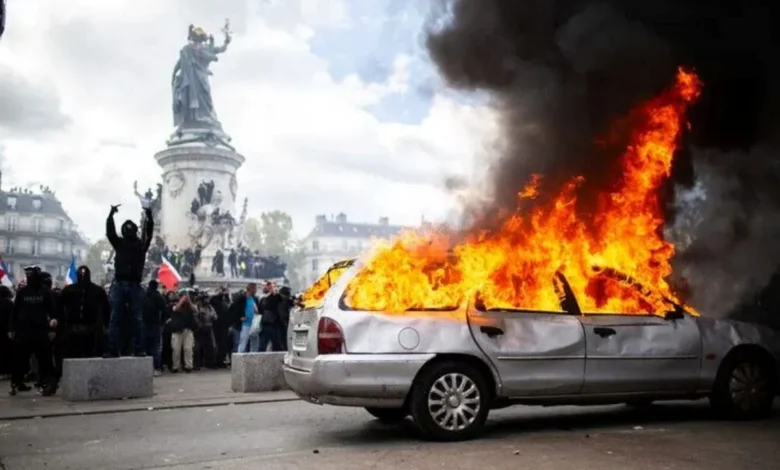
France is currently grappling with one of the most significant waves of civil unrest in recent memory, as massive demonstrations that began over educational grievances have spiraled into widespread riots across the nation’s major urban centers. By mid-October 2026, the frustration of the French public—fueled by the soaring cost of living, widening economic inequality, and a perceived decline in essential public services—had reached a boiling point. The mobilization, which saw hundreds of thousands of citizens take to the streets, underscores a volatile socio-political climate as the nation approaches the 2027 presidential election cycle.
The intensity of the situation peaked on Saturday, October 17, 2026, when major cities including Paris, Marseille, Lyon, Lille, and Bordeaux became flashpoints for both peaceful protest and violent confrontation. While the vast majority of demonstrators gathered to advocate for policy reforms, the movement was marred by opportunistic violence, resulting in the destruction of public property, arson, and looting. The scale of the unrest has prompted urgent calls for calm from the Élysée Palace, even as the government struggles to address the systemic issues underpinning the public’s grievances.
A Chronology of Escalation: From Classroom to Street
The current crisis did not emerge overnight; it is the culmination of months of simmering tension. The seeds of the movement were sown in mid-September 2026, rooted primarily in the crumbling state of the French public education system.
- September 17, 2026: The catalyst for the movement occurred at the Lycée Saint-Exupéry in Créteil, where teaching staff launched a strike. The primary grievances included severe teacher shortages, lack of funding for classroom resources, and the dilapidated state of school infrastructure.
- Late September to Early October: The localized strike quickly gained momentum as students, parents, and teacher unions joined the cause. The narrative expanded from specific school-level failures to a broader critique of state investment in the future of the nation’s youth.
- October 15–16, 2026: Protests began to integrate with broader economic grievances. Activists focused on the cost-of-living crisis, drawing parallels to the 2018 "Yellow Vests" (Gilets Jaunes) movement, which had paralyzed France for months.
- October 17, 2026: The day of mass mobilization. Estimates from various news agencies, including Reuters and the Associated Press, suggest between 550,000 and 800,000 people participated in demonstrations nationwide. By evening, the character of the protests shifted as violent factions clashed with security forces.
- October 18, 2026: The government took stock of the wreckage. Interior Minister Laurent Nuñez confirmed the arrest of approximately 2,400 individuals. Reports surfaced of nearly 1,000 police officers injured and the tragic death of one demonstrator in Paris following cardiac arrest during the chaotic scenes.
The Triad of Discontent: Economics, Education, and Governance
The unrest is driven by a complex interplay of three distinct but interconnected factors. By analyzing these components, one gains insight into why the French public has reached such an impasse with the Macron administration.
1. The Cost-of-Living Crisis
Inflation has eroded the purchasing power of the average French household. Despite government attempts to subsidize energy costs, the prices of staple goods and fuel have remained stubbornly high. For the working and middle classes, the economic pressure feels relentless. This feeling of being "left behind" mirrors the populist anger seen in 2018. However, the 2026 iteration is arguably more dangerous because it lacks a single, negotiable demand; instead, it represents a generalized rejection of current fiscal policy.
2. The Educational Emergency
The education system is widely viewed as a microcosm of the state’s failure to maintain public services. Teachers report working in overcrowded classrooms with outdated technology, while the shortage of staff has led to the cancellation of thousands of instructional hours. When the youth, who see their future opportunities narrowing, joined forces with organized labor unions, the movement gained a level of structural legitimacy that forced the government into a defensive posture.
3. The Crisis of Representation
Underlying the economic and educational demands is a profound skepticism regarding President Emmanuel Macron’s governance. Many demonstrators perceive the current administration as being disconnected from the realities of daily life for ordinary citizens. With the 2027 election looming, these protests have evolved into a political litmus test. Opposing political factions are increasingly using the chaos to highlight the administration’s perceived failure to provide a vision for an equitable France.
Government Response and Public Security
The French state has attempted to bifurcate its response to the unrest, separating the legitimate democratic expression of the citizenry from the criminal behavior of rioters. President Macron has consistently urged calm, emphasizing that the grievances of the peaceful protesters are valid and distinct from the acts of vandalism and looting that have targeted local businesses, such as Carrefour, and public buildings like the Town Hall in Limoges.
However, the government’s reliance on law enforcement to contain the violence has been heavy-handed. The use of tear gas and the deployment of massive security cordons have, in some instances, exacerbated tensions. Interior Minister Laurent Nuñez noted that the authorities are now considering the implementation of localized restrictions on assembly to protect vital infrastructure. Critics of the government argue that this approach addresses the symptoms—the rioting—while failing to provide a credible pathway to address the root causes of the protest.
Economic and Societal Implications
The economic impact of the mid-October riots is substantial. Beyond the physical damage to storefronts and public infrastructure, the volatility has created an atmosphere of uncertainty that is discouraging to domestic investment. Retail sectors, already struggling with inflation, face additional losses due to closures and the destruction of inventory.
Furthermore, the social fabric of the country is showing signs of strain. The death of a demonstrator in Paris serves as a grim reminder of the risks associated with such widespread civil disobedience. The fact that the riots spread to other European cities, such as Milan, suggests that the discontent is not unique to France but is part of a broader European trend characterized by post-pandemic economic malaise and rising political polarization.
Fact-Based Analysis: The Road Ahead
As the dust settles, the question remains whether this movement will solidify into a long-term political force. Historically, France has a robust tradition of protest, but the sustainability of the current unrest depends on three factors:
- The Government’s Negotiating Strategy: If the administration fails to present a concrete plan for educational reform and cost-of-living relief, the protests are likely to continue sporadically.
- The Role of Labor Unions: The participation of organized labor adds a layer of stability and strategic intent to the movement. If the unions decide to escalate through coordinated national strikes, the impact on the economy would be far more severe than the spontaneous riots observed in mid-October.
- The 2027 Election Context: Every major action taken by the government is now being filtered through the lens of the upcoming presidential contest. The opposition will likely continue to amplify these grievances, making it difficult for the current administration to project an image of stability and control.
The events of October 2026 serve as a stark warning to European leaders. When a significant portion of the population feels that the social contract—the promise of a stable, educated, and reasonably comfortable life—has been broken, the resulting instability can manifest with startling speed. The riots are not merely a reaction to school conditions or fuel prices; they are a manifestation of a deeper, systemic dissatisfaction that will require more than police cordons to resolve. The path forward for France will necessitate a delicate balance between maintaining public order and demonstrating a genuine willingness to engage with the structural inequalities that have brought thousands of its citizens into the streets.