Excel Accounting Accelerator Program Equips Finance Professionals with Advanced Data Management Skills for Complex Reporting

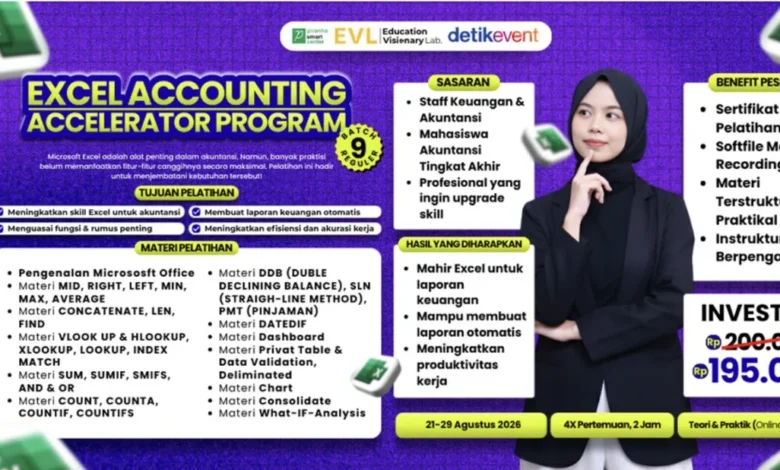
The landscape of modern accounting and corporate finance has shifted dramatically toward data-driven decision-making, where the ability to manipulate large datasets is no longer an advantage but a fundamental requirement. While Microsoft Excel remains the ubiquitous tool for financial professionals, there is a growing realization that basic proficiency—creating simple tables or elementary arithmetic—is insufficient for the complexities of contemporary accounting. Recognizing this gap between general software literacy and specialized financial application, the Excel Accounting Accelerator Program has launched its tenth regular batch, aiming to bridge the divide through structured, case-based learning.
The Evolution of Financial Data Management
In the current professional environment, accountants and financial analysts are tasked with processing vast amounts of transactional data, maintaining complex ledgers, and delivering real-time financial insights. Despite the proliferation of sophisticated Enterprise Resource Planning (ERP) systems, Excel persists as the primary interface for reporting, ad-hoc analysis, and modeling.
Industry data suggests that a significant portion of finance professionals still spend an estimated 40% of their work week on manual data entry and formatting. This reliance on manual processes often stems from a lack of familiarity with advanced Excel functions, such as VLOOKUP, INDEX-MATCH, complex logical formulas, and automated Pivot Tables. When these tools are underutilized, the risk of human error increases, audit trails become fragmented, and the overall efficiency of the finance department declines.
Bridging the Competency Gap
The Excel Accounting Accelerator Program was conceived to address this specific professional deficiency. Rather than focusing on general spreadsheet features, the curriculum is meticulously curated to mirror real-world accounting scenarios. By contextualizing learning, participants move beyond rote memorization of formulas toward an intuitive understanding of how data structures inform financial strategy.
The program, which is entering its tenth iteration, has refined its pedagogical approach to focus on the high-impact areas of the finance function. These include:
- Advanced Data Processing: Transitioning from manual input to automated data consolidation.
- Logical and Search Functions: Mastering the logic required for reconciliation and variance analysis.
- Pivot Table Analytics: Leveraging multi-dimensional analysis to summarize large datasets.
- Financial Modeling: Constructing robust templates for cash flow forecasting and budgeting.
- Dashboard Visualization: Communicating complex financial health metrics to stakeholders in an accessible format.
Program Chronology and Curriculum Structure
The upcoming cohort for the Excel Accounting Accelerator Program is scheduled for late September 2026. The training is structured into four distinct sessions held on September 21, 22, 28, and 29. Each session, spanning from 18:30 to 20:30 WIB, is delivered online to accommodate working professionals.
The progression of the curriculum is designed as follows:
- Foundational Optimization (Sept 21): Establishing efficient workflows for journal entries and ledger management using advanced shortcuts and data validation.
- Strategic Formula Application (Sept 22): Deep-diving into conditional formatting, nested functions, and financial math formulas essential for month-end closing procedures.
- Data Synthesis and Pivot Tables (Sept 28): Mastering the extraction of insights from raw transactional logs and the creation of dynamic, updateable reports.
- Reporting and Visualization (Sept 29): Finalizing the module with dashboard design, ensuring that financial data is presented with clarity and impact for executive review.
By the end of the four-day intensive, participants are expected to have completed a series of simulated case studies that replicate the pressure and complexity of an actual corporate finance office.
The Economic Context: Why Excel Still Reigns Supreme
While cloud-based software and automated accounting platforms have gained market share, industry analysts note that Excel continues to command a central role in finance. A recent survey of mid-to-large enterprises indicated that over 90% of finance departments utilize Excel as an essential secondary tool for auditing data extracted from primary ERP software.
The primary reason for this longevity is the flexibility Excel offers. Unlike rigid ERP modules, Excel allows analysts to create bespoke models that address unique business requirements—such as sensitivity analysis for capital expenditure or complex tax calculation scenarios. However, this flexibility is a double-edged sword; without proper training, analysts may create "spaghetti spreadsheets"—files so complex and poorly structured that they become prone to corruption and difficult for colleagues to audit. The Accelerator Program emphasizes clean modeling practices, which are essential for maintaining the integrity of financial information.
Implications for Professional Development
For the modern accountant, the implications of this training are twofold: operational efficiency and career progression. Professionals who can automate their reporting cycles free up significant time to engage in high-value analysis, such as identifying cost-saving opportunities or analyzing market trends. In a competitive labor market, proficiency in advanced data management is a key differentiator that signals to employers that a candidate can contribute immediately to the financial health of the organization.
The program organizers have indicated that the transition to an online format has allowed for a more diverse participant base, ranging from fresh graduates seeking to enter the financial services sector to mid-level managers looking to standardize their team’s reporting processes. By utilizing an interactive platform, the program ensures that every participant receives personalized feedback during the exercises, mimicking the collaborative environment of a professional accounting firm.
Official Perspective and Participant Outcomes
While individual performance varies, the feedback from previous batches suggests that participants experience a marked improvement in their daily workflow efficiency. The shift from manual processing to formula-driven workflows is the most frequently cited benefit.
"The objective is to change the mindset of the finance professional," stated a representative from the program’s management. "We want participants to stop looking at Excel as a digital typewriter and start seeing it as a powerful, integrated analytical engine. When an accountant understands how to structure data, the reports practically generate themselves."
The emphasis on "Accounting Accelerators" reflects a broader trend in professional education: the move toward micro-credentials that offer immediate, practical value. Rather than undertaking lengthy certifications, many professionals are opting for targeted, intensive training that focuses on the specific technical hurdles they face in their daily roles.
Broader Industry Impact
The sustained demand for the Excel Accounting Accelerator Program underscores the ongoing digital transformation of the accounting profession. As the volume of data generated by businesses continues to grow, the ability to manage that data is becoming a foundational literacy for the 21st-century workforce.
Furthermore, as companies place a higher premium on transparency and reporting accuracy, the role of the accountant is evolving into that of a "data translator." By mastering the technical requirements of the profession—facilitated by advanced Excel training—accountants are better positioned to provide the strategic insights that drive business success.
For those interested in participating in the current batch, registration remains open via the official event portal on Detikevent. As the industry continues to prioritize technical proficiency, the decision to invest in these specialized skills is a significant step toward achieving long-term professional stability and career growth within the competitive landscape of finance and accounting. The 10th batch represents a milestone for the program, reflecting a decade of refinement in curriculum design and a proven track record of equipping professionals with the tools necessary to navigate the complex world of modern corporate finance.