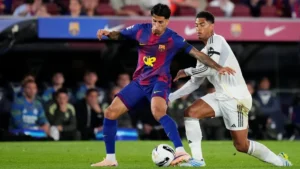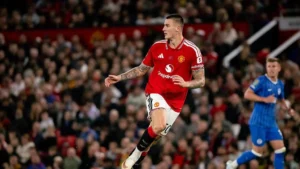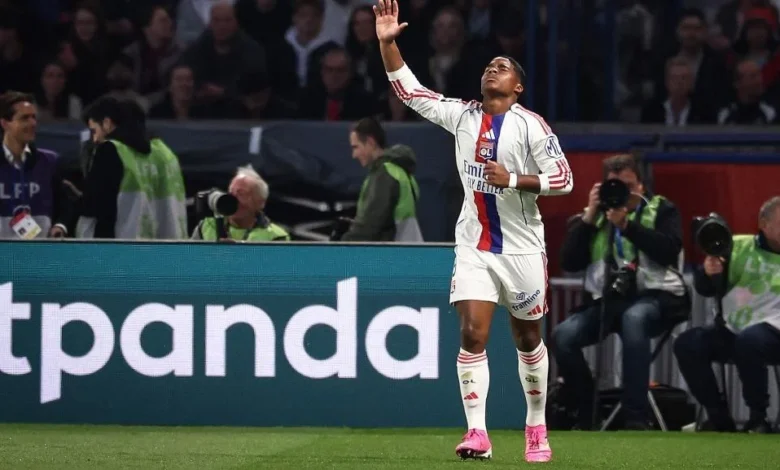
Paris, France – A dramatic French Ligue 1 encounter between Paris Saint-Germain (PSG) and Olympique Lyonnais (Lyon) on Monday, April 20, 2026, concluded not just with a surprising 2-1 victory for Lyon at the Parc des Princes, but also with a contentious celebration by Lyon’s rising star, Endrick. The 19-year-old Brazilian forward, on loan from Real Madrid, scored the opening goal and subsequently engaged in a highly provocative celebration directed at the home crowd, triggering a wave of condemnation, a stern rebuke from PSG defender Achraf Hakimi, and a visibly cold shoulder from PSG manager Luis Enrique. The incident has since opened a broader discussion within the football community regarding player conduct, sportsmanship, and the boundaries of expressive celebrations in high-stakes matches.
Match Overview: Lyon’s Upset Victory at Parc des Princes
The match itself was a pivotal fixture for both clubs, albeit for different reasons. PSG, widely expected to cruise to another Ligue 1 title, aimed to consolidate their lead at the top of the table and maintain momentum across all competitions. Lyon, on the other hand, arrived in Paris with a renewed sense of purpose, having endured a challenging start to their season but showing signs of resurgence under new management. Their recent form had seen them climb steadily in the league standings, making this trip to the capital a crucial test of their newfound resilience and ambition.
From the outset, Lyon displayed an unexpected tenacity, pressing high and disrupting PSG’s customary dominance in possession. The tactical approach paid dividends early in the game. In the seventh minute, a swift counter-attack saw Lyon break through PSG’s defensive line. Midfielder Afonso Moreira, showcasing exceptional vision, threaded a perfectly weighted pass into the path of a surging Endrick. The young Brazilian attacker, demonstrating a predatory instinct far beyond his years, expertly controlled the ball and clinically slotted it past PSG’s goalkeeper, Gianluigi Donnarumma, giving Lyon a shock early lead. The goal was a testament to Lyon’s strategic planning and Endrick’s burgeoning talent, marking his fifth goal in the current Ligue 1 campaign and a significant contribution to his team’s efforts.
Lyon continued to press their advantage, doubling their lead later in the first half through a well-worked set-piece. Despite PSG pulling a goal back in the second half, the hosts were unable to find an equalizer, allowing Lyon to secure a momentous 2-1 victory away from home. This result sent shockwaves through the league, not only because of the upset but also due to the controversial events that unfolded following Lyon’s opening goal.
The Controversial Celebration: A Moment of Provocation
Immediately after finding the back of the net, Endrick ran towards the section of the Parc des Princes stands populated by PSG ultras. What followed was a highly unusual and confrontational celebration. He began to dance with exaggerated, almost mocking, gestures. The most provocative aspect of his celebration involved him grabbing his crotch repeatedly while maintaining eye contact with the jeering PSG supporters. This act was widely perceived as a deliberate attempt to antagonize the home crowd, crossing a line from exuberant celebration to outright provocation.
The reaction from the PSG faithful was instantaneous and vociferous. A chorus of boos and whistles erupted, drowning out any cheers from the small contingent of traveling Lyon supporters. Objects, though none appearing to directly hit Endrick, were reportedly thrown from the stands, highlighting the intensity of the fan displeasure. The incident quickly became the focal point of post-match discussions, overshadowing Lyon’s impressive performance and the tactical intricacies of the game.
Reactions from the Pitch: Hakimi’s Rebuke
The on-field reaction to Endrick’s celebration was equally swift. PSG’s experienced Moroccan right-back, Achraf Hakimi, was among the first to confront the young forward. Known for his competitive spirit and leadership qualities, Hakimi immediately approached Endrick, engaging him in a tense verbal exchange. While the exact words exchanged were not fully audible, Hakimi’s gestures clearly indicated his disapproval.
Following the match, Hakimi elaborated on his confrontation with Endrick in an interview with Tribuna, stating, "I wanted him to stop doing things that are not appropriate towards our supporters. I wanted him to focus on playing football, especially because he is a good player." Hakimi’s statement underscored a sentiment that many in football share: while passion is commendable, respect for opponents and their fans is paramount. He further emphasized the detrimental impact of such actions on team morale, adding, "But when he does things that are not related to football, it can make me angry, especially since we almost lost." Hakimi’s comments highlight the fine line between passionate expression and unsportsmanlike conduct, especially in the heated atmosphere of a top-tier football match. His intervention served as a direct on-field reprimand from a seasoned professional to a promising, albeit perhaps misguided, young talent.
Managerial Disapproval: Luis Enrique’s Cold Shoulder
The tension surrounding Endrick’s actions extended beyond the pitch. As the final whistle blew and players began their post-match routines, PSG manager Luis Enrique made his way onto the field to greet his own players and, as is customary, acknowledge the opposition. However, when Endrick approached Enrique, seemingly to offer a handshake, the Spanish coach conspicuously ignored the young forward. Enrique walked past Endrick without making eye contact or offering a gesture of acknowledgment, a move that was widely interpreted as a deliberate snub and a clear sign of his displeasure with Endrick’s conduct.
Luis Enrique, known for his strong disciplinary stance and emphasis on respect and professionalism, rarely tolerates actions he perceives as unsportsmanlike. His decision to publicly ignore Endrick, a player on loan from a club like Real Madrid, speaks volumes about his disapproval. While Enrique did not issue a direct public statement about the incident, his actions provided a potent visual commentary on his stance regarding the celebration. This incident, coming from a manager of Enrique’s stature, adds another layer of gravity to Endrick’s actions, signaling that such behavior is not only frowned upon by opponents but also by figures of authority within the sport.
Endrick’s Profile and Background Context
Endrick Felipe Moreira de Sousa, simply known as Endrick, is one of the most highly-touted young talents in world football. Born in July 2006, he gained international recognition early in his career while playing for Palmeiras in Brazil. His exceptional performances attracted the attention of Europe’s elite clubs, culminating in a high-profile transfer agreement with Real Madrid in December 2022, though he was only eligible to join the Spanish giants upon turning 18. This season, he was loaned to Lyon as part of his developmental pathway, a strategic move by Real Madrid to ensure he gains consistent top-flight experience in a competitive European league.
At just 19 years old, Endrick carries immense expectations on his shoulders. He is seen as a future cornerstone for both Real Madrid and the Brazilian national team. His goal-scoring prowess and technical ability are undeniable, making him a formidable presence despite his youth. However, this incident at the Parc des Princes highlights a potential area for growth: managing emotions and understanding the broader implications of actions on the field, particularly in high-pressure environments. While his exuberance is part of his charm, navigating the fine line between passion and provocation is a crucial lesson for any young player aspiring to reach the pinnacle of the sport. Previous instances of players engaging in controversial celebrations, such as those by Mario Balotelli or even the infamous gestures by figures like Paul Gascoigne, often spark heated debates and can sometimes lead to retrospective disciplinary action.
Lyon’s Resurgence and PSG’s Setback
For Olympique Lyonnais, the victory over PSG was a significant milestone in their season. After a tumultuous start that saw them languishing near the relegation zone, the club has experienced a remarkable turnaround. This win at the Parc des Princes not only provided a massive boost to their confidence but also propelled them further up the Ligue 1 table, reigniting hopes for a European qualification spot. The tactical discipline and fighting spirit displayed against the league leaders underscore the progress made by the team. Endrick’s goal and assist were instrumental in securing these crucial three points, making his individual contribution invaluable to Lyon’s resurgence.
Conversely, for Paris Saint-Germain, the defeat was a rare stumble in what has otherwise been a dominant domestic campaign. While they still maintain a comfortable lead in the league, such losses can disrupt momentum, particularly as they navigate the latter stages of European competitions. The defeat exposed some vulnerabilities, and the post-match controversy surrounding Endrick’s celebration added an unwelcome distraction. For a club with PSG’s ambitions, any setback, whether on the scoreboard or in terms of public perception, is scrutinized intensely. The focus now shifts to how Luis Enrique’s squad will respond to this unexpected loss and the lingering tension from the celebratory incident.
The Etiquette of Celebration: A Broader Football Debate
The incident involving Endrick has reignited the perennial debate within football regarding the etiquette of goal celebrations. While celebrations are an integral part of the game’s excitement and allow players to express joy and passion, there are unwritten rules and formal regulations that govern acceptable conduct. FIFA’s Laws of the Game, specifically Law 12, addresses unsporting behavior, including "excessive" or "provocative" celebrations. While the regulations are often interpreted loosely, gestures deemed offensive, abusive, or inciting can lead to bookings or even retrospective bans.
Historically, football has witnessed a spectrum of celebrations, from respectful acknowledgments to highly theatrical and sometimes controversial acts. Iconic celebrations like Roger Milla’s corner flag dance or Francesco Totti’s selfie have become part of football folklore, celebrated for their originality and harmless charm. However, others, such as those involving mocking gestures towards opponents, inciting crowd trouble, or displaying politically charged messages, have consistently drawn criticism and disciplinary action. The line between passionate expression and disrespectful provocation is often subjective, but Endrick’s crotch-grabbing gesture directly in front of rival fans is widely considered to have crossed into the latter category, violating the spirit of sportsmanship.
Potential Disciplinary Actions and League Oversight
Given the nature of Endrick’s celebration, there is a possibility that the French Ligue 1 disciplinary committee could review the incident. While the referee did not issue a yellow card for the celebration during the match, league authorities often have the power to conduct retrospective investigations into acts of unsporting conduct that were missed or deemed insufficient by the on-field officials. Potential sanctions could range from a warning to a fine, or even a suspension, depending on the severity of the committee’s interpretation and whether the act is deemed to have incited public disorder or brought the game into disrepute.
Such disciplinary actions are not uncommon. Football federations across Europe have, in the past, taken action against players for gestures deemed offensive or provocative. The outcome of any potential review would be closely watched, not only by Lyon and PSG but also by the wider football community, as it would set a precedent for what is considered acceptable behavior from young, high-profile players in the league. Lyon, as Endrick’s current club, would likely defend their player, perhaps arguing it was an act of youthful exuberance rather than malicious intent, while PSG would undoubtedly support any action taken to uphold sportsmanship.
The Media Storm and Public Perception
The incident at Parc des Princes quickly became a dominant topic across sports media platforms and social media. Clips of Endrick’s celebration went viral, sparking intense debate among fans, pundits, and former players. Opinions varied, with some defending Endrick as a passionate young player expressing himself, while the overwhelming majority condemned the act as disrespectful and unsportsmanlike. The fact that he is on loan from Real Madrid, one of the world’s most prestigious clubs, adds another layer of scrutiny, as his conduct reflects not only on Lyon but also on his future parent club.
The incident is a significant moment in Endrick’s young career. While his talent is undeniable, controversies such as this can shape public perception and influence how he is viewed by teammates, opponents, and fans alike. Managing his public image and demonstrating maturity will be crucial for his continued development and success at the highest level of football.
Implications for Endrick’s Future
The implications of this incident for Endrick’s future are multi-faceted. On one hand, his goal and assist against PSG underscore his immense talent and ability to perform in high-pressure situations, reaffirming Real Madrid’s investment in him. On the other hand, the controversy surrounding his celebration raises questions about his temperament and maturity. Real Madrid, known for its strict code of conduct and emphasis on professionalism, will undoubtedly be monitoring the situation closely. While they value passion and winning mentality, they also expect their players to uphold the club’s image and values.
Endrick will need to learn from this experience. As he transitions to one of the biggest clubs in the world, the spotlight on him will only intensify. Understanding the cultural nuances of European football, the importance of sportsmanship, and the impact of his actions on and off the field will be vital for his long-term success. This incident serves as a harsh but potentially valuable lesson for a prodigy on the cusp of superstardom, reminding him that talent alone is not sufficient; character and conduct also play a pivotal role in defining a legacy.
Conclusion
The match between PSG and Lyon on April 20, 2026, will be remembered for Lyon’s surprising victory and, more pointedly, for Endrick’s controversial goal celebration. What began as a moment of youthful triumph quickly devolved into a heated debate on sportsmanship, player conduct, and the fine line between passion and provocation. The reactions from Achraf Hakimi and Luis Enrique underscore the disapproval from within the professional ranks, while potential disciplinary actions from league authorities loom. For Endrick, this incident marks a critical juncture in his promising career, offering a stark reminder that immense talent comes with an equally immense responsibility to uphold the values and integrity of the beautiful game. The football world will now watch closely to see how this young star navigates the aftermath of his actions and continues to evolve both as a player and as a professional.