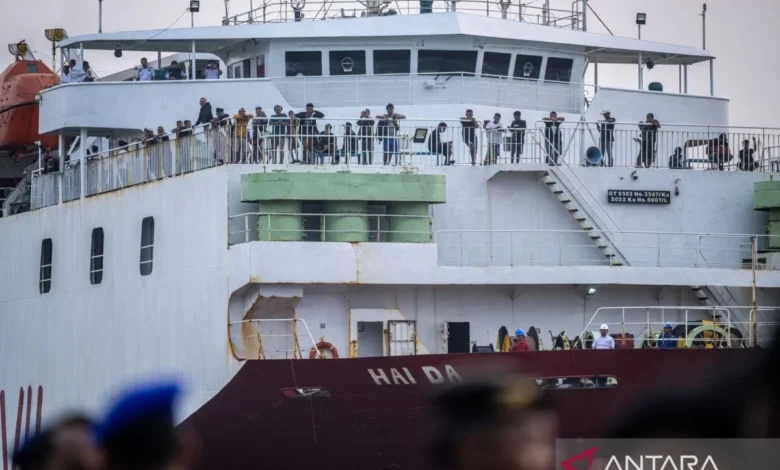
The unpredictable and volatile nature of maritime weather in Indonesia has once again been cast into sharp relief following a series of harrowing accidents at sea, most notably the tragic capsizing of the KM Virgo Transport 8 in the Java Sea. This disaster, unfolding concurrently with an intensive search and rescue operation for missing journalists near the Sunda Strait, has reignited critical discussions regarding maritime safety, vessel stability physics, cargo management, and the absolute limits of ship resilience when confronted with extreme oceanic conditions.
Maritime authorities, naval architects, and safety regulators are closely examining the complex interplay of environmental factors, hydrodynamic forces, and operational decisions that transform a routine commercial voyage into a catastrophic event. As search and rescue teams battle high waves and turbulent winds to locate survivors, the broader maritime community is forced to confront fundamental questions about how large vessels interact with severe sea states and why structural size alone offers no absolute guarantee against the raw power of the ocean.
Chronology and Background of Recent Maritime Incidents
The sequence of events leading to the KM Virgo Transport 8 disaster began as the vessel undertook a routine commercial voyage, cutting through the Java Sea from Surabaya toward its destination of Banjarmasin. According to initial logs and reports from maritime tracking authorities, the ship encountered rapidly deteriorating weather conditions characterized by sudden squalls and high-velocity winds. Meteorological data from the region indicated that wave heights in the immediate vicinity of the incident escalated rapidly, reaching towering proportions of up to three meters.
Prior to total communication blackout, the master of the vessel transmitted a critical distress signal, notifying maritime authorities that the ship was taking on a severe list. Despite these warnings, the transition from operational distress to total loss occurred with alarming rapidity. Subsequent accounts from surviving crew members revealed that the KM Virgo Transport 8 capsized and sank in less than five minutes, leaving virtually no time for an orderly evacuation or the deployment of secondary life-saving apparatuses in an organized manner.
In the days following the disaster, search and rescue operations confirmed that the hull of the KM Virgo Transport 8 had drifted approximately 1.6 nautical miles from its last known coordinates while remaining in an inverted position. Joint SAR teams, utilizing specialized sonar and surface vessels, continue sweeping the area to locate passengers and crew members who remain unaccounted for.
Simultaneously, Indonesian authorities have been managing a parallel, high-stakes maritime emergency in the Sunda Strait. An extensive search operation entered its critical seventh day, focusing on locating five journalists and three other individuals who went missing while covering the volcanic activity and eruptions of Mount Anak Krakatau. Deploying substantial assets, the National Search and Rescue Agency (Basarnas) mobilized 18 specialized vessels and at least one aerial reconnaissance helicopter, expanding the operational search grid to an expansive 6,649 square miles.
The convergence of these two maritime crises highlights a sobering reality: Indonesian waters, serving as vital maritime highways for commerce and communication, can undergo drastic environmental transformations within hours, demanding uncompromising vigilance from vessel operators and emergency responders alike.
The Physics of Vessel Stability: Why Ships List and Capsize
To understand how a massive commercial vessel can be rendered helpless by ocean waves, one must examine the fundamental principles of naval architecture and hydrodynamics. At its core, stability refers to a ship’s intrinsic ability to return to an upright, balanced position after being subjected to external forces such as wind pressure, ocean currents, hydrodynamic wave action, or internal weight shifts.
A vessel at sea is rarely in a state of absolute static equilibrium. When navigating open waters, a ship constantly reacts to dynamic forces. For instance, when a wave strikes a vessel from the beam (the side), the hull will naturally lean or roll temporarily. As long as the ship possesses a positive righting moment—the mechanical force generated by the relationship between the ship’s center of gravity and its center of buoyancy—it will successfully restore itself to an even keel.
However, a catastrophic tipping point is reached when the external heeling forces exerted by wind and waves overwhelm the vessel’s internal righting capacity. Naval architecture dictates that stability is governed by a delicate equilibrium involving the shape of the hull, the location of the center of buoyancy, and, most critically, the vertical and horizontal position of the ship’s center of gravity.
When severe wave action repeatedly pounds a vessel’s flank, the continuous lateral pressure forces the hull into increasingly extreme angles of heel. If the wave frequency synchronizes unfavorably with the natural rolling period of the ship, resonance can occur, dramatically amplifying the roll angle and pushing the vessel past its maximum angle of static stability. Once this threshold is crossed, the righting arm disappears, and the ship inevitably rolls over.
The Critical Hazard of Shifting Cargo and Weight Distribution
While wave action provides the external catalyst for maritime accidents, internal factors—specifically the distribution and security of cargo—play an equally decisive role in determining whether a ship survives a storm. The center of gravity of a vessel is not a fixed point; it shifts dynamically whenever weight moves within the hull.
Consider the physical analogy of a closed container filled with dense objects. If those objects slide en masse toward one interior wall, the entire container loses its balance and tilts sharply. The same governing physical laws apply to commercial cargo ships, ferries, and transport vessels. When encountering violent rolling motions induced by heavy seas, inadequately secured cargo, container stacks, or wheeled vehicles can break loose from their lashings.
As heavy cargo migrates toward one side of the vessel, it abruptly shifts the ship’s center of gravity horizontally and vertically. This sudden weight transfer drastically reduces the vessel’s righting arm, making it progressively more difficult, and eventually impossible, for the hull to recover from subsequent wave strikes. For ro-ro (roll-on/roll-off) ships and vehicle carriers, rigorous adherence to cargo lashing protocols and weight distribution formulas is therefore a matter of absolute survival during heavy weather.
The Insidious Danger of the Free Surface Effect
Compounding the dangers of shifting cargo is a phenomenon known in naval engineering as the free surface effect. When a vessel sustains structural damage or takes on significant quantities of green water over its weather decks, water accumulates within internal compartments, holds, or tanks.
Unlike solid cargo, which remains stationary once it shifts, liquid water possesses complete mobility. When a ship rolls to starboard, the accumulated water rushes rapidly to the starboard side, concentrating weight precisely where the hull is already leaning. This movement forces the ship’s effective center of gravity to shift laterally toward the low side, further accelerating the heel angle.
As the ship attempts to roll back to port, the body of water surges across the compartment in the opposite direction, creating a dynamic destabilizing force that actively fights against the ship’s natural recovery cycle. This continuous sloshing effect severely degrades the vessel’s residual stability, often sealing its fate long before structural flooding completely fills the hull.
The Myth of Absolute Size and the Reality of Environmental Limits
A persistent misconception among the general public is that vessel size provides an impenetrable shield against maritime disasters. Large ships, due to their sheer mass, inertia, and high freeboard, certainly exhibit different motion characteristics in heavy seas compared to smaller coastal craft. They roll more sluggishly and absorb moderate swells with minimal disruption.
Nevertheless, naval architects emphasize that no vessel, regardless of tonnage or dimensions, is immune to the laws of physics. Size does not nullify the destructive power of rogue waves, extreme wave steepness, or localized meteorological anomalies. A mega-structure at sea simply possesses a higher capacity threshold; once extreme environmental forces exceed that threshold, the resulting disaster can be equally sudden and catastrophic.
Furthermore, larger vessels often face unique operational vulnerabilities. Their substantial windage area (the above-water profile exposed to wind) can act like a massive sail, making them exceptionally difficult to maneuver in gale-force winds, even if the structural hull remains theoretically sound.
Official Responses, SAR Operations, and Ongoing Investigations
In the wake of the Java Sea tragedy and the ongoing Sunda Strait search operations, Indonesian maritime authorities have intensified calls for heightened safety compliance across all commercial and operational sectors. The National Transportation Safety Committee (KNKT), alongside maritime police and regulatory bodies, has launched comprehensive investigations into the KM Virgo Transport 8 disaster.
Official inquiries are moving beyond the surface attribution of "bad weather" to conduct forensic reconstruction of the vessel’s final hours. Investigators are analyzing maintenance records, structural integrity certifications, loading manifests, weight distribution logs, and voyage data recorder (VDR) downloads where available. Particular scrutiny is being applied to the exact timeline of communication, the speed of water ingress, and whether cargo shifting played a primary role in the vessel’s rapid, five-minute descent.
Concurrently, search and rescue operations coordinated by Basarnas continue around the clock despite hazardous hydro-meteorological obstacles. High winds, turbulent surface currents, and restricted visibility continue to hamper search grids in both the Java Sea and the waters surrounding Mount Anak Krakatau. Search coordinators have underscored that operations will persist unabated, deploying surface assets, specialized diving teams, and aerial surveillance units until all missing individuals are accounted for.
Implications for Future Maritime Safety and Operational Protocols
The dual tragedies serving as a backdrop to current maritime discourse in Indonesia underscore an urgent need for a paradigm shift in how commercial operators, captains, and regulatory agencies approach heavy-weather navigation. Experts point out that while meteorological forecasting has advanced significantly, the decision-making process aboard vessels when encountering sudden squalls remains the critical variable in accident prevention.
Maritime academies and training institutions are being urged to place renewed emphasis on advanced stability theory, recognizing the early indicators of synchronous rolling, parametric resonance, and free surface liquid destabilization. Additionally, port authorities and terminal operators face heightened expectations regarding the rigorous inspection of cargo securing mechanisms prior to vessel departure, ensuring that no ship leaves port with a compromised center of gravity.
Ultimately, the sobering lessons of the KM Virgo Transport 8 disaster and the ongoing Sunda Strait emergency serve as a stark reminder of humanity’s enduring vulnerability to the unforgiving environment of the open sea. While advanced engineering and stringent regulations can mitigate risks, the ultimate safeguard remains an unwavering commitment to operational caution, proactive meteorological avoidance, and uncompromising adherence to the fundamental laws of maritime stability.
Related posts: