The central government of Indonesia has formally committed to ramping up long-term recovery efforts in the western region of the archipelago, following a series of devastating natural disasters that have severely compromised local infrastructure and community livelihoods. President Prabowo Subianto has officially approved an overarching budget allocation of approximately Rp42 trillion ($2.6 billion USD) dedicated entirely to expediting the comprehensive rehabilitation and reconstruction of regions heavily impacted by natural calamities in Aceh, North Sumatra, and West Sumatra. This financial commitment, slated for execution heading into 2027, marks a critical pivot from immediate emergency response to sustainable, structural rebuilding across vulnerable provinces that have faced recurring environmental shocks over recent years.
The approved financial framework is structured around two distinct allocations to ensure continuity of operations. According to high-level briefings provided by government officials following a strategic limited cabinet meeting at the Presidential Palace in Jakarta, the package comprises an estimated Rp33 trillion earmarked specifically for fresh expenditures in the upcoming operational year, supplemented by an additional Rp9 trillion leftover from the 2026 fiscal cycle. This latter portion represents funds that were initially allocated but remained undisbursed to various ministries and governmental institutions due to procedural constraints and compressed execution timelines toward the end of the previous fiscal period. By rolling these unspent funds over, the administration aims to prevent bureaucratic bottlenecks from stalling critical infrastructure projects on the ground.
Strategic Coordination and Ministerial Implementation
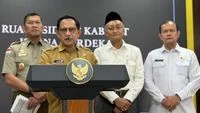
The necessity and operational readiness of this massive funding initiative were formally presented to President Prabowo Subianto by Minister of Home Affairs Tito Karnavian during a targeted limited cabinet meeting (ratas). Following the session, Minister Tito addressed the press, confirming that the Head of State expressed full endorsement of the fiscal plan without raising structural objections, emphasizing the urgency of restoring normalcy to the affected communities.
Crucially, the disbursement mechanism has been designed to bypass unnecessary bureaucratic layers by channeling funds directly to designated implementing ministries and state agencies rather than consolidating them under a single supervisory desk. The Ministry of Public Works (PU) is slated to receive a primary share of the portfolio, given its mandate to spearhead structural reconstruction. The funds will be systematically funneled into a diverse array of foundational recovery projects, encompassing the rebuilding of arterial roadways, educational institutions, houses of worship, traditional public markets, and targeted economic stimulus programs designed to revive micro, small, and medium-sized enterprises (MSMEs) that form the backbone of the local economies in Sumatra.
To ensure that execution matches the urgency of the situation, Minister Tito has issued strict directives for the rapid issuance of formal budgetary certainties. This administrative step is paramount, as it enables line ministries to immediately submit their definitive operational requirements to the Ministry of Finance and initiate early procurement auctions ahead of time. By accelerating the bureaucratic groundwork through early tendering processes, the government intends to have construction and recovery teams actively working in the field by January, or at the absolute latest, February 2027.
"The moment the Ministry of Finance issues the formal letter of approval, ministries and agencies are authorized to execute early procurement auctions. Following rapid bidding, we expect that once the funds are transferred in January, or by February at the absolute latest, boots must be on the ground and work must actively resume," Minister Tito underscored during his post-cabinet press briefing.
Comprehensive Master Plan and Three-Year Financial Roadmap
The newly approved Rp42 trillion allocation forms a vital component of a much broader, highly structured master blueprint overseen by the Task Force for the Acceleration of Rehabilitation and Reconstruction (PRR). According to comprehensive data compiled by the task force, the holistic recovery and master plan for the Sumatra region encompasses an expansive portfolio of 11,520 distinct operational activities scheduled across the 2026-2028 multi-year period.
This ambitious agenda targets the systemic repair and resilience enhancement of vital public assets, including comprehensive road networks, vulnerable bridges, river basin normalization to prevent future overflow, destroyed educational facilities, residential housing units, and the revival of critical agricultural and aquaculture sectors that sustain regional food security and employment.
The execution architecture relies on a multi-agency approach involving 23 primary ministries and state institutions. The aggregate financial requirement calculated for these core entities over the designated three-year span amounts to a staggering Rp100.16 trillion. When broken down chronologically, the financial commitment requires Rp38.93 trillion for the initial 2026 phase, Rp32.84 trillion for the 2027 operational window, and a concluding tranche of Rp28.28 trillion slated for 2028. In addition to these primary institutional actors, the framework incorporates 10 supporting ministries and agencies, which collectively require an additional Rp575.4 billion over the same operational timeline. Consequently, the total cumulative financing blueprint outlined within the national master plan reaches approximately Rp100.67 trillion.
Evaluating 2026 Progress and Regional Disparities
A retrospective assessment of the recovery efforts deployed during the preceding 2026 fiscal year highlights both significant progress and persistent bureaucratic challenges at the sub-national level. Out of the approximately Rp39.1 trillion central institutional budget requested for the initial phase, the central government successfully channeled Rp29.9 trillion to 33 participating ministries and agencies. These funds formed the financial bedrock for early-stage stabilization, debris clearance, and emergency shelter construction across the three designated provinces.
Simultaneously, the central administration provided substantial supplementary financial support directly to local regional governments, totaling roughly Rp12.34 trillion. This localized fiscal injection was divided into specific streams: Rp268 million channeled through the Unexpected Expenditure (BTT) post, approximately Rp10.65 trillion distributed via augmented General Transfer Funds (TKD), and an additional TKD allocation of about Rp1.4 trillion explicitly designated to cover regional personnel expenditures and ongoing disaster mitigation operations.
Despite these robust injections of capital, subsequent evaluations revealed concerning disparities in the actual realization and absorption rates of the supplementary TKD funds across different regencies and municipalities. Regional accountability varied wildly, threatening to undermine the efficacy of the centralized aid. In West Sumatra, the highest regional realization rate reached 54 percent, while other jurisdictions languished at a mere 5 percent utilization rate. In North Sumatra, the performance spectrum was similarly uneven; Asahan Regency managed to achieve a commendable 60 percent realization rate, whereas neighboring Mandailing Natal and Toba Regencies recorded a dismal zero percent absorption rate.
A parallel dichotomy was observed in Aceh, where Pidie Regency demonstrated exceptional efficiency by absorbing 93 percent of its additional TKD allocation, contrasting sharply with Bireuen Regency, which similarly recorded zero utilization. Addressing these discrepancies, Minister Tito issued a stern warning to local government leaders, demanding absolute fiscal transparency and strict adherence to mandated allocations. He cautioned regional authorities against diverting disaster recovery funds toward unrelated bureaucratic expenditures or allowing the capital to stagnate into unspent budget remainders (SILPA).
"Utilize these funds strictly for disaster-related purposes. Do not merely sit back and wait for handouts or instructions from the central government," Minister Tito asserted, emphasizing the principle of regional accountability.
Vulnerability to Secondary Disasters and Environmental Realities
Compounding the financial and logistical complexities of the large-scale reconstruction effort is the relentless threat of secondary natural disasters. Data compiled by disaster monitoring agencies indicate that between April and October, the affected provinces were struck by at least 41 secondary disaster events, predominantly flash floods, river overflows, and severe landslides.
These recurring environmental shocks have been documented across 13 distinct regencies and municipalities throughout Aceh, North Sumatra, and West Sumatra. The destructive nature of these secondary incidents has severely complicated recovery timelines, with several critical infrastructure segments that had already undergone emergency repairs being systematically destroyed or compromised a second time by subsequent deluges. This continuous cycle underscores the urgent necessity for the 2027-2028 reconstruction framework to prioritize climate-resilient engineering standards over simple structural restoration, ensuring that rebuilt roads, bridges, and public facilities can withstand future high-intensity weather anomalies driven by regional climatic shifts.
Broader Implications and Socio-Economic Outlook
The approval of the Rp42 trillion budget package by President Prabowo Subianto represents a critical milestone in Indonesia’s ongoing commitment to regional equity, disaster resilience, and human security. By establishing a clear, multi-year financial runway backed by early procurement protocols, the central government is attempting to mitigate the chronic bureaucratic delays that have historically plagued large-scale infrastructure projects in post-disaster zones.
The successful execution of the 11,520 planned recovery activities over the coming years will not only restore physical connectivity and social services to hundreds of thousands of displaced or economically disrupted citizens in Sumatra, but it will also serve as a definitive stress test for inter-institutional coordination between central ministries and regional administrations. As the clock ticks toward the targeted January-February 2027 operational launch, the pressure now rests heavily on both line ministries to finalize procurement swiftly and on local government heads to optimize their financial absorption rates, ensuring that every rupiah of the multi-trillion-rupiah investment translates into tangible, long-lasting safety and economic revival for the people of Aceh, North Sumatra, and West Sumatra.
Related posts: