Elevating Your Career in the Capital Market Through Professional WPPE Certification and Specialized Training

The Indonesian capital market has witnessed a significant surge in retail investor participation over the past five years, creating an unprecedented demand for qualified professionals who possess more than just academic knowledge. For university students and recent graduates, the transition from classroom theory to practical application in the financial sector remains a formidable challenge. To bridge this gap, industry-standard training programs focusing on the Wakil Perantara Pedagang Efek (WPPE) certification are becoming an essential prerequisite for those seeking to secure a competitive edge in the securities industry.
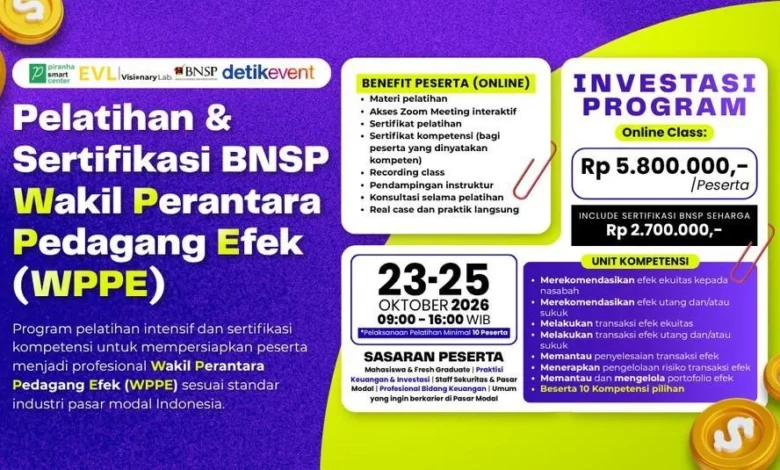
As the complexities of global finance continue to integrate with local market dynamics, the role of a licensed securities broker-dealer representative has evolved. It is no longer sufficient to merely understand market fluctuations; professionals must now navigate intricate regulatory frameworks, ethical standards, and advanced portfolio management strategies. With this in mind, a structured training program and certification initiative—scheduled for October 23-25, 2026—aims to equip the next generation of financial professionals with the technical competencies required by the National Professional Certification Agency (BNSP).
The Evolving Landscape of the Indonesian Capital Market
The Indonesian Stock Exchange (IDX) has reported a steady increase in the number of Single Investor Identification (SID) holders. According to recent data from the Indonesian Central Securities Depository (KSEI), the demographic profile of investors is shifting toward younger, tech-savvy individuals. This growth has prompted a corresponding need for licensed professionals who can provide sound, ethical, and regulatory-compliant advice to a burgeoning client base.
The WPPE certification serves as a professional gateway, ensuring that individuals acting as intermediaries in the securities market possess the requisite knowledge to protect investors and maintain market integrity. The certification covers a broad spectrum of critical areas, including the mechanics of equity transactions, the nuances of debt securities and sukuk, the intricacies of transaction settlement, and the implementation of robust risk management protocols.
Breaking Down the WPPE Competency Framework
A professional career in the capital market requires a synthesis of legal knowledge and analytical prowess. The curriculum for the upcoming WPPE training program is designed to move beyond the traditional "textbook approach," emphasizing practical, real-world scenarios.
- Regulatory Compliance and Ethics: Understanding the Otoritas Jasa Keuangan (OJK) regulations and the ethical obligations of a broker-dealer is the cornerstone of the certification. Professionals must be able to identify potential conflicts of interest and adhere to strict anti-money laundering (AML) and counter-terrorism financing (CTF) protocols.
- Equity and Fixed Income Markets: Participants are trained to analyze the technical aspects of stock trading, including order execution, market making, and the valuation of debt securities and sukuk.
- Portfolio Management and Risk Assessment: Modern financial advisory relies on the ability to monitor client portfolios, assess risk tolerance, and rebalance assets in accordance with market volatility. This requires a deep understanding of macroeconomic indicators and corporate financial statements.
- Operational Excellence: The settlement process, often overlooked by newcomers, is a critical component of market efficiency. Trainees gain insights into clearing and settlement mechanisms, ensuring they understand the "back-office" operations that facilitate seamless trading.
Bridging the Gap: From Theory to Professional Practice
The necessity for specialized training stems from the inherent disconnect between academic curricula and the rapid-fire nature of the financial services industry. While university programs provide a foundation in finance, economics, and accounting, they often lack the simulation-based learning required to manage high-pressure trading environments.
The methodology employed in this specific training program incorporates case studies, simulated trading environments, and direct mentorship from industry veterans. By engaging in these simulated exercises, participants learn to interpret market signals and apply regulatory constraints in real-time. This pedagogical shift—from theoretical rote learning to experiential training—is increasingly favored by human resources departments within major securities firms and investment banks.
Chronology of the Certification Program
The structured timeline for the October 2026 certification cycle is designed to maximize retention and ensure candidates are fully prepared for the rigorous BNSP assessment.
- Preparatory Phase (Pre-October 2026): Candidates are provided with preliminary reading materials and foundational modules to ensure all participants start with a baseline level of knowledge regarding market infrastructure.
- The Intensive Training Period (October 23–25, 2026): Over three consecutive days, participants undergo 42 hours of intensive instruction. Sessions are scheduled from 09:00 to 16:00 WIB daily, delivered via interactive digital platforms to accommodate both local and regional participants.
- Assessment and Simulation: Following the training modules, participants engage in a series of "tryouts" and mock examinations. These sessions are supervised by instructors who provide individualized feedback, identifying areas where candidates may need additional focus.
- BNSP Examination: The final stage involves the official competency test conducted by BNSP-accredited assessors. Successful candidates are awarded a certificate of competency, which is the gold standard for individuals pursuing roles in Indonesian broker-dealer firms.
Industry Implications and Career Prospects
The implications of obtaining a WPPE certification are significant for early-career professionals. In the current labor market, a degree is often viewed as the "entry ticket," but professional certifications such as the WPPE serve as a differentiator that signals technical competence and commitment to the profession.
For securities firms, hiring personnel who are already certified or are in the process of obtaining certification reduces the internal training burden and ensures that new recruits can contribute to the firm’s bottom line more quickly. Furthermore, as the Indonesian government continues to promote financial literacy, the demand for licensed professionals who can act as trustworthy intermediaries is expected to grow.
Market analysts suggest that the professionalization of the intermediary sector is a vital component of the country’s ambition to become a major regional financial hub. By ensuring that every market participant is guided by licensed, ethical, and competent representatives, the IDX can maintain investor confidence even during periods of market volatility.
Expert Insights on Professional Development
Industry leaders frequently emphasize that the "soft skills" of a broker—communication, critical thinking, and ethical judgment—are just as important as the technical knowledge of the market. During the training sessions, participants are encouraged to engage in discussions regarding current market trends, such as the impact of digital transformation on traditional brokerage services.
The inclusion of session recordings and post-training consultations ensures that participants have a resource to return to as they begin their careers. This ongoing support is crucial, as the capital market is subject to constant regulatory updates and technological disruptions, such as the rise of automated trading systems and algorithmic execution.
Conclusion and Call to Action
For those aspiring to build a sustainable and impactful career in the Indonesian capital market, the transition from an academic environment to the professional arena requires strategic preparation. The WPPE certification represents not just a requirement for employment, but a commitment to the highest standards of professional conduct in the financial sector.
By leveraging the combination of intensive instruction, practical simulation, and formal accreditation, students and professionals alike can ensure they are well-positioned to navigate the challenges and opportunities of the evolving financial landscape. Interested individuals are encouraged to review the comprehensive program details and finalize their registration through the official portal provided by DetikEvent. As the industry moves toward higher standards of competency, those who invest in their professional development today will undoubtedly lead the market tomorrow.