Bongkar 7 Red Flags Jurnal Predator Sebelum Submit: A Strategic Approach to Academic Integrity and Research Career Protection

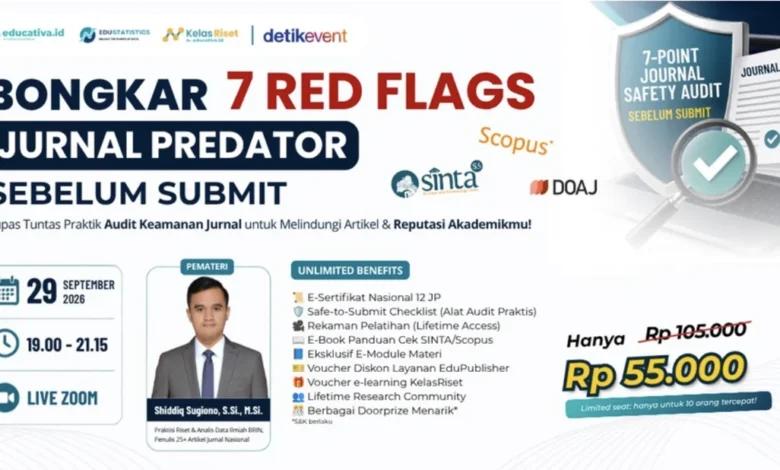
The academic landscape in Indonesia is currently facing a significant challenge regarding the proliferation of predatory journals, a phenomenon that threatens the integrity of scholarly research and the professional progression of countless researchers. As the pressure to publish intensifies within the higher education sector, the risk of falling victim to deceptive publishing practices has become a critical concern for both junior researchers and seasoned academics. To address this, a high-level educational initiative titled "Premium Webinar: Bongkar 7 Red Flags Jurnal Predator Sebelum Submit" has been scheduled for September 29, 2026. This Pre-Submission Journal Safety Audit is designed to equip the academic community with the necessary tools to navigate the complex, and often treacherous, terrain of scientific publishing.
The Anatomy of the Predatory Publishing Crisis
Predatory journals are characterized by their exploitation of the open-access model, where publishers charge high fees to authors without providing the rigorous peer-review processes, editorial oversight, or indexing services that characterize legitimate scholarly journals. In many cases, these journals mirror the look and feel of reputable publications, utilizing sophisticated website designs, falsified impact factors, and hijacked ISSNs to appear credible to unsuspecting researchers.
The implications of submitting a manuscript to a predatory outlet are severe. In Indonesia, the Ministry of Education, Culture, Research, and Technology (Kemendikbudristek) and the National Research and Innovation Agency (BRIN) maintain stringent standards for academic recognition. Research published in non-accredited or predatory journals is frequently disqualified from the Promotion and Rank Credit (PAK) system. For researchers, this means that months, or even years, of painstaking laboratory work, data collection, and manuscript preparation can be rendered obsolete in a single administrative review. Furthermore, the financial burden is substantial, as authors often pay millions of rupiah in publication fees, only to see their work ignored by the scientific community or rejected by institutional review boards.
Understanding the Risks: A Growing Institutional Concern
The rise of predatory publishing is not merely an individual error but a systemic issue. With the "publish or perish" culture deeply embedded in global academia, predatory publishers have found a lucrative market by promising rapid publication timelines, which are particularly attractive to researchers under pressure to meet grant deadlines or promotion cycles.
Data suggests that the volume of submissions to questionable journals has increased exponentially over the last decade. A study by the Committee on Publication Ethics (COPE) highlights that predatory practices are becoming increasingly difficult to detect as they evolve from simple spam emails to highly customized, domain-specific traps. In the Indonesian context, this issue has become a priority for institutional leaders who must safeguard the quality of national research output. The failure to identify these "red flags" early in the submission process can lead to significant delays in career advancement and the loss of valuable funding, as grant-awarding bodies often conduct audits of a researcher’s publication history as part of their eligibility criteria.
The 2026 Pre-Submission Safety Audit: A Proactive Solution
Recognizing the need for a standardized approach to journal verification, the upcoming webinar on September 29, 2026, serves as a practical intervention. The session will be led by Shiddiq Sugiono, S.Si., M.Si., a distinguished research practitioner and scientific data analyst at BRIN, who has successfully navigated the publication process with over 25 articles in reputable national and international journals.
The curriculum is structured to move beyond theoretical warnings. Instead, it focuses on a "Live Audit" methodology. During this segment, participants will observe the real-time dissection of active journal websites, learning to identify the subtle discrepancies that distinguish a legitimate publication from a predatory one. This hands-on experience is critical for researchers who may not have formal training in bibliometrics or editorial standards.
Seven Red Flags of Predatory Publishing
The webinar will center on the "7 Red Flags" framework, which serves as a checklist for researchers before they hit the "submit" button. While the full technical details will be unveiled during the session, the framework generally focuses on:
- Inconsistent Editorial Board Information: Predatory journals often list reputable researchers without their consent or provide vague information about their editors’ professional affiliations.
- Opaque Peer-Review Processes: A lack of clear timelines or the promise of "guaranteed acceptance" within an impossibly short duration is a primary indicator of non-standard practices.
- Deceptive Indexing Claims: Many predatory journals fabricate their metrics, claiming affiliation with databases like Scopus or Web of Science, or citing "alternative" metrics that mimic legitimate ones to appear more influential than they are.
- Poor Website Infrastructure: Look for broken links, grammatical errors, and outdated site designs that are inconsistent with high-impact publishing standards.
- Unsolicited Aggressive Marketing: While some legitimate journals advertise, predatory publishers often use spam, cold-calling, or personalized emails that flatter the author to induce quick submissions.
- Unclear Financial Transparency: Reputable journals disclose all fees upfront. Predatory journals often hide costs or change the terms of payment after the peer-review process has supposedly begun.
- Scope Creep: A journal that publishes on disparate topics—ranging from nuclear physics to early childhood education—often lacks the specialized focus and editorial expertise required for quality review.
Institutional Verification and Validation Tools
A major portion of the workshop will be dedicated to teaching researchers how to utilize the primary tools for academic verification. These include, but are not limited to, the SINTA (Science and Technology Index) system, Scopus Sources, the SJR (SCImago Journal Rank) database, the ISSN Portal, and the Directory of Open Access Journals (DOAJ).
Furthermore, participants will be introduced to the "Think.Check.Submit." initiative, an international campaign that helps researchers identify trusted journals for their research. By mastering these cross-referencing techniques, researchers can build a multi-layered defense against predatory tactics. The addition of a "Safe-to-Submit Checklist" provides a tangible asset that researchers can integrate into their regular workflow, ensuring that every submission is subjected to the same rigorous scrutiny.
Broader Implications for Indonesian Research
The impact of this webinar extends beyond the individual participant. By fostering a culture of verification, the initiative aims to enhance the overall quality of Indonesian scholarly output. As the country strives to improve its global standing in research and innovation, the ability to discern high-quality publishing outlets is a fundamental skill.
"The integrity of a nation’s research output is the foundation of its credibility in the global scientific community," says a representative close to the event organizers. "By empowering researchers with the ability to audit journals, we are not just helping them avoid administrative pitfalls; we are contributing to the elevation of Indonesian science."
Beyond the core instruction, the event offers a comprehensive support package. Participants will receive an E-Certificate (equivalent to 12 JP, or hours of professional development), the aforementioned Safe-to-Submit Checklist, lifetime access to the training recordings, and exclusive e-modules. Additionally, attendees gain entry into a broader community of researchers, facilitating ongoing peer support and collaborative verification.
Registration and Participation Details
The session is scheduled for Tuesday, September 29, 2026, via the Zoom platform. Interested researchers, doctoral candidates, and faculty members are encouraged to register through the official detikevent portal.
As the academic year progresses, the demand for such specialized training is expected to grow. Institutional leaders are encouraged to support their staff in attending, as the cost of a single misstep—both in terms of professional reputation and financial loss—far outweighs the investment in professional development. By systematically tackling the issue of predatory publishing, the academic community in Indonesia can ensure that its hard-earned research receives the recognition it deserves while maintaining the highest standards of scientific ethics.