Houdini II Performs High-Stakes Escapology Stunt in Hollywood to Commemorate the Centenary of Harry Houdini’s Passing

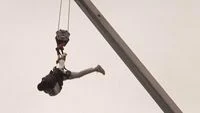
In a chilling display of physical endurance and psychological fortitude, a modern-day escapologist known as Houdini II performed an extreme stunt in Hollywood on Friday, October 30. Suspended 27 meters (approximately 88 feet) above the pavement outside the iconic Magic Castle, the performer successfully extricated himself from a tightly secured straitjacket. The demonstration, conducted without the safety net of a landing system, served as the centerpiece for a series of commemorative events marking the 100th anniversary of the death of Harry Houdini, the legendary illusionist who passed away on Halloween night in 1926.
The Anatomy of an Extreme Escape
The stunt began at midday, drawing a substantial crowd of onlookers, magic historians, and tourists who gathered along the bustling streets of Hollywood. Houdini II, encased in a heavy-duty canvas straitjacket, was hoisted into the air by a industrial-grade crane. As he dangled 27 meters above the ground, the performance relied entirely on the performer’s ability to manipulate his joints and utilize specific breathing techniques to gain the necessary slack within the restraints.
The absence of a safety net or cushioning system underscored the gravity of the performance. For the spectators, the tension was palpable; the sight of a human body suspended against the backdrop of the Los Angeles skyline created a stark visual reminder of the stakes involved in classic escapology. As the minutes passed, the crowd fell into a hushed silence, broken only by the mechanical hum of the crane and the occasional wind gust that buffeted the performer. When the straitjacket finally fell away, revealing the freed illusionist, the crowd erupted in applause—a moment that served as a visceral bridge between the traditions of early 20th-century performance art and contemporary spectacle.
Contextualizing the Centenary: The Life and Legacy of Harry Houdini
To understand the significance of this event, one must revisit the history of Erik Weisz, known to the world as Harry Houdini. Born in Budapest in 1874, Houdini rose to prominence as a master of confinement escapes, often performing death-defying feats in chains, ropes, and water tanks. His death on October 31, 1926, in Detroit, Michigan, from complications related to a ruptured appendix, sent shockwaves through the world of entertainment and beyond.
For the past century, Houdini’s name has become synonymous with the impossible. His influence transcends magic; he was a pioneer in public relations, an early proponent of aviation, and a vocal critic of the burgeoning spiritualist movement of the 1920s. The Magic Castle, a private clubhouse for the Academy of Magical Arts, has long been the primary custodian of his legacy in Southern California. By organizing this stunt, the institution sought to honor the technical precision Houdini brought to his craft while acknowledging the endurance of his brand in modern pop culture.
A Weekend of Remembrance and Ritual
The stunt was merely the opening act of a comprehensive weekend of memorialization at the Magic Castle. The itinerary included a curated auction of Houdini-related artifacts, featuring personal correspondence, original posters, and stage apparatuses that had remained in private collections for decades. These items provide researchers and collectors with granular data regarding the mechanics of Houdini’s illusions and the meticulous planning that underpinned his seemingly spontaneous escapes.
Perhaps most culturally significant was the inclusion of the "Houdini Seance." Throughout his life, Houdini was deeply skeptical of mediums and psychics, frequently exposing fraudulent practices. Before his death, he and his wife, Bess, agreed on a secret code—a series of words that only they knew—which he would attempt to communicate from the "other side." While the seance at the Magic Castle was presented as a traditional ritual, it served as a poignant nod to the lifelong struggle between the rationalism Houdini championed and the human desire for a connection beyond the veil of death.
Analysis of Escapology as a Performance Discipline
From a technical perspective, the act of escaping from a straitjacket—or any restraint—is a rigorous exercise in biomechanics rather than magic. Experts in the field note that such performances require extreme flexibility, the ability to control heart rate under duress, and a profound understanding of the equipment’s structural vulnerabilities.
"The danger is not an illusion," noted a spokesperson for the Academy of Magical Arts. "While we have evolved in terms of stunt coordination and risk management, the physical demands placed on an escapologist remain unchanged from 1926. What we witnessed today was an acknowledgment of the physical toll that Houdini accepted as part of his career."
The lack of a landing net, while controversial from a modern occupational health and safety perspective, was a deliberate choice to emulate the "purity" of the performances Houdini gave in the early 1900s. In an era of digital editing and CGI, the raw, unadulterated nature of the stunt provided a rare spectacle that resonated with the audience’s inherent fascination with physical risk.
Institutional and Public Response
The event drew praise from local civic leaders and members of the entertainment community. The Magic Castle, which operates as a bastion of magical history, emphasized that the event was not merely about entertainment, but about education. By placing a contemporary performer in a high-stakes scenario, the institution successfully translated the historical significance of Houdini into a format accessible to a modern, social-media-driven audience.
Reaction from the public was largely characterized by admiration for the performer’s physical composure. Law enforcement and city officials had coordinated with the production team to ensure that the necessary permits were in place, underscoring the shift from the unregulated stunts of the early 20th century to the highly professionalized, albeit still dangerous, performances of today.
Broader Impact: Why Houdini Still Matters
The enduring relevance of Harry Houdini, 100 years after his death, is a subject of ongoing sociological study. His life serves as a narrative arc that tracks the transition of entertainment from the Vaudeville circuit to the dawn of mass media. He was one of the first global celebrities to understand the power of branding, ensuring that his name remained on the lips of the public through constant innovation.
Furthermore, his legacy acts as a litmus test for the public’s relationship with mystery. In an age where information is instantaneous, the "unknown" has become a scarce commodity. Houdini’s success was rooted in his ability to manufacture mystery in a way that felt dangerous, personal, and profoundly human. The performance by Houdini II in Hollywood proves that the appetite for this type of theater has not waned. The audience’s reaction—a mixture of visceral fear and ultimate relief—mirrors the exact emotions documented in newspaper accounts from 1926.
Looking Toward the Future of the Craft
As the centenary events conclude, the focus for the magic community shifts to the preservation of these historical techniques. The auction of Houdini’s memorabilia is expected to set new benchmarks in the market for historical stage props, with proceeds reportedly slated to fund the restoration of archive materials held by the Magic Castle.
For the performer who braved the heights above Hollywood, the event was a culmination of years of training and a deep reverence for his predecessor. As he descended from the crane, the message was clear: while the man himself is long gone, the spirit of the "Handcuff King" continues to influence those who test the limits of human capability. The 27-meter drop was not just a stunt; it was a testament to the fact that, even in a world transformed by technology, the simple act of a human breaking free from their bonds retains an unmatched, primal power to captivate.
In summary, the events of October 30 served as a bridge between two centuries of performance history. By blending the high-stakes physical drama of the past with the logistical rigor of the present, the commemorative efforts ensured that the mystery surrounding Harry Houdini remains as potent in 2026 as it was in 1926. Whether through the lens of a historian analyzing the evolution of magic or a spectator simply watching a man defy gravity, the legacy of Houdini is firmly cemented for another generation, standing as a reminder that the most compelling story a human can tell is the one where they escape the seemingly impossible.
Related posts: