Excel for Accounting: Elevating Financial Proficiency Through Specialized Technical Training in Jakarta

In the modern corporate landscape, Microsoft Excel has transcended its origins as a basic spreadsheet application to become the backbone of financial operations worldwide. For accounting and finance professionals in Jakarta and beyond, mastery of this tool is no longer a luxury but a fundamental requirement for career progression and operational efficiency. As the volume of data generated by businesses continues to scale exponentially, the reliance on manual data entry and basic arithmetic functions has become a significant bottleneck, increasing the margin for human error and consuming valuable time that could be better spent on strategic analysis.
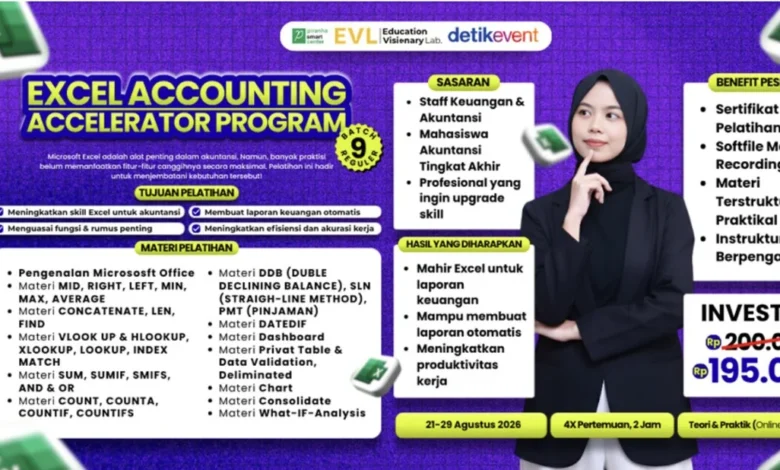
Recognizing this gap between basic spreadsheet usage and the complex analytical demands of contemporary finance, industry experts are emphasizing the transition from rudimentary data recording to advanced financial modeling. To address these evolving professional requirements, the Excel Accounting Accelerator Program has launched its 10th regular batch, providing a structured curriculum designed to bridge the gap between theoretical accounting knowledge and practical, high-efficiency digital execution.
The Evolution of Excel in Financial Reporting
Historically, accounting processes were confined to physical ledgers and rudimentary calculators. The advent of spreadsheet software in the 1980s revolutionized this workflow, yet many professionals today remain stuck in a transitional phase—using digital tools to replicate manual processes rather than leveraging the software’s inherent analytical capabilities.
Recent industry surveys indicate that while 85% of accounting professionals claim to be proficient in Excel, less than 30% possess the skills required to utilize advanced features such as Power Query, complex nested logic functions, or automated dashboarding. This skill gap often results in "Excel fatigue," where finance teams spend upward of 40% of their work week on data cleaning and reconciliation tasks that could be automated through sophisticated formula structures.
The transition to advanced Excel proficiency involves a shift toward dynamic reporting. Rather than static sheets, modern accounting standards demand real-time data visualization and scenario modeling. Features like "What-If Analysis," including Data Tables, Goal Seek, and Scenario Manager, allow professionals to simulate market volatility, tax fluctuations, and cash flow contingencies. By mastering these tools, an accountant shifts from being a mere record-keeper to a financial advisor capable of providing actionable insights to executive management.
Anatomy of the Excel Accounting Accelerator Program
The Excel Accounting Accelerator Program Reguler Batch 10 is designed to address these specific industry pain points. By focusing on a pedagogical approach that favors experiential learning, the program moves beyond rote memorization of formulas.
Curriculum Structure and Pedagogical Approach
The curriculum is segmented into four primary pillars:
- Advanced Formula Architecture: Moving beyond basic SUM and AVERAGE functions to master complex financial formulas such as VLOOKUP/XLOOKUP, INDEX-MATCH, and sophisticated logical operators that facilitate automated account reconciliation.
- Data Integrity and Validation: Implementing strict Data Validation protocols to ensure that financial reports remain error-free, regardless of the volume of input.
- Analytical Powerhouses: Deep dives into Pivot Tables and Slicers, which enable professionals to synthesize thousands of transactions into meaningful financial snapshots in seconds.
- Reporting and Dashboarding: The final phase focuses on data visualization—transforming raw general ledger data into executive-ready dashboards that track KPIs, budget variances, and cash flow projections.
Chronology of the Program
The program is structured to accommodate the schedules of working professionals. The sessions are scheduled for the following dates in September 2026:
- Session 1: September 21, 2026 (18:30 – 20:30 WIB) – Foundational Data Architecture.
- Session 2: September 22, 2026 (18:30 – 20:30 WIB) – Advanced Analytical Formulas.
- Session 3: September 28, 2026 (18:30 – 20:30 WIB) – Pivot Tables and Data Modeling.
- Session 4: September 29, 2026 (18:30 – 20:30 WIB) – Dashboarding and Final Presentation.
The virtual delivery via Zoom reflects the global shift toward remote professional development, ensuring that participants from diverse sectors can attend without the constraints of geographic location.
Data-Driven Decision Making: Why It Matters
The necessity for this level of training is underscored by the current economic climate in Indonesia. As businesses face increasing pressure to optimize costs and maximize profitability, the role of the accountant has evolved into a strategic business partner.
According to data released by several financial analytics firms, companies that utilize advanced automated reporting systems experience a 25% reduction in month-end closing times. This efficiency gain is not merely about speed; it is about accuracy. In an era where a single misplaced decimal point can lead to significant financial discrepancies, the use of automated data validation and formula-driven reporting is a critical risk mitigation strategy.
Moreover, the ability to conduct "What-If" analysis is particularly vital in the current inflationary environment. CFOs and financial controllers are increasingly reliant on their teams to provide rapid-fire analysis of "what happens if interest rates rise by 50 basis points" or "how does a 10% change in logistics costs impact our net margin." Without advanced Excel skills, these questions remain unanswered for days; with them, they can be answered in minutes.
The Broader Implications for the Finance Industry
The rise of specialized training programs like the Excel Accounting Accelerator suggests a broader trend: the "reskilling" of the finance workforce. As Artificial Intelligence and machine learning begin to enter the accounting space, the baseline expectation for human accountants is shifting. The mundane tasks—data entry, basic reconciliation—are increasingly being automated by AI. This leaves the human element of the profession to focus on high-level strategy, ethics, and interpretation.
However, even for those working alongside AI, Excel remains the universal language of finance. It is the bridge between raw data and human decision-making. Programs like this batch in Jakarta are serving as a necessary bridge for professionals who need to maintain their relevance in a digital-first economy.
Industry observers note that the success of such programs is often measured by the professional mobility of the graduates. Participants who upgrade their skill sets frequently report higher job satisfaction, improved salary negotiation leverage, and greater confidence in presenting reports to C-suite stakeholders. By mastering the tool, the accountant gains a level of autonomy that transforms their daily work from repetitive labor into an analytical craft.
Conclusion and Future Outlook
As the 10th batch of the Excel Accounting Accelerator Program approaches, the emphasis remains on the practical application of these tools. For the finance professional, the message is clear: the technology is only as powerful as the person wielding it.
The program organizers have noted that registration is currently open via the official Detikevent portal. The goal for this batch is to ensure that participants leave not just with a certificate, but with a toolkit of assets that can be deployed immediately in their professional lives.
As the industry moves forward, the divide between those who rely on manual calculations and those who leverage advanced Excel architecture will only continue to widen. For those in Jakarta’s accounting sector, this training represents an opportunity to close that gap, improve organizational efficiency, and solidify their positions as indispensable components of their respective financial departments. In a world where data is the new currency, the ability to process, analyze, and interpret that data through Excel is the definitive skill set of the modern professional.
Ultimately, the commitment to continuous learning in technical domains is what separates high-performing finance teams from the rest. As the September 2026 sessions commence, the focus will remain on building a cohort of professionals equipped to navigate the complexities of the future, armed with the knowledge that their spreadsheets are no longer just grids of numbers, but engines of business strategy.
Related posts: