Tragic Wedding Celebration Crash in Lumajang: Out-of-Control Truck Leaves Two Dead and Nine Injured

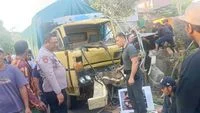
A joyous wedding celebration in the highlands of East Java turned into a scene of unimaginable horror when a heavy-duty truck suffered a catastrophic brake failure, careening directly into a crowd of festive guests and a line of parked vehicles. The devastating incident, which occurred mid-week in Dusun Sidomakmur, Gucialit Village, Gucialit Subdistrict, Lumajang Regency, has left an entire community in mourning. What was meant to be a day of union, cultural celebration, and communal gathering transformed instantly into a disaster zone characterized by shattered metal, flying debris, and frantic attempts to save the injured.
According to local law enforcement authorities, the final casualty toll stands at two fatalities and nine individuals sustaining injuries ranging from minor scrapes to severe trauma. The accident underscores ongoing concerns regarding the mechanical safety of heavy transport vehicles operating on challenging rural topography, particularly in regions marked by steep descents and densely populated local settlements. As investigators comb through the wreckage and gather witness accounts, the incident has reignited critical conversations surrounding road safety compliance, vehicle maintenance standards, and the inherent risks of hosting large-scale community events along active public thoroughfares.
Chronology of the Disaster: From Descending Slope to Chaos
The sequence of events leading up to the catastrophe unfolded rapidly on a Thursday afternoon, transforming a peaceful rural roadway into a path of destruction. Preliminary findings from the Lumajang Regency Police Traffic Unit establish the timeline and trajectory of the out-of-control vehicle.
At approximately 3:00 PM local time, a yellow Mitsubishi truck bearing the license plate N 8187 YH was traveling from west to east. The driver, a 69-year-old male identified by the initials KSM and hailing from the nearby Sukodono district, was navigating a notoriously downward-sloping section of the public road in Gucialit. As the heavy vehicle descended, the driver reportedly lost total control of the steering and braking mechanisms. Investigators have strongly pointed toward a catastrophic brake failure as the primary mechanical catalyst for the ensuing chain-reaction collision.
Unable to slow its momentum on the decline, the runaway truck first slammed into the rear of a black Suzuki Carry pickup truck with the license plate L 8060 AA. The smaller pickup was being driven in the same eastbound direction by a 38-year-old resident of Ngawi identified as ETS. The sheer force of the initial impact was immense, propelling the Suzuki Carry forward like a projectile into a tight cluster of pedestrians.
Tragically, this cluster consisted of wedding guests who had gathered outside the venue. The suddenness of the impact gave the victims virtually no time to react or seek shelter.
Even after plowing through the group of pedestrians, the destructive path of the Mitsubishi truck did not halt. The vehicle continued its uncontrolled eastward slide, subsequently crashing violently into a stationary Mitsubishi L300 pickup truck (license plate N 8157 YA) owned by a 49-year-old resident identified as SA, which had been parked along the roadside.
The cascading momentum of the runaway truck then directed its force toward a row of five motorcycles parked neatly by local attendees. The affected motorcycles included a red-and-black Honda Scoopy (N 2092 YAG), a brown Honda Scoopy (N 6139 YBD), a black Honda Beat (N 2515 YAD), and two black Honda Vario units bearing plates N 4855 YBF and W 4126 BI, respectively.
The destructive journey finally culminated when the truck smashed directly into the professional sound system setup positioned on the left shoulder of the road for the wedding reception, completely obliterating the audio equipment before finally coming to a rest. The entire sequence of destruction, from the initial loss of brakes to the final impact with the wedding equipment, transpired in a matter of terrifying seconds.
Casualties and Medical Response
The human toll of the Gucialit tragedy became immediately apparent in the chaotic moments following the crash, triggering a massive emergency response from local medical personnel, police officers, and civilian volunteers.
Among the wedding guests caught directly in the path of the propelled Suzuki Carry was MRN, a 46-year-old individual from Probolinggo. MRN sustained critical head injuries during the impact and was rushed by emergency responders to the nearest medical facility, the Gucialit Public Health Center (Puskesmas). Despite immediate resuscitation efforts by medical staff, the victim succumbed to severe cranial trauma while undergoing emergency stabilization.
A second fatality was recorded after the victim was transferred to a higher-level medical facility. AMV, a 20-year-old individual who suffered severe, life-threatening injuries during the collision, was rushed to the dr. Haryoto General Hospital. Despite the deployment of advanced trauma care resources, medical professionals were unable to save AMV, who passed away due to the severity of internal trauma.
In addition to the two fatalities, nine other individuals sustained various non-fatal injuries. The wounded victims have been identified by police initials as TR (40), YAI (29), SMY (63), YDR (30), MST (63), MSH (39), MDC (49), and DM (31). These survivors presented with a harrowing array of physical trauma, including extensive abrasions, severe facial contusions, deep lacerations, and multiple bone fractures, particularly in the upper extremities where victims attempted to shield themselves from the oncoming vehicles.
Furthermore, the driver of the runaway truck, KSM, did not escape unscathed. He sustained significant abdominal injuries as a result of the steering column collapsing inward during the initial impact. KSM was subsequently placed under police guard while receiving medical treatment for his injuries, as investigators prepared to take his formal statement regarding the mechanical status of the vehicle prior to the crash.
Official Investigation and Law Enforcement Response
In the wake of the disaster, the Traffic Unit (Satlantas) of the Lumajang Regency Police swiftly secured the accident scene, established a perimeter to manage curious onlookers, and initiated a comprehensive forensic investigation. Head of Public Relations for the Lumajang Police, Inspector Ipda Suprapto, provided official updates to regional media outlets, detailing the preliminary findings of the ongoing inquiry.
"Initially, the yellow Mitsubishi truck with license plate N 8187 YH was traveling from west to east, traversing a descending roadway," Suprapto stated during a press briefing. "As it traversed the downward-sloping public road, the truck suddenly experienced a malfunction in its braking system, resulting in total brake failure. The truck subsequently struck a black Suzuki Carry pickup truck traveling in the same direction directly ahead of it."
Suprapto emphasized that the investigation is currently being managed by the Traffic Accident Investigation Unit (Unit Gakkum) of the Lumajang Police. Authorities are examining multiple facets of the incident, including a rigorous technical inspection of the Mitsubishi truck’s braking system, transmission components, and overall load weight at the time of the crash. Investigators are also reviewing whether the vehicle possessed a valid periodic roadworthiness certificate (KIR) and whether routine maintenance schedules had been properly adhered to by the vehicle’s owner or operating company.
Furthermore, police are gathering testimonies from eyewitnesses, surviving guests, and the driver himself to construct an unassailable evidentiary timeline. While mechanical failure remains the primary working hypothesis, investigators are keeping all possibilities open, including potential issues related to driver fatigue, improper gear selection during a steep descent, or overloading of cargo that could have exacerbated the failure of the braking system.
Socio-Cultural Context and Road Safety Implications
The tragic incident in Gucialit has cast a stark spotlight on the complex intersection of local cultural traditions and public infrastructure safety across rural Indonesia. Across the archipelago, hosting wedding receptions, community celebrations, and family gatherings directly adjacent to or even spilling onto public roadways is a deeply entrenched social norm. In many rural townships where residential plots are tightly clustered along arterial village roads, utilizing the street shoulder or erecting temporary celebration tents (tenda hajatan) is often viewed as the only viable logistical option for accommodating large gatherings of relatives, neighbors, and well-wishers.
However, this widespread practice has long sparked debate among traffic safety experts and urban planners regarding the inherent vulnerabilities of mixing large concentrations of pedestrians with vehicular traffic, particularly heavy commercial transport. Rural roads in regions like Lumajang often feature challenging topographies—steep inclines, sharp hairpin turns, and narrow lanes—that demand exceptional mechanical reliability and driver vigilance. When heavy transport vehicles, which frequently haul agricultural produce, construction materials, or commercial goods through these corridors, experience unexpected mechanical failures, the proximity of pedestrians to the asphalt transforms a routine equipment malfunction into a mass-casualty event.
Transport safety analysts point out that aging commercial fleets continue to pose a persistent hazard on secondary and tertiary roads in Indonesia. Many older trucks operate well beyond their prime operational years without undergoing rigorous, standardized inspections, heightening the risk of catastrophic component failures such as severed brake lines, overheated brake drums, or transmission lockups. The disaster in Gucialit serves as a grim reminder that regulatory oversight of commercial vehicle roadworthiness cannot be restricted solely to major national highways; it must extend with equal rigor to rural feeder roads where heavy trucks share space with vulnerable road users and community gatherings.
Moreover, the psychological and social impact on the local community cannot be overstated. A wedding, universally celebrated as a milestone of joy, renewal, and familial unity, has been irrevocably scarred by sudden tragedy. The psychological trauma experienced by the surviving family members, the newlywed couple, and the residents of Dusun Sidomakmur will require long-term community support and psychological intervention. Funerals for the deceased victims replaced what should have been post-wedding festivities, leaving a profound void in the social fabric of the neighborhood.
As the legal proceedings advance under the jurisdiction of the Lumajang Police, community leaders and regional authorities are expected to re-evaluate local protocols concerning the issuance of permits for roadside celebrations. Discussions are likely to focus on establishing stricter safety buffers, mandating clearer warning signage for events held near active roads, and encouraging families to utilize enclosed community halls or open fields rather than public thoroughfares whenever feasible. Ultimately, the Gucialit tragedy stands as a sobering call to action for transport authorities, vehicle owners, and local communities alike, demanding a renewed commitment to vehicular safety and spatial mindfulness to prevent similar devastation from recurring on the nation’s roads.
Related posts: