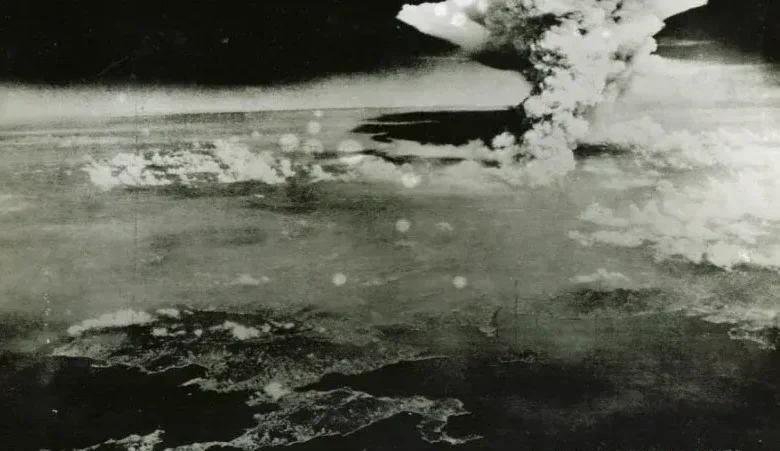
The catastrophic events of August 6, 1945, remain etched in human history as a turning point that fundamentally altered the geopolitical landscape and the existential security of the species. Recently, a meticulous re-examination of the flight logs from the Enola Gay—the B-29 Superfortress responsible for delivering the "Little Boy" atomic bomb—has unveiled a cryptic, two-word entry that has sent ripples through the scientific and historical communities: "Cloud gone." This brief observation, recorded by the crew nearly three hours after the detonation, provides critical data points that confirm the sheer, terrifying scale of the atmospheric disturbance caused by the blast.
The Shadow of Atmospheric Ignition
Before the detonation over Hiroshima, the Manhattan Project scientists were gripped by a profound, albeit theoretical, fear. J. Robert Oppenheimer, the scientific director of the project, and his colleagues had grappled with the mathematical possibility that a nuclear explosion might trigger a runaway chain reaction in the Earth’s atmosphere.
The primary concern, as articulated by physicist Arthur Compton in subsequent reflections, involved the potential for atmospheric nitrogen or hydrogen to ignite. The theory posited that the extreme temperatures generated by an atomic bomb could theoretically act as a catalyst for fusion, effectively setting the atmosphere on fire. If such a reaction were to occur, it would have been self-sustaining, leading to the rapid annihilation of all life on the planet. While the test at Trinity in New Mexico had passed without such a catastrophe, the deployment of the more volatile uranium-based "Little Boy" design in an urban environment brought these fears back into sharp focus for the scientific team behind the curtain of the war effort.
Chronology of the Hiroshima Mission
The mission to Hiroshima was the culmination of years of intensive research and development. On August 6, 1945, at 08:15 local time, the Enola Gay released the bomb over the city. The detonation occurred at an altitude of approximately 600 meters, creating a blast wave and a thermal pulse that obliterated the city’s infrastructure and claimed tens of thousands of lives instantaneously.
Following the drop, the Enola Gay and its support aircraft did not immediately depart the vicinity. The flight crews remained in the area to document the aftermath. George Caron, the tail gunner, provided one of the most haunting descriptions of the event: "I could see the city, and the city was covered by a low mass and appeared to be churning. It was like boiling molasses, spreading wide to the foothills, covering the whole city. Then there was fire, I could see flames coming through the layer covering the city. Tongues of flame appeared to be burning at various points."
It was during this period of observation, specifically at 10:52 a.m., that the crew logged the note "cloud gone." At that moment, the aircraft was approximately 760 kilometers away, cruising at an altitude of 7.6 kilometers.
Scientific Analysis: Decoding the "Cloud Gone" Entry
In a recent study published in Geophysical Research Letters, researchers utilized this specific log entry to reconstruct the behavior of the nuclear plume. The phrase "cloud gone" was interpreted as the moment the visual contact with the massive smoke column was lost, not because the plume had dissipated, but because it had moved beyond the visual horizon or been obscured by shifting atmospheric conditions.
By applying historical weather data and simulating 100,000 different atmospheric scenarios, the researchers were able to calculate the minimum height of the smoke column with a high degree of statistical confidence. The study concluded with over 95% certainty that the column of smoke and debris reached a height of at least 11.3 kilometers. The median estimate suggested that the column surged to an altitude of 12.1 kilometers.
This altitude is critical because it places the debris well into the upper troposphere, near the tropopause. At this height, smoke and radioactive particles can linger for extended periods, spreading across vast distances and significantly impacting global weather patterns.
Implications: The Specter of Nuclear Winter
The findings are profoundly significant when viewed through the lens of modern climate science. The height achieved by the Hiroshima plume is consistent with the initial parameters required for a "nuclear winter" scenario. A nuclear winter is a hypothetical period of global cooling caused by the injection of massive amounts of soot and aerosol particles into the upper atmosphere.
In such a scenario, these particles block a significant percentage of incoming solar radiation. If a large-scale nuclear exchange were to occur, the resulting smoke from burning cities—fueled by plastics, wood, and petroleum—would rise into the stratosphere. Once there, these particles could persist for years, leading to a catastrophic drop in global temperatures, the collapse of agricultural systems, and the potential for widespread famine.
While the bombing of Hiroshima serves as a grim baseline for these models, it remains a unique case study. Unlike the Nagasaki bombing, which did not trigger the same intensity of firestorms, the atmospheric conditions and the urban density of Hiroshima facilitated a massive, concentrated firestorm. The study underscores that the destruction caused by nuclear weapons is not limited to the immediate blast zone; it extends to the very structure of the Earth’s climate system.
Retrospective Analysis and Historical Context
The scientific community’s renewed interest in this 1945 log entry highlights how even historical records, previously scrutinized for military intelligence, hold vital lessons for contemporary survival. The fear expressed by Oppenheimer and his peers was not merely the product of paranoia; it was a reflection of the profound unknown inherent in unlocking the power of the atom.
Today, as international tensions remain fluid, the implications of the "cloud gone" observation serve as a sober reminder of the fragility of the global climate. The study suggests that even a singular, localized nuclear event is capable of generating massive atmospheric disruption. When scaled up to the stockpiles currently held by nuclear-armed nations, the potential for an anthropogenic climate catastrophe is not merely theoretical—it is an empirical probability.
The meticulous work of the researchers involved in this study provides a bridge between the visceral terror of 1945 and the data-driven concerns of the 21st century. By quantifying the altitude and impact of the Hiroshima plume, they have provided a clearer picture of the environmental legacy of the atomic age.
Conclusion: A Legacy of Responsibility
The phrase "cloud gone" may have been a simple notation by a flight crew in the cockpit of a B-29, but it represents the threshold of a new, dangerous era for humanity. The data derived from this entry confirms that the consequences of nuclear warfare transcend borders and generations. As the world continues to grapple with the proliferation of nuclear technology, the lesson from Hiroshima is clear: the environmental cost of nuclear detonation is a global burden that remains as relevant today as it was in the final days of World War II. The research underscores that the decision to use such weaponry carries with it the risk of altering the planetary climate in ways that could prove irreversible, reinforcing the necessity of diplomacy and the rigorous maintenance of nuclear non-proliferation frameworks.
Related posts: