From Earthrise to Earthset: A Visual Chronicle of Humanity’s Impact on a Fragile Planet, Seen from Lunar Orbit

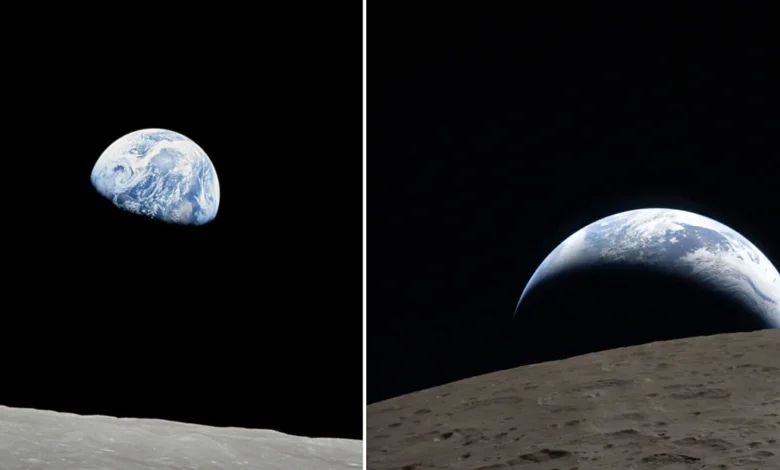
Fifty-eight years after Apollo 8 astronauts captured the iconic "Earthrise" photograph, forever changing humanity’s perception of its home, a new image, dubbed "Earthset," has emerged from the Artemis mission, offering a stark visual update on the profound transformations our blue planet has undergone. These two celestial snapshots, separated by decades of accelerating human activity, serve as powerful testaments to both Earth’s enduring beauty and its increasing vulnerability, revealing a world significantly altered by climate change and expansive human development.
The Genesis of Environmental Awakening: Apollo 8’s Earthrise
The year 1968 was tumultuous on Earth, yet high above, a pivotal moment in human history unfolded. On December 24, 1968, the Apollo 8 mission, the first crewed spacecraft to orbit the Moon, provided humanity with an unprecedented perspective. Aboard the command module, Commander Frank Borman, Lunar Module Pilot William Anders, and Command Module Pilot James Lovell Jr. were circling the Moon, preparing for the fourth of their ten lunar orbits. Borman vividly recalled the initial impression of the lunar landscape in an interview with the BBC in 2018. "The surface of the Moon was badly damaged, filled with meteoritic craters and volcanic remnants," he described. "Its colors were only grey, black, or white; there was absolutely no other color on the surface. Its condition was unimaginably chaotic."
However, as the spacecraft emerged from the far side of the Moon on its fourth orbit, a breathtaking sight greeted the crew. "We looked up, and Earth appeared in the background, rising above the lunar surface," Borman recounted. It was at this precise moment that Bill Anders, reacting quickly, grabbed a Hasselblad camera loaded with color film and captured what would become one of the most historically significant photographs ever taken: "Earthrise." This image, depicting a vibrant blue-and-white marble suspended in the black void of space, rising above the desolate lunar horizon, instantly captivated the world. Borman’s reflection on that moment underscored its profound impact: "Earth is the only object in the entire universe that has color; it was an extraordinary sight. We are very, very lucky to live on this planet."
The "Earthrise" photograph transcended its scientific and photographic significance, becoming a powerful catalyst for the burgeoning environmental movement. It offered humanity a unified perspective of its home, a fragile oasis of life in an otherwise barren cosmos. This image underscored the planet’s finite nature and the interconnectedness of all life, fostering a sense of global stewardship. Its impact was so profound that it is widely credited with inspiring the creation of Earth Day, first celebrated in 1970, and igniting a generation’s commitment to environmental protection. This phenomenon, often referred to as the "Overview Effect," describes the cognitive shift experienced by astronauts when viewing Earth from space, characterized by an increased understanding of the planet’s unity and fragility.
Artemis Returns: A New Vantage Point with "Earthset"
Fast forward nearly six decades, and NASA’s Artemis program is charting humanity’s return to the Moon, with the ultimate goal of establishing a long-term human presence and preparing for missions to Mars. As part of the Artemis I mission, an uncrewed test flight that orbited the Moon, the Orion spacecraft provided a new, equally poignant perspective. On April 6, 2023, at 18:41 UTC, the Orion spacecraft captured an image depicting Earth "setting" below the rugged lunar horizon, a visual counterpoint to the original "Earthrise." This image, aptly named "Earthset," offers a modern lens through which to examine our planet.
Unlike 1968, when space photography was a rarity, today, thousands of satellites constantly orbit Earth, capturing millions of images daily. Yet, the "Earthset" photo, taken by human-designed technology on a human-led mission, retains a unique emotional resonance. Craig Donlon of the European Space Agency (ESA) articulated this distinction, noting that human-captured images provide a different perspective. "It evokes a kind of emotion that says, ‘Wow, okay, that’s our little old Earth there, but that’s where we live, that’s everything’," he explained, emphasizing the unique connection and sense of responsibility such images can inspire. The "Earthset" image, taken through Orion’s window, revealed a side of Earth illuminated by the sun, showcasing white clouds swirling above the blue oceans of Oceania, while other regions lay shrouded in night. The detailed lunar surface in the foreground provided a stark reminder of the cosmic stage upon which this drama unfolds.
A Planet Transformed: Six Decades of Anthropogenic Change
The true power of comparing "Earthrise" and "Earthset" lies in their ability to visually represent the dramatic planetary changes that have occurred over the intervening 58 years. While "Earthrise" sparked an initial awareness of environmental fragility, "Earthset" serves as a sobering update, illustrating the tangible consequences of nearly six decades of accelerated human activity.
Atmospheric Shifts and Rising Temperatures
One of the most significant and quantifiable changes is the dramatic increase in atmospheric carbon dioxide (CO2) concentrations and the subsequent rise in global temperatures. In 1968, when Apollo 8 circled the Moon, CO2 levels hovered around 323 parts per million (ppm). By the time Artemis I captured "Earthset," these levels had surged past 420 ppm, representing an increase of approximately one-third. This rise is directly linked to the burning of fossil fuels, industrial processes, and deforestation.
Richard Allan, a professor of climate science at the University of Reading in the UK, highlighted the temperature implications: "Since Earthrise, carbon dioxide in the atmosphere has increased by about a third, and global temperatures have warmed rapidly, by at least 1°C." More precisely, global average temperatures have risen by approximately 1.1 to 1.2°C above pre-industrial levels, with the majority of this warming occurring in the last few decades. This warming manifests in more frequent and intense heatwaves, altered precipitation patterns, and rising sea levels, impacts that are increasingly visible and felt across the globe.
Vanishing Waters and Altered Landscapes
Beyond atmospheric changes, the physical surface of Earth has also been profoundly transformed. Human activities have reshaped vast swathes of land, a phenomenon that, while not always visible from a single space photograph due to cloud cover or angle, is well-documented by satellite imagery and ground observations. Professor Allan noted, "The planet is transforming as human activity changes the texture of the land as seen from space, such as the expansion of cities, the clearing of dense forests replaced by lighter agricultural land, and contributing to the drying of the Aral Sea."
The Aral Sea, once the fourth-largest lake in the world, serves as a tragic emblem of human-induced environmental catastrophe. Located between Kazakhstan and Uzbekistan, it has shrunk to less than 10% of its 1960s size, primarily due to Soviet-era irrigation projects that diverted its feeder rivers for cotton farming. This ecological disaster has led to the collapse of local fishing industries, severe dust storms carrying toxic agricultural chemicals, and extreme climate changes in the region. While "Earthset" might not show the Aral Sea directly, its dramatic shrinkage underscores the scale of human impact on hydrological systems and land use. The relentless expansion of urban areas, often at the expense of natural habitats and fertile agricultural land, also contributes to a visible alteration of the planet’s surface texture from orbit. Deforestation, particularly in vital regions like the Amazon and Borneo, replaces dense, dark forest canopies with lighter, often less biodiverse agricultural lands or barren ground, changing Earth’s albedo and contributing to climate feedback loops.
The Polar Sentinel: Antarctica’s Rapid Decline
Despite the differing angles and cloud cover between the two photographs, certain geographical features remain constant, offering crucial points of comparison. Benjamin Wallis, a glaciologist at the University of Leeds, pointed out, "While the photos show different parts of the Earth, one thing that does appear in both images is Antarctica and the Southern Ocean." This frozen continent and its surrounding waters are critical indicators of global climate health, and their transformation has been alarming.
"The Antarctic Peninsula is one of the fastest-warming parts of Earth, and 28,000 km² of ice shelves collapsed between the time the original image and the latest image were taken," Wallis revealed. This collapse includes significant events like the disintegration of the Larsen B ice shelf in 2002 and further losses, demonstrating the accelerating pace of glacial retreat. Petra Heil, science director at the British Antarctic Survey, added to this stark assessment: "We are now seeing drastic declines in seasonal sea ice cover in both hemispheres, and in North America, Eurasia, and Asia, we are seeing a much slower onset of seasonal snow cover and also earlier melting." The reduction in sea ice not only impacts polar ecosystems but also contributes to global warming by reducing the Earth’s reflectivity (albedo), allowing more solar radiation to be absorbed by the darker ocean. These changes have far-reaching consequences, including rising sea levels, altered ocean currents, and disrupted global weather patterns.
Scientific Consensus: Pinpointing Human Causation
The scientific community overwhelmingly attributes these observed changes to human activities. Petra Heil’s assessment reinforces this consensus: "I think we are quite confident, based on observations and also numerical models, to conclude that probably 90-95% of these changes are due to human activity." This strong scientific agreement is based on decades of rigorous research, climate modeling, and extensive data collection from various sources, including satellites, ground stations, and ice core samples. The evidence points to anthropogenic greenhouse gas emissions as the primary driver of current climate change, distinguishing it from natural climate variability.
Beyond the Frame: The Enduring Legacy and Future Imperative
The "Earthrise" and "Earthset" images, separated by an era of profound environmental change, together form a compelling visual narrative. "Earthrise" served as an initial call to action, reminding humanity of its shared home and common destiny. "Earthset," however, arrives at a critical juncture, serving as a powerful, albeit subtle, warning. It highlights that the beautiful, vibrant planet seen from afar is under immense pressure, and the damage observed today is far more extensive than what was evident in 1968.
Kathleen Rogers, president of the Earth Day network, reflected on the historical context and ongoing challenge: "From a distance, Earth looks so perfect and so beautiful. But when you get closer, you can see the damage from, let’s say, 150 years of progress. But it did inspire a generation to take real steps and become part of a movement." While significant damage was already being inflicted upon Earth in 1968, the scale and acceleration of environmental degradation since then have been unprecedented.
The images from space offer a unique psychological perspective – the "Overview Effect" – which has the potential to reignite a sense of global solidarity and urgency. They remind us that national borders and geopolitical disputes fade into insignificance when viewed against the backdrop of our shared, singular planetary home. As humanity continues its ambitious exploration of space, with programs like Artemis pushing the boundaries of human presence beyond Earth, these missions inadvertently reinforce the profound value and fragility of our home world. The data and visual evidence presented by "Earthset" underscore an imperative for renewed, concerted action. The journey from "Earthrise" to "Earthset" is not merely a chronicle of scientific achievement but a crucial visual diary of our planet’s transformation and a powerful reminder of our collective responsibility to safeguard it for future generations. The challenge now is to translate this cosmic perspective into tangible, transformative action here on Earth, ensuring that the next generation of lunar explorers sees a planet revitalized, not further diminished.
Related posts: