
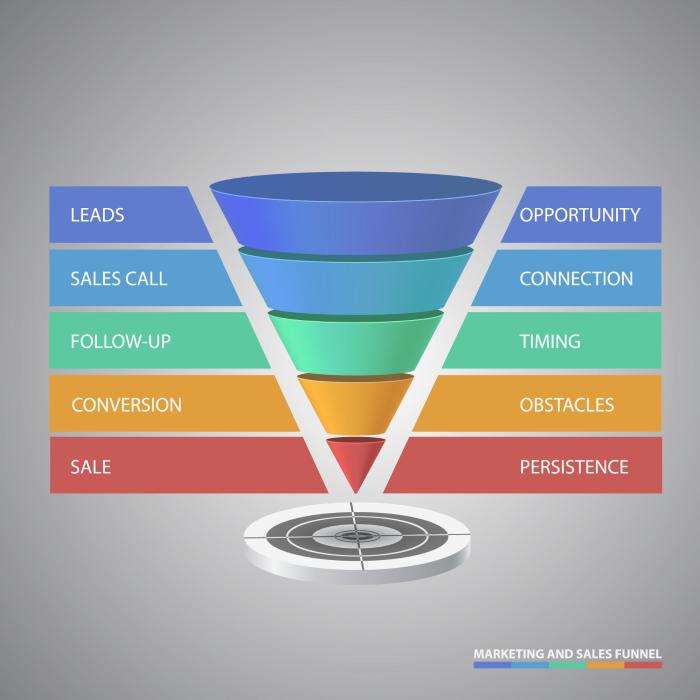
What is a conversion funnel? It’s the roadmap your website uses to guide visitors from initial interest to satisfied customers. This detailed exploration dives deep into the stages, components, and strategies for crafting a powerful conversion funnel that drives results. We’ll cover everything from defining the funnel itself to optimizing its performance.
Understanding the various stages of a conversion funnel is crucial for businesses. Each step, from initial awareness to final purchase, plays a vital role in the overall customer journey. A well-designed funnel not only increases conversions but also fosters stronger customer relationships and loyalty.
Defining the Conversion Funnel
A conversion funnel is a visual representation of the customer journey from initial awareness to the desired action, such as a purchase or signup. It breaks down the complex process into distinct stages, highlighting where potential customers might drop off and providing insights into optimizing the customer experience. Understanding these stages is crucial for businesses to understand how to effectively guide users through the process and maximize conversions.
Defining the Conversion Funnel
A conversion funnel is a structured process that guides potential customers through various stages to achieve a desired outcome. This outcome, often a purchase or subscription, is the conversion. Each stage represents a step in the customer’s journey, from initial exposure to the final action. The funnel metaphor highlights the narrowing nature of the process, with a larger pool of potential customers progressively filtering down to a smaller group who complete the desired action.
Stages of a Typical Conversion Funnel
The stages of a typical conversion funnel generally include awareness, interest, decision, action, and loyalty. Each stage is critical for moving the customer further along the path to conversion. Understanding the customer’s needs and motivations at each step is essential to guiding them effectively.
| Stage | Description | Importance |
|---|---|---|
| Awareness | Potential customers become aware of the product or service. This stage often involves initial exposure through marketing materials, social media, or search engine results. | Crucial for attracting the right audience and generating initial interest. Effective marketing strategies are essential to reaching potential customers at this stage. |
| Interest | Customers who have become aware of the product or service now show a genuine interest. They may begin researching the product or service, exploring features, and comparing options. | The opportunity to demonstrate value and address potential concerns. Providing relevant information and addressing questions is key. |
| Decision | Potential customers evaluate their options and make a decision on whether or not to proceed. This is often the stage where the customer is actively considering alternatives. | Highlighting unique selling propositions, demonstrating trust, and showcasing customer testimonials can be pivotal at this point. |
| Action | Customers take the desired action, such as making a purchase, signing up for a service, or downloading a resource. | This is the stage where the conversion occurs. A smooth and efficient process is critical to ensure a positive experience. |
| Loyalty | Satisfied customers become repeat customers and advocates for the brand. This stage is critical for long-term growth and brand building. | Encouraging repeat business through excellent customer service and loyalty programs can significantly boost revenue and brand reputation. |
Visual Representation of a Conversion Funnel
The following table provides a simplified visual representation of a conversion funnel. This illustration helps visualize the progressive narrowing of potential customers as they move through the different stages.
| Stage | Description |
|---|---|
| Awareness | Large pool of potential customers. Marketing efforts are aimed at reaching this large audience. |
| Interest | Smaller group of individuals actively showing interest. They are engaging with content and learning more. |
| Decision | Even smaller group actively considering their options. Persuasion is crucial at this point. |
| Action | Smallest group who have converted. The conversion has been successfully achieved. |
| Loyalty | Subset of satisfied customers who have become repeat customers. These individuals become advocates. |
Components of a Conversion Funnel
A conversion funnel isn’t just a theoretical model; it’s a roadmap to understanding how customers interact with your business. Understanding its components allows you to optimize each stage, leading to more conversions and ultimately, greater business success. This crucial knowledge allows businesses to identify pain points and improve user experience, driving engagement and boosting conversion rates.The conversion funnel, a vital tool for marketing analysis, comprises distinct stages through which potential customers progress toward a desired action.
Each stage plays a specific role in guiding the customer journey and ultimately influencing their decision-making process. Identifying and optimizing these stages can lead to a more efficient and effective marketing strategy.
Key Stages of a Conversion Funnel
Understanding the different stages within a conversion funnel is essential for businesses to understand the customer journey. Each stage represents a unique opportunity to engage with potential customers and guide them towards conversion. The stages aren’t linear; customers can enter at different points or revisit previous stages, requiring adaptability in your marketing approach.
| Stage | Description | Role in the Customer Journey |
|---|---|---|
| Awareness | The initial stage where potential customers become aware of your product or service. This stage focuses on reaching a wider audience and generating interest. | Creating initial interest and brand recognition. |
| Interest | Potential customers begin to explore your offerings in more detail. They are actively seeking information and evaluating your product or service against alternatives. | Providing valuable information and addressing customer questions. |
| Decision | This stage is crucial; potential customers actively compare your offering with competitors. They are weighing the pros and cons before making a decision. | Highlighting the benefits of your product/service, addressing any concerns, and showcasing trust signals. |
| Action | The stage where the potential customer takes the desired action, such as making a purchase or signing up for a newsletter. This is the conversion point. | Facilitating a smooth and efficient process for the customer to complete the desired action. |
| Retention | This stage focuses on keeping customers engaged and satisfied after conversion. It involves building loyalty and encouraging repeat business. | Building long-term relationships with customers and encouraging repeat business. |
Types of Conversion Funnels
Different businesses may have unique conversion funnel models, depending on the product or service offered. Understanding the variety of funnel types allows businesses to adapt their strategies accordingly.
- E-commerce Funnels: These funnels focus on driving online sales. They typically include stages like browsing, adding to cart, checkout, and order confirmation. A key component is showcasing product details, secure payment options, and clear shipping information.
- Lead Generation Funnels: These funnels aim to collect leads for future sales. They involve capturing contact information through forms, webinars, or other means. High-quality content and valuable offers are crucial in converting interest into leads.
- Service-Based Funnels: For service-oriented businesses, the funnel might include stages like scheduling a consultation, discussing needs, presenting solutions, and confirming the service. Clear communication and building trust are essential.
Optimizing Conversion Funnels
Optimizing conversion funnels is a continuous process. Regularly analyzing data and feedback is crucial to identify areas for improvement. A/B testing different elements of the funnel can help determine what resonates best with the target audience. For example, altering the placement of a call to action button, testing different pricing models, or modifying the design of a landing page can significantly impact conversion rates.
Conversion Funnel Stages in Detail
Understanding the journey your potential customers take from initial awareness to conversion is crucial for optimizing your marketing efforts. Each stage of the conversion funnel represents a distinct opportunity to engage and nurture prospects. A clear understanding of these stages, coupled with the ability to measure progress at each step, allows for strategic adjustments and ultimately, greater conversion rates.This detailed look at each stage provides actionable insights into how to enhance engagement and drive conversions at each critical point in the customer journey.
Knowing how users interact at each phase empowers businesses to fine-tune their strategies and maximize the return on investment.
Awareness Stage
This initial stage focuses on making your product or service known to potential customers. It’s about creating brand visibility and generating interest. Users are typically not ready to purchase at this stage but are becoming familiar with your offering.
- Initial Interaction: Potential customers might discover your brand through social media ads, search engine results, or referrals. They may browse your website or engage with your social media profiles.
- Action Examples: Visiting your website, liking or sharing social media posts, clicking on advertisements, subscribing to newsletters, or engaging with content on platforms like LinkedIn or Twitter.
- Measurement: Key metrics include website traffic, social media engagement, impressions, click-through rates (CTR), and newsletter sign-ups.
Interest Stage
At this stage, users have shown a genuine interest in your product or service. They’re actively seeking more information and exploring potential solutions.
- Further Engagement: Users might delve deeper into your website, reading product pages, case studies, blog posts, or watching explainer videos. They might also request more information through contact forms or chat functions.
- Action Examples: Downloading ebooks, watching webinars, exploring product demos, contacting sales representatives for inquiries, and interacting with customer support.
- Measurement: Key metrics include time spent on site, pages per visit, bounce rate, conversion rates from awareness to interest (e.g., percentage of website visitors who download a resource).
Decision Stage
This is the critical point where users evaluate your offering against competitors and make a purchasing decision.
A conversion funnel is essentially a roadmap for guiding visitors towards a desired action, like making a purchase. To make this journey smooth and intuitive, you need a clear and well-structured website. This includes strategically placing key calls to action and optimizing your site’s navigation. For example, learning how to add custom navigation menus in WordPress themes, like how to add custom navigation menus in wordpress themes , can greatly improve the user experience and ultimately boost your conversion rates.
Ultimately, a well-designed funnel is crucial for turning website visitors into paying customers.
- Comparison and Evaluation: Potential customers might compare your product or service to alternatives. They might read reviews, compare pricing, or look at testimonials from previous customers.
- Action Examples: Comparing your pricing plans with competitors, reviewing customer feedback, reading testimonials, and contacting customer support with specific questions.
- Measurement: Key metrics include the number of leads who progress to the decision stage, comparison actions taken, conversion rates from interest to decision (e.g., percentage of leads who initiate a contact request).
Action Stage
This is where the conversion happens. The user takes the final step of purchasing your product or service.
A conversion funnel is basically a visual representation of the customer journey, showing how potential customers move through different stages to become paying customers. Understanding this journey is crucial for effective marketing, and that includes incorporating SEO into your branding strategy. Incorporating SEO into your branding strategy is key to attracting and converting those potential customers.
Optimizing your website for search engines improves visibility and makes it easier for customers to find you, thus making your conversion funnel more efficient. Ultimately, a well-structured conversion funnel, with SEO integrated seamlessly, drives more conversions.
- Purchase or Conversion: Users complete the purchase process, subscribe to a service, or register for an event. This is the desired outcome.
- Action Examples: Filling out a purchase order form, completing a subscription process, signing up for a trial period, or clicking the “purchase” button.
- Measurement: Key metrics include conversion rate, average order value (AOV), customer acquisition cost (CAC), and the number of completed transactions.
Retention Stage
This stage is focused on building customer loyalty and driving repeat business.
- Post-Purchase Engagement: This involves providing excellent customer service, offering ongoing support, and encouraging repeat purchases. You might offer loyalty programs, exclusive content, or updates on new products/services.
- Action Examples: Responding to customer inquiries promptly, sending thank-you messages, offering follow-up support, and providing exclusive content or early access to new features.
- Measurement: Key metrics include customer lifetime value (CLTV), customer retention rate, and repeat purchase rates.
Visual Representation of Stages
| Stage | Description | User Actions | Measurement |
|---|---|---|---|
| Awareness | Initial brand exposure | Website visit, social media engagement | Traffic, engagement |
| Interest | Active exploration | Content downloads, demos, contact inquiries | Time on site, conversions |
| Decision | Evaluation and comparison | Reading reviews, comparing pricing, contacting support | Lead progression, conversion rates |
| Action | Purchase or conversion | Order completion, subscription | Conversion rates, AOV |
| Retention | Customer loyalty | Repeat purchases, engagement with support | CLTV, retention rates |
Creating a Conversion Funnel
Crafting a robust conversion funnel is more than just assembling a series of steps; it’s about meticulously designing a user journey that seamlessly guides prospects toward becoming customers. This involves understanding the specific needs and motivations of your target audience at each stage. This guide will detail a structured approach to building a successful funnel, from attracting users to encouraging conversions.Building a conversion funnel is not a one-size-fits-all process.
The specifics will depend on your industry, product, and target audience. However, a structured approach will ensure that you effectively capture attention, nurture interest, and ultimately drive sales. Let’s delve into the practical steps.
Attracting Users to Each Stage
Attracting users to different stages of the funnel requires tailoring your approach to resonate with their specific needs and motivations. Generic marketing tactics often fail because they don’t address the unique pain points and desires of prospects at each stage.
- Awareness Stage: Here, your primary goal is to make your product or service visible to potential customers. This can be achieved through strategic content marketing, social media engagement, search engine optimization (), and paid advertising campaigns. Consider creating valuable blog posts, informative videos, or engaging social media content that addresses their pain points and highlights your solution.
- Interest Stage: Once potential customers are aware of your offering, nurturing their interest is crucial. This involves showcasing the benefits of your product and demonstrating how it solves their problems. Use case studies, testimonials, and detailed product descriptions to paint a compelling picture of the value proposition.
- Decision Stage: This is where potential customers weigh their options. To encourage a decision in your favor, offer clear and concise calls to action (CTAs), competitive pricing, and robust product demonstrations. Make it easy for them to understand the next steps and confidently commit.
- Action Stage: This is the conversion stage. Make the purchase process as frictionless as possible. A user-friendly checkout process, secure payment gateways, and clear order confirmation are critical. Simplify the steps, and make sure the customer feels secure.
Encouraging Conversions at Each Stage
Encouraging conversions at each stage of the funnel requires strategic implementation of various techniques. The key is to tailor the messaging and actions to the specific needs and expectations of your audience.
- Awareness Stage: Generate valuable content that educates and informs potential customers. Offer free resources like ebooks, webinars, or checklists that address their pain points and position your brand as a thought leader.
- Interest Stage: Highlight the benefits and value of your product. Use compelling visuals, videos, and case studies to showcase how your product or service solves their problems. Focus on building trust and credibility.
- Decision Stage: Provide clear and concise calls to action (CTAs). Offer limited-time discounts, free trials, or guarantees to incentivize conversions. Provide detailed product information and testimonials from satisfied customers to reduce uncertainty.
- Action Stage: Simplify the purchase process. Ensure a seamless checkout experience with a clear and intuitive design. Offer multiple payment options and provide immediate order confirmation.
Designing and Implementing a Conversion Funnel
A structured approach is crucial for designing and implementing a successful conversion funnel.
- Define your target audience: Understand their needs, pain points, and motivations. Create detailed buyer personas to inform your messaging and strategy.
- Identify your goals: Clearly define the desired outcome of your funnel. What specific actions do you want users to take?
- Map out the customer journey: Create a visual representation of the steps a user takes from awareness to conversion. Identify potential bottlenecks and pain points.
- Choose the right tools: Select the platforms and technologies needed to support your funnel. This might include website builders, marketing automation software, and analytics tools.
- Implement and test: Put your funnel into action and continuously monitor its performance. Use A/B testing to optimize different elements and make data-driven improvements.
- Analyze and refine: Track key metrics and use the data to understand what works and what doesn’t. Continuously adjust and refine your funnel based on performance insights.
Measuring and Optimizing a Conversion Funnel: What Is A Conversion Funnel
Knowing your funnel’s performance is crucial for improvement. Tracking user interactions and analyzing data allows you to pinpoint bottlenecks and optimize each stage for maximum conversion. This proactive approach can significantly boost your bottom line by identifying areas for enhancement and ensuring a smooth user journey.Understanding your conversion funnel’s effectiveness is paramount for continuous growth and improvement. Measuring and optimizing this funnel enables businesses to identify areas requiring attention and implement strategies to enhance user experience, ultimately leading to increased conversions and a better return on investment.
Tracking User Interactions
Understanding how users navigate your funnel is essential for identifying pain points and optimizing the experience. Different methods offer varying levels of insight, and combining several can provide a comprehensive view. Tools like Google Analytics, heatmaps, and session recordings offer valuable data for this purpose.
Analyzing Data for Improvement
Data analysis reveals patterns and trends within the conversion funnel, highlighting areas needing attention. By examining bounce rates, click-through rates, and conversion rates at each stage, businesses can identify where users are dropping off and the reasons behind it. This systematic approach to data analysis helps focus improvement efforts on the most impactful areas.
Optimizing Each Stage of the Funnel
Optimizing each stage of the funnel involves a strategic approach. Each stage has unique considerations for enhancing user experience and driving conversions.
- Awareness Stage Optimization: Improving content quality and search engine optimization () can increase visibility and attract relevant traffic. Using compelling visuals, engaging headlines, and clear calls to action (CTAs) can enhance engagement. A well-structured landing page that accurately addresses user needs is also essential.
- Consideration Stage Optimization: Providing detailed product information, customer testimonials, and case studies can build trust and encourage further engagement. High-quality product demonstrations and interactive content that answer user questions can foster deeper interest. A strong FAQ section and personalized recommendations can also be valuable.
- Decision Stage Optimization: Offering multiple payment options, clear return policies, and secure checkout processes are crucial. Strong customer support is essential during this phase. A simple and intuitive design for the purchase process minimizes friction and improves the likelihood of conversion.
- Action Stage Optimization: Following up with customers after purchase is critical for customer satisfaction and repeat business. Prompt and helpful customer service can nurture loyalty. Providing post-purchase resources like product manuals or helpful articles can reinforce the value proposition.
Strategies for Increasing Conversions and Reducing Drop-Off Rates
Strategies for improving conversion rates and reducing drop-off rates often involve iterative improvements. A data-driven approach is critical to identify and address specific issues within the funnel.
| Interaction | Tracking Method | Analysis | Optimization Example |
|---|---|---|---|
| Landing Page Visits | Google Analytics, Heatmaps | Bounce rate, time on page, scroll depth | Improve page loading speed, clarity of value proposition, enhance design, optimize calls to action |
| Form Submissions | Form analytics, CRM data | Submission rate, completion rate, errors | Simplify form fields, validate inputs, reduce steps, enhance clarity |
| Product Views | E-commerce platform analytics | Average view duration, product details viewed | Enhance product descriptions, high-quality images, detailed specifications, recommendations |
| Cart Abandonment | E-commerce platform analytics | Reasons for abandonment, cart value | Offer incentives, provide checkout assistance, personalized messaging, reduce checkout steps |
Different Types of Conversion Funnels
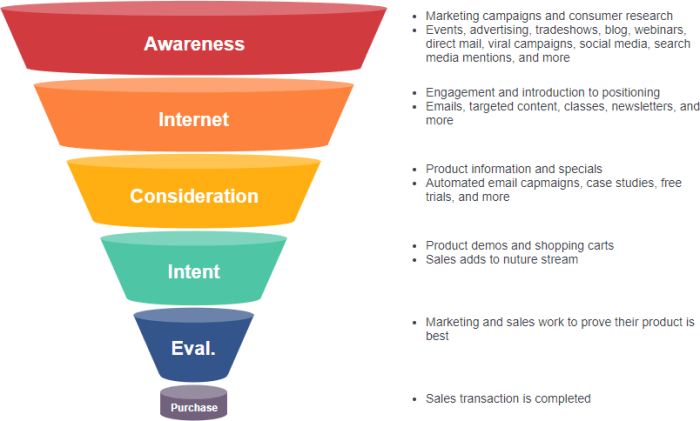
Conversion funnels aren’t a one-size-fits-all solution. Different businesses and products necessitate unique approaches to guide potential customers toward a desired action. Understanding the various types of conversion funnels empowers marketers to tailor strategies for optimal results. The choice of funnel type depends on the specific goals, target audience, and product or service being offered.Different funnel structures cater to diverse needs and customer journeys.
Each type possesses unique characteristics that influence its effectiveness in driving conversions. Understanding these differences enables businesses to select the funnel most aligned with their objectives.
E-commerce Conversion Funnels
E-commerce funnels are tailored for online retail businesses. They guide visitors through the stages of browsing, considering options, adding items to a cart, and completing a purchase. These funnels are heavily reliant on visual appeal, product descriptions, and seamless checkout processes. The goal is to create a frictionless experience that encourages high conversion rates.
Lead Generation Funnels
Lead generation funnels focus on acquiring potential customers’ contact information. These funnels typically involve offering valuable content (like ebooks or webinars) in exchange for email addresses or other contact details. This allows businesses to nurture leads and convert them into paying customers through follow-up communication. The key is to provide enticing content that justifies the exchange of information.
Sales Funnels for Services
Service-based businesses often employ specialized funnels. These funnels emphasize building trust and showcasing expertise. Content frequently includes case studies, testimonials, and high-quality educational resources. The goal is to establish credibility and position the service as the ideal solution for the client’s needs.
Content Marketing Funnels
Content marketing funnels are built around providing valuable information and engaging with potential customers through various content formats. These funnels are designed to establish authority, build brand awareness, and generate organic traffic to the website. Content pieces range from blog posts to infographics, aiming to attract and nurture leads.
Comparison of Funnel Types
| Funnel Type | Unique Characteristics | Effectiveness Comparison | Example Application |
|---|---|---|---|
| E-commerce | Focuses on seamless purchase process, high-quality product visuals, and persuasive product descriptions. | High conversion potential if implemented effectively. | Online clothing store, electronics retailer |
| Lead Generation | Emphasizes valuable content offers in exchange for contact information. | Strong lead generation potential, if the offer is compelling and the follow-up process is effective. | Software company, consulting firm, online courses |
| Sales for Services | Focuses on building trust and credibility, showcasing expertise through case studies and testimonials. | High conversion potential, if the service demonstrates high value and caters to a clear need. | Consulting firms, marketing agencies, financial advisors |
| Content Marketing | Focuses on attracting organic traffic through valuable content and establishing authority. | Builds brand awareness, long-term lead generation, and improved rankings. | Technology blog, SaaS company, educational website |
Illustrative Examples of Conversion Funnels
Conversion funnels aren’t just theoretical concepts; they drive real results for businesses across diverse industries. Understanding how successful companies utilize these funnels offers valuable insights for optimizing your own strategies. Let’s explore some compelling examples.Seeing successful conversion funnels in action provides concrete illustrations of the principles discussed earlier. By examining real-world implementations, we gain a clearer understanding of how to build effective funnels tailored to specific needs.
E-commerce Example: An Online Clothing Store
This online clothing store focused on a streamlined, visually appealing experience. They recognized the importance of mobile optimization and ensured a seamless shopping experience on all devices.
- The funnel started with targeted social media ads showcasing trending styles and limited-time offers. This generated high-quality leads, leading to a strong conversion rate.
- High-quality product images and detailed descriptions were crucial for encouraging purchase decisions. A clear return policy and secure payment gateway further boosted trust and conversion.
- Customer testimonials and reviews played a vital role in social proof. This approach increased credibility and confidence in the brand, directly impacting conversion.
- Personalized email marketing campaigns further nurtured customer relationships and encouraged repeat purchases. They segmented customers based on past purchases and preferences.
Software as a Service (SaaS) Company: A Project Management Tool, What is a conversion funnel
A SaaS company promoting a project management tool leveraged content marketing and a strong lead nurturing strategy.
- Blog posts and informative webinars were offered as valuable resources to potential users, establishing the company as an industry expert.
- Free trials and demos were readily available to allow potential customers to experience the software’s capabilities firsthand. A smooth onboarding process made the trial as seamless as possible.
- Targeted email sequences nurtured leads by providing relevant content and addressing their specific needs. They segmented the audience based on the trial’s completion status.
- A dedicated customer success team followed up with trial users, answering questions and addressing concerns. This helped to convert trial users into paying customers.
Travel Agency: Customizable Vacation Packages
A travel agency specializing in customizable vacation packages focused on building trust and showcasing value.
A conversion funnel is essentially a roadmap of how users interact with your website, from initial visit to desired action. Understanding this journey is crucial for optimizing your website’s performance. To effectively guide visitors through this process, you need to focus on strategies like how to promote your website , which includes SEO, social media marketing, and content creation.
Ultimately, a strong conversion funnel will lead to more conversions, which is the goal of any online business.
- The funnel began with targeted ads on travel-related websites and social media platforms. This focused on reaching users actively searching for specific vacation styles.
- Detailed, high-quality content showcasing various destinations, activities, and accommodations was presented. This highlighted the value proposition of the agency’s customizable packages.
- A personalized quote system allowed users to input their preferences to receive customized package options. This showed value by addressing individual needs.
- Testimonials and reviews from past clients were prominently featured, demonstrating the agency’s reliability and customer satisfaction. This further boosted trust.
Comparison Table
| Category | E-commerce | SaaS | Travel Agency |
|---|---|---|---|
| Acquisition Strategy | Targeted social media ads, | Content marketing, webinars | Targeted travel-related ads |
| Conversion Tactics | High-quality product images, customer reviews | Free trials, demos, email sequences | Personalized quotes, testimonials |
| Key Metrics | Conversion rate, average order value | Trial conversion rate, customer lifetime value | Lead generation, booking conversion rate |
Conversion Funnel Best Practices
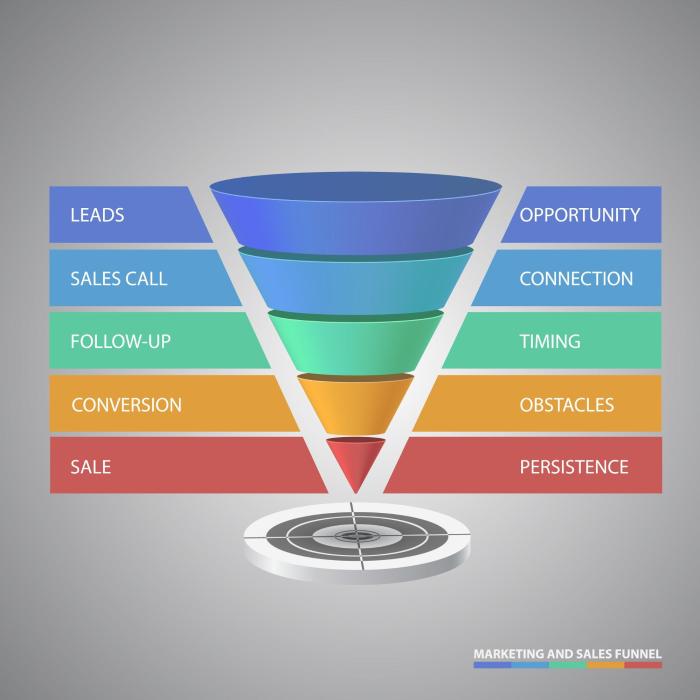
Crafting a high-performing conversion funnel requires a strategic approach that considers every step of the customer journey. Understanding the nuances of user behavior and implementing best practices throughout each stage is crucial for optimizing conversions. This involves not just attracting visitors but also guiding them smoothly through the process to achieve desired outcomes.Optimizing a conversion funnel isn’t a one-time fix; it’s an ongoing process of analysis, refinement, and adaptation.
By consistently monitoring key metrics and iterating on strategies, businesses can continuously improve their funnel performance and achieve greater success.
Attracting the Right Visitors
Effective funnel design begins with attracting the right visitors to the site. This requires a clear understanding of the target audience and tailoring the funnel to their specific needs and interests. This involves careful consideration of search engine optimization () and targeted advertising campaigns.
A well-defined target audience is crucial for a successful conversion funnel.
- Research: Thoroughly research s relevant to your product or service to attract users actively searching for solutions.
- Targeted Advertising: Employ targeted advertising campaigns on platforms like Google Ads or social media to reach potential customers based on demographics, interests, and online behavior.
- High-Quality Content: Creating valuable and engaging content that addresses user needs and answers their questions can significantly improve organic search rankings and attract targeted traffic.
Optimizing the Landing Page
A compelling landing page is the cornerstone of a successful conversion funnel. It’s the first point of contact for potential customers and should be designed to capture their attention and motivate them to take action. Clear calls to action (CTAs) and a visually appealing design are essential elements.
- Clear Value Proposition: Clearly communicate the value proposition of your product or service and highlight its benefits to the target audience.
- Compelling Headline: Craft a captivating headline that immediately grabs attention and conveys the value proposition concisely.
- High-Quality Visuals: Use high-quality images and videos to enhance engagement and credibility. Showcase product features and benefits effectively.
- Concise and Scannable Content: Present information in a clear, concise, and scannable format to avoid overwhelming users. Use bullet points, short paragraphs, and headings to guide the reader.
Enhancing User Experience (UX)
A positive user experience is paramount for driving conversions. Users should navigate the funnel effortlessly and intuitively, and they should feel confident in their interactions. A streamlined design and intuitive navigation are key elements.
- Intuitive Navigation: Design the funnel with intuitive navigation, allowing users to easily find the information they need.
- Mobile Optimization: Ensure the funnel is optimized for mobile devices to accommodate users accessing it from various devices.
- Fast Loading Times: Minimize loading times to maintain user engagement and prevent bounce rates. A slow-loading website is a major turnoff.
- Accessibility Considerations: Design the funnel to be accessible to users with disabilities, adhering to accessibility guidelines.
Encouraging Conversions
Effective strategies to encourage conversions at each stage of the funnel are essential. Implementing clear and compelling calls to action, utilizing persuasive language, and providing necessary information can significantly boost conversions.
- Clear and Compelling CTAs: Utilize clear and compelling calls to action (CTAs) throughout the funnel, guiding users toward desired actions.
- Incentivize Action: Consider offering incentives, such as discounts or bonuses, to encourage conversions. A limited-time offer can be very effective.
- Customer Support: Provide readily available customer support channels to address questions and concerns.
- Re-engagement Strategies: Implement strategies for re-engaging users who have abandoned their purchase or left the funnel at a certain stage.
Final Review
In conclusion, a conversion funnel is a dynamic tool for guiding potential customers toward desired actions. By understanding its components, stages, and optimization strategies, businesses can significantly enhance their conversion rates. This comprehensive guide provides the knowledge and tools necessary to build a high-performing funnel, resulting in tangible business growth.