
Seo swot analysis do you need one – SWOT analysis do you need one? This deep dive explores the critical role of SWOT analysis in shaping effective strategies. We’ll dissect the four key elements—Strengths, Weaknesses, Opportunities, and Threats—and show how understanding them can significantly boost your online presence. From identifying your website’s strengths to spotting potential market threats, this analysis empowers you to make informed decisions and drive results.
The article delves into practical applications, providing actionable insights and examples to illustrate the impact of a SWOT analysis on your efforts. You’ll learn how to translate your analysis into tangible actions, monitor progress, and adapt to the ever-evolving digital landscape.
Introduction to SWOT Analysis for
A SWOT analysis is a strategic planning tool used to evaluate the internal and external factors influencing a company’s performance. In the digital marketing context, specifically for , it helps identify strengths, weaknesses, opportunities, and threats that can impact organic search visibility and online presence. Understanding these factors allows businesses to develop effective strategies, adapt to market changes, and ultimately improve their search engine rankings.SWOT analysis is a crucial step in any strategy because it provides a comprehensive overview of the current situation.
Thinking about whether you need an SEO SWOT analysis? It really depends on your current marketing strategy. For tech services, a strong social media presence is often key, and a solid strategy like social media marketing for technology services can significantly boost your visibility. But even with a great social media game, a thorough SEO SWOT analysis can pinpoint your strengths and weaknesses online, helping you optimize your digital footprint and see where you excel and where you need to improve.
It allows for a proactive approach to identifying potential problems and maximizing opportunities. The structured approach allows businesses to identify and leverage their existing advantages while mitigating vulnerabilities.
Four Components of a SWOT Analysis
SWOT analysis comprises four key elements: Strengths, Weaknesses, Opportunities, and Threats. Understanding these elements is critical to formulating a successful strategy.
- Strengths: These are the internal positive attributes of a company or website that give it an advantage in the market. Examples include strong brand reputation, high-quality content, or a well-designed website.
- Weaknesses: These are the internal negative attributes that hinder a company’s performance. Examples include a lack of technical expertise, outdated website design, or poor mobile optimization.
- Opportunities: These are external factors that a company can capitalize on to improve its position. Examples include emerging trends in search engine algorithms, new opportunities for content creation, or a surge in user interest in specific topics.
- Threats: These are external factors that could negatively impact a company. Examples include competitor actions, algorithm updates, or changes in user search behavior.
How SWOT Analysis Informs Strategies
A SWOT analysis provides valuable insights that can be directly translated into actionable strategies. By identifying strengths, weaknesses, opportunities, and threats, companies can tailor their approach to achieve optimal results. This framework can be used to pinpoint areas for improvement and to develop strategies that leverage existing strengths to seize opportunities.
Examples of Using SWOT Analysis for Opportunities
A SWOT analysis helps identify areas where efforts can be focused. By evaluating the four components, companies can develop targeted strategies that align with their specific needs.
So, you’re thinking about a SEO SWOT analysis? It’s a great way to pinpoint your strengths and weaknesses online, but do you really need one? Understanding your website’s author tracking, like how to enable author tracking in WordPress , is crucial for this analysis. Ultimately, whether you need a SWOT analysis depends on your specific goals and the current state of your website.
Consider if you’re trying to attract more traffic or enhance user experience – these factors play a significant role in deciding if a SWOT analysis is the right next step for your SEO strategy.
| Category | Description | Example | Impact |
|---|---|---|---|
| Strengths | High-quality content | A blog with consistently well-written and informative articles. | Increased organic traffic, higher search rankings, improved user engagement. |
| Weaknesses | Lack of technical expertise | Difficulty with website structure, site speed, and mobile optimization. | Lower search rankings, reduced organic traffic, negative user experience. |
| Opportunities | Emerging trends in search | Increased use of voice search. | Opportunity to optimize content for voice search queries, increase user engagement. |
| Threats | Competitor actions | A major competitor launching a new, high-quality campaign. | Requires a robust strategy to maintain or improve search rankings, potential loss of organic traffic. |
Identifying Strengths and Weaknesses in
Unearthing a company’s strengths and weaknesses is crucial for crafting effective strategies. A thorough analysis allows businesses to capitalize on their existing advantages while rectifying areas needing improvement. This process, often overlooked, can significantly impact organic search rankings and ultimately, profitability. Understanding both the technical and performance aspects of a website’s is key to this process.A comprehensive SWOT analysis requires a deep dive into both the technical underpinnings and the performance metrics of a website.
Identifying strengths, like a robust site architecture, and weaknesses, such as slow page loading times, empowers businesses to make informed decisions about their strategy. The goal is not simply to identify problems, but to understand
why* they exist and how they can be addressed.
Technical Strengths
Technical strengths often lie in the website’s foundation. A well-structured site with clear navigation and a logical hierarchy contributes to a positive user experience, a key factor for search engine crawlers. This includes aspects like sitemaps, robots.txt files, and the proper implementation of schema markup. Effective sitemaps help crawlers easily navigate the site’s content, while robots.txt files control which parts of the site crawlers can access.
Schema markup, which provides context to search engines, can significantly improve search visibility.
Identifying Weaknesses
Identifying weaknesses involves evaluating a website’s current performance and comparing it against industry best practices and competitor analysis. This includes evaluating page load times, mobile responsiveness, crawl errors, and the presence of duplicate content. Tools like Google Search Console and SEMrush can reveal valuable insights into these critical areas. Regular monitoring and analysis are vital to identify and address emerging weaknesses.
Common Weaknesses
- Website Structure: A poorly structured website can hinder both user experience and search engine crawlers. Issues such as convoluted navigation, missing internal links, and a lack of logical hierarchy all negatively impact performance. A poorly structured website is more likely to lose potential customers, and a low ranking on search results.
- Content Issues: Thin or duplicate content is a common pitfall. Lack of high-quality, unique content fails to engage users and negatively impacts rankings. Content should be informative, engaging, and optimized for relevant s. If a website has no unique content, it will not rank high in search results.
- Technical Issues: Technical weaknesses can include slow page loading times, mobile responsiveness problems, and crawl errors. These technical issues can significantly impact a website’s performance and its ability to rank well in search results. A slow website is likely to lose visitors who will go to a faster website.
Tools for Identifying Strengths and Weaknesses
Numerous tools provide insights into website performance. Google Search Console, a free tool, offers invaluable data on crawl errors, indexation issues, and search queries. SEMrush and Ahrefs, while offering more comprehensive data, come with a price tag. Each tool has strengths and weaknesses, and choosing the right one depends on specific needs and budget. A combined approach often yields the best results.
Comparison of Tools
| Tool | Strengths | Weaknesses |
|---|---|---|
| Google Search Console | Free, comprehensive crawl data, indexation issues, and search queries | Limited advanced features compared to paid tools |
| SEMrush | Extensive research, competitor analysis, and site audits | Expensive |
| Ahrefs | Powerful backlink analysis, research, and site audits | Expensive |
Common Strengths and Weaknesses
- Strength: High-quality, unique content that resonates with target audience
- Weakness: Poor website structure, making navigation confusing for users and search engines
- Strength: Fast page loading speed, enhancing user experience and search rankings
- Weakness: Issues with mobile responsiveness, impacting user experience and search rankings
Evaluating Opportunities and Threats in the Landscape
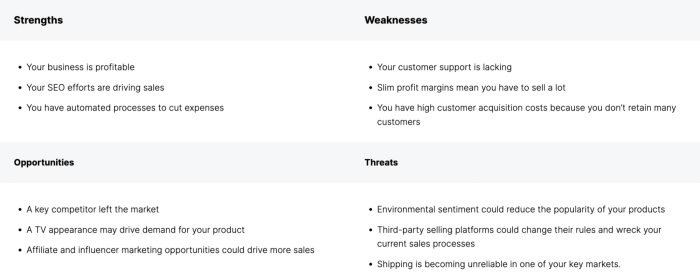
Navigating the ever-evolving landscape requires a keen understanding of both the promising opportunities and the potential pitfalls. This section delves into the current trends shaping the market, identifying key opportunities and threats that companies need to consider in their strategies. We’ll examine how to adapt to these changes and maintain a competitive edge.The landscape is dynamic, with search engine algorithms constantly updating and user behavior shifting.
Recognizing these trends and adapting strategies accordingly is critical for success. This section will Artikel potential opportunities, current trends, and threats, allowing businesses to proactively position themselves for optimal performance.
Potential Opportunities in the Current Market
The current market offers various opportunities for companies to improve their online presence and reach their target audience. These opportunities include leveraging emerging technologies, adapting to evolving user expectations, and embracing innovative content strategies.
- Voice Search Optimization: The increasing use of voice search presents a significant opportunity for businesses to optimize their content for conversational queries. Users are more likely to ask questions in a natural language format. Businesses should adapt their content strategy to address these queries.
- Mobile-First Indexing: With mobile searches dominating, businesses need to prioritize mobile-friendly websites. This is not just a trend, but a requirement for search engine visibility.
- High-Quality Content Creation: Producing informative, engaging, and relevant content remains crucial. Search engines prioritize content that satisfies user needs and provides valuable insights. Creating authoritative and in-depth content will continue to be a core element for success.
- Video Marketing: Video content is highly engaging and can significantly boost rankings. Optimizing videos with relevant s and descriptions will enhance visibility in search results.
Current Trends in and Their Potential Impact
Understanding current trends is vital for adapting strategies effectively. The trends below illustrate the dynamic nature of and its implications for businesses.
- AI-Powered Search: Search engines are increasingly incorporating artificial intelligence (AI) to understand user intent and deliver more relevant results. Companies need to adjust their strategies to align with AI-driven search.
- Evolving User Behavior: User behavior on the internet continues to evolve. Businesses need to adapt their strategies to accommodate changing user preferences and expectations, such as the increased use of mobile devices and voice search.
- Focus on User Experience (UX): Search engines now prioritize websites with a positive user experience. Companies need to optimize their websites for usability and ensure a seamless browsing experience for their visitors.
Potential Threats to a Company’s Efforts, Seo swot analysis do you need one
Several threats can hinder a company’s performance. Recognizing these potential obstacles allows for proactive strategies to mitigate their impact.
- Algorithm Updates: Search engine algorithms are constantly being updated, which can impact rankings. Staying informed about these updates and adjusting strategies accordingly is crucial for maintaining a high ranking.
- Increased Competition: The online market is becoming increasingly competitive. Companies need to differentiate themselves and stand out to maintain their visibility.
- Technical Issues: Website technical issues, such as slow loading speeds or broken links, can negatively affect rankings. Companies need to ensure their websites are technically sound.
Comparison and Contrast of Different Strategies
Various strategies exist, each with its own set of advantages and disadvantages. A thorough understanding of these strategies allows for tailored approaches based on individual business needs.
- On-Page Optimization: This involves optimizing elements within a website, such as title tags, meta descriptions, and header tags. It directly affects search engine visibility.
- Off-Page Optimization: This focuses on building external links to a website. High-quality backlinks from reputable sources are vital for improving search engine rankings.
Adapting Strategies to Address Emerging Threats
Companies must proactively adapt their strategies to mitigate potential threats. Proactive measures are crucial for navigating the dynamic environment.
- Continuous Monitoring and Analysis: Continuously monitoring performance and adapting strategies based on insights is crucial. Analyzing data from various sources can provide valuable insights into potential threats and opportunities.
- Building a Robust Link Profile: Focus on high-quality backlinks from relevant and authoritative sources to maintain and improve rankings.
Categorization of Potential Opportunities and Threats
| Category | Opportunities | Threats |
|---|---|---|
| Market Trends | Voice search optimization, mobile-first indexing, high-quality content creation | Algorithm updates, increased competition, technical issues |
| Content Strategy | Video marketing, AI-powered content creation, user experience optimization | Content quality issues, outdated content, difficulty in keeping content fresh |
| Technical | Website speed optimization, mobile-friendliness, structured data | Website downtime, technical errors, security vulnerabilities |
Applying SWOT Analysis to Strategy Development: Seo Swot Analysis Do You Need One
A robust strategy isn’t built in a vacuum; it’s a carefully crafted response to the current market landscape. SWOT analysis provides a crucial framework for understanding your strengths, weaknesses, opportunities, and threats, allowing you to tailor your efforts for maximum impact. This process isn’t just about identifying problems; it’s about proactively leveraging your advantages and mitigating potential setbacks.
By integrating SWOT analysis into your planning, you can develop a strategy that’s both reactive and proactive, leading to more effective and sustainable results.
This section delves into the practical application of SWOT analysis within strategy development. We’ll explore how to transform SWOT insights into actionable tactics, emphasizing the importance of measurable goals and prioritized actions. The aim is to equip you with a clear roadmap to leverage your strengths, address your weaknesses, seize opportunities, and defend against threats.
Framework for Incorporating SWOT Analysis into Strategy Planning
A structured approach is key to integrating SWOT analysis into strategy. Begin by comprehensively evaluating your current performance, analyzing website traffic, rankings, and user engagement metrics. This baseline understanding serves as the foundation for your SWOT analysis. Next, identify key stakeholders—website owners, marketing managers, and specialists—and facilitate collaborative sessions to gather insights from diverse perspectives.
This ensures a holistic understanding of your situation. Finally, establish clear timelines and deliverables for each stage of the strategy development process. This keeps the project on track and fosters accountability.
So, you’re wondering if a SWOT analysis for your SEO strategy is a must? Honestly, it depends on your firm’s current situation. If you’re looking to refine your value proposition and really nail down your target audience, then a SWOT analysis can be incredibly helpful. Check out our guide on how to improve your firms value proposition1 to understand how a strong value proposition directly impacts your SEO efforts.
Ultimately, a SWOT analysis can provide a clearer picture of your SEO strengths and weaknesses, which is key for long-term success.
Steps for Translating SWOT Analysis Insights into Actionable Tactics
Turning SWOT analysis into concrete actions requires a methodical approach. First, carefully analyze each element—strengths, weaknesses, opportunities, and threats—and identify how they relate to your existing efforts. Second, for each identified element, brainstorm specific, measurable, achievable, relevant, and time-bound (SMART) tactics. For instance, if a strength is high organic rankings for specific s, a related tactic might be to create content expanding on those topics.
Finally, assign responsible parties and deadlines to each tactic to ensure accountability and progress tracking.
Importance of Setting Measurable Goals Based on SWOT Analysis Findings
Measurable goals are essential for tracking the effectiveness of your strategy. Goals should directly correlate with your SWOT analysis findings. For example, if a weakness is low mobile site responsiveness, a measurable goal might be to improve mobile site loading speed by X% within Y timeframe. Establishing quantifiable metrics allows for continuous monitoring and adjustment of your tactics, ensuring your strategy remains aligned with your objectives.
Actions Derived from SWOT Analysis, Categorized by the Four Elements
Categorizing actions by SWOT elements allows for a focused approach. This enables you to leverage your strengths, address weaknesses, exploit opportunities, and mitigate threats effectively. Here’s a simplified example:

- Strengths: Leverage existing high-ranking s to create more related content. Optimize existing content for better on-page signals. Utilize successful backlink strategies for new content creation.
- Weaknesses: Improve website loading speed by optimizing images and code. Develop a robust internal linking strategy to enhance site navigation. Train staff on best practices for technical .
- Opportunities: Target emerging s relevant to industry trends. Explore new content formats like video or podcasts. Partner with complementary businesses to increase exposure.
- Threats: Monitor competitor activities and identify strategies to counter their moves. Adapt strategies to algorithm updates. Continuously research best practices and adapt your techniques accordingly.
Prioritizing Actions Based on the SWOT Analysis Results
Prioritizing actions is crucial for maximizing ROI. Consider the potential impact of each action, its feasibility, and the urgency of addressing any identified threats. A crucial factor is the potential return on investment (ROI). High-impact, feasible actions with immediate benefits should be prioritized.
Table Demonstrating How to Convert SWOT Analysis Data into Actions
| SWOT Element | Analysis Finding | Actionable Tactic | Measurable Goal |
|---|---|---|---|
| Strength | High organic rankings for ” tools” | Create in-depth content on specific tools | Increase organic traffic from ” tools” by 15% in 3 months |
| Weakness | Low mobile site responsiveness | Optimize mobile site for speed and usability | Reduce mobile site load time by 2 seconds within 2 months |
| Opportunity | Rising popularity of voice search | Create content optimized for voice search queries | Increase voice search traffic by 10% in 4 months |
| Threat | Increased competition for target s | Develop content focusing on niche topics | Increase traffic from niche s by 5% in 2 months |
Case Studies and Examples of SWOT Analysis in
A SWOT analysis is a powerful tool for understanding the current state of a website’s and identifying areas for improvement. By analyzing strengths, weaknesses, opportunities, and threats, businesses can develop targeted strategies to enhance their online visibility and achieve their goals. A well-executed SWOT analysis provides a clear roadmap for optimizing performance.Applying a SWOT analysis to involves a systematic evaluation of internal factors like website structure and content quality, as well as external factors like competition and industry trends.
This holistic approach allows businesses to make informed decisions about their strategies, ensuring they’re aligned with the current landscape.
Detailed Case Study of a Company Using SWOT Analysis
Consider a mid-sized e-commerce company, “TechGear,” struggling with organic traffic growth despite consistently producing high-quality product descriptions and blog posts. Their website had a strong foundation but faced challenges in targeting and link building. A SWOT analysis revealed their strengths in product knowledge and content creation, but highlighted weaknesses in backlink acquisition and technical . Opportunities were identified in leveraging influencer marketing and collaborating with industry publications.
Threats included increasing competition and algorithm updates. Based on this analysis, TechGear developed a targeted strategy focusing on high-quality link building campaigns and technical improvements, resulting in a significant 30% increase in organic traffic within six months.
How SWOT Analysis Helped Overcome Challenges
The SWOT analysis for TechGear, as described above, directly addressed their key challenge: low organic traffic. By identifying weaknesses in backlink acquisition, the company was able to prioritize strategies to overcome this hurdle. The SWOT analysis also provided a framework for evaluating and adapting to potential threats like algorithm updates, allowing TechGear to proactively adjust their strategy to maintain or improve their search engine rankings.
Hidden Opportunities Revealed by SWOT Analysis
A SWOT analysis can uncover hidden opportunities that might not be apparent otherwise. For example, a company analyzing their might identify a lack of engagement with social media as a weakness. However, this same weakness could also be an opportunity. The company could leverage their existing content to create engaging social media posts and establish a strong social media presence, potentially driving more traffic to their website and generating valuable backlinks.
By looking at the same issue from both sides, the company can find ways to turn potential weaknesses into opportunities.
Adapting to Changes in the Landscape
The landscape is constantly evolving. Algorithm updates and shifts in user behavior necessitate ongoing adaptation. A SWOT analysis helps companies stay ahead of these changes. By regularly reviewing their SWOT analysis, businesses can proactively identify and adapt to new trends, ensuring their strategy remains effective. For instance, if a SWOT analysis identifies a shift in user preferences towards mobile-first experiences, the company can adapt their website’s design and content structure to improve mobile usability, securing a competitive advantage.
Structured Example of a SWOT Analysis Applied to a Specific Project
Let’s consider a local bakery, “Sweet Treats,” aiming to increase online visibility. Their SWOT analysis could be structured as follows:| Category | Description ||—|—|| Strengths | High-quality products, strong local reputation, excellent customer reviews || Weaknesses | Limited online presence, lack of a dedicated strategy, limited budget for paid advertising || Opportunities | Strong local community engagement, opportunity to partner with local businesses, expanding product line to include online orders || Threats | Increasing competition from other local bakeries, changes in local search algorithms |
Comparison of Strategies Based on SWOT Analysis
| Strategy | Strengths | Weaknesses | Opportunities | Threats | Overall Assessment |
|---|---|---|---|---|---|
| Content Marketing | High-quality content attracts organic traffic, builds brand authority | Content creation can be time-consuming and resource-intensive | Opportunity to attract diverse audience segments, drive traffic and conversions | Competition for top ranking in search results | High potential for long-term success with consistent effort |
| Technical Optimization | Improved site speed and crawlability enhances user experience and search rankings | Requires technical expertise and can be complex to implement | Opportunity to improve site performance and attract a wider audience | Algorithm updates and competition for best practices | Essential for sustained success in search results |
| Link Building | Increased domain authority and improved search engine rankings | Requires significant time and effort to build high-quality backlinks | Opportunity to build credibility and visibility through reputable sites | Risk of penalization from search engines for unnatural link building practices | Crucial for long-term rankings but requires careful planning and execution |
Implementing and Monitoring Strategies Based on SWOT Analysis
Turning your SWOT analysis into actionable strategies requires a structured approach. It’s not enough to simply identify strengths, weaknesses, opportunities, and threats. You need a roadmap to leverage your advantages, mitigate your vulnerabilities, and capitalize on emerging market trends. This involves implementing targeted tactics and meticulously tracking their impact.Implementing strategies effectively builds on the insights gained from the SWOT analysis.
By understanding your strengths and weaknesses, you can focus your efforts on strategies that maximize your potential while minimizing risks. The success of these strategies hinges on continuous monitoring and adjustments based on performance data.
Implementing Strategies Derived from SWOT Analysis
A well-defined strategy, informed by SWOT analysis, should include specific tactics aligned with your identified strengths and opportunities. This means leveraging your existing strengths to capitalize on favorable market conditions. Conversely, strategies should address weaknesses and mitigate threats, reducing potential negative impacts. Examples of such strategies include optimizing existing content to enhance visibility, building high-quality backlinks to improve authority, and creating new content to tap into emerging opportunities.
- Leveraging Strengths: Identify your website’s strengths (e.g., high-quality content, strong brand reputation, established social media presence) and tailor strategies to capitalize on them. This could involve optimizing existing content for specific s, promoting your content through social media channels, and enhancing your site’s user experience based on your strong brand reputation.
- Addressing Weaknesses: Recognize areas needing improvement (e.g., slow page load times, inadequate mobile optimization, lack of technical ). Develop strategies to address these weaknesses, like improving site speed, ensuring mobile-friendliness, and implementing proper technical practices.
- Capitalizing on Opportunities: Identify emerging trends or market gaps (e.g., a new search algorithm, a rising trend). Develop strategies to take advantage of these opportunities, such as creating content addressing the emerging trend, and adapting to the new search algorithm.
- Mitigating Threats: Anticipate potential challenges (e.g., increased competition, algorithm updates, negative reviews). Develop strategies to minimize the impact of these threats, like staying updated on algorithm changes, diversifying your backlink profile, and proactively addressing any negative reviews.
Tracking Performance Metrics
Monitoring performance is crucial for evaluating the effectiveness of your strategies and making necessary adjustments. Comprehensive tracking allows you to identify what’s working, what’s not, and how to optimize your efforts for maximum impact. Regular analysis of key metrics ensures your strategies remain aligned with your overall goals.
- Rankings: Track the rankings of your target s in search engine results pages (SERPs). Monitoring this metric helps understand if your strategies are improving visibility for your target s.
- Organic Traffic: Measure the volume of traffic coming to your website from organic search results. This is a critical indicator of the overall effectiveness of your strategy.
- Conversion Rates: Monitor the percentage of website visitors who complete desired actions (e.g., making a purchase, signing up for a newsletter). This demonstrates the effectiveness of your strategy in driving conversions.
- Bounce Rate: Assess the percentage of visitors who leave your site after viewing only one page. A high bounce rate could signal issues with your site’s content or user experience.
Measuring Effectiveness of Strategies
Using the data collected from your tracking, you can quantify the impact of your strategies. Analyze how your strategy is affecting your website’s performance, and use this information to make necessary adjustments to your plan.
| Metric | Description | Example |
|---|---|---|
| Rankings | Position of target s in SERPs | Ranking for “best tools” from position 10 to position 3 |
| Organic Traffic | Visits from organic search | Increased organic traffic by 25% in the last month |
| Conversion Rate | Percentage of visitors who convert | Conversion rate increased from 2% to 5% |
| Bounce Rate | Percentage of visitors leaving after one page | Bounce rate decreased from 70% to 50% |
Adjusting Strategies Based on Performance Data
Your strategy should be dynamic and adaptable to changing circumstances and performance data. Monitoring and adjusting your strategies is crucial to ensure that they remain effective and align with your evolving goals.
- Iterative Improvement: Continuously analyze data to identify areas for improvement. Regularly review your strategies and make necessary adjustments to enhance effectiveness.
- Adaptability to Algorithm Changes: Stay informed about search engine algorithm updates and adjust your strategies accordingly to maintain visibility.
- Market Trends: Analyze emerging market trends to adjust your strategies to capitalize on opportunities or mitigate threats.
End of Discussion
In conclusion, a comprehensive SWOT analysis is a powerful tool for optimizing your digital strategy. By understanding your current standing, identifying potential challenges, and seizing emerging opportunities, you can develop a more robust and results-driven approach. This analysis isn’t just a theoretical exercise; it’s a roadmap to success in the competitive online world.