
Salesforce CTI integration for your business is a game-changer, connecting your CRM with your call center for a seamless customer experience. Imagine agents instantly accessing customer data during calls, leading to faster resolutions and happier clients. This guide delves into the various aspects of implementing CTI, from choosing the right platform to optimizing performance and maximizing ROI. Get ready to elevate your customer service and sales strategies!
We’ll explore the core benefits of integrating Salesforce with your CTI system, examining different types of CTI platforms and their unique capabilities. We’ll analyze specific use cases, such as improving customer service and agent productivity, and discuss crucial implementation considerations, including planning, training, and potential challenges. Finally, we’ll dissect integration methods, cost analysis, and future trends to equip you with the knowledge to make informed decisions.
Introduction to Salesforce CTI Integration: Salesforce Cti Integration For Your Business
Salesforce CTI (Computer Telephony Integration) integration bridges the gap between your Salesforce CRM and your phone system. This powerful connection allows seamless data exchange, enabling agents to access customer information directly from their phone calls, improving efficiency and responsiveness. It streamlines interactions, reducing manual data entry and enhancing the overall customer experience.Implementing Salesforce CTI integration offers numerous benefits.
It enhances agent productivity by providing real-time access to customer profiles, order histories, and support tickets. This empowers agents to resolve issues faster, leading to increased customer satisfaction and reduced call handling time. Furthermore, accurate data capture and automated tasks reduce errors, minimizing the potential for miscommunication and improving overall operational efficiency.
Types of CTI Systems
Various CTI systems cater to different needs and budgets. These systems range from basic call routing and recording solutions to more sophisticated platforms integrating with various communication channels. Understanding the different types can help businesses choose the best fit for their specific requirements. For instance, some CTI systems focus on call handling and routing, while others may incorporate features like call recording and analytics.
The diverse range of functionalities allows businesses to select a solution that precisely addresses their needs and enhances operational effectiveness.
Salesforce CTI Integration Options
Choosing the right Salesforce CTI integration platform is crucial for optimal results. Different platforms offer varying capabilities and price points. The following table compares several options, highlighting their strengths and weaknesses to aid in the decision-making process.
| Integration Platform | Pros | Cons | Use Cases |
|---|---|---|---|
| RingCentral | Excellent integration with Salesforce, robust call handling features, comprehensive reporting capabilities, flexible pricing plans. | Can be complex to set up for less technical teams, potentially higher costs compared to basic options. | Businesses with high call volumes, requiring advanced reporting and analytics, seeking a comprehensive communication platform. |
| Avaya OneCloud | Strong integration with Salesforce, a wide range of features for contact center optimization, user-friendly interface for agents. | May have higher initial setup costs, some features may not be necessary for all businesses, potential limitations on scalability for smaller teams. | Organizations with existing Avaya infrastructure, needing advanced contact center capabilities, prioritizing a smooth agent experience. |
| Five9 | Known for its robust contact center functionality, highly customizable for specific business needs, offers extensive reporting and analytics. | Pricing structure can be complex, the learning curve for setting up more complex integrations can be steep. | Large-scale contact centers requiring advanced reporting, customization, and high volume call handling, prioritizing flexibility and control. |
| Nextiva | Simple to use, affordable, and easy to integrate with Salesforce. Ideal for small to medium-sized businesses. | Limited customization options, may not have all the advanced features needed by large contact centers. | Small businesses or startups needing a straightforward and cost-effective CTI solution with basic call handling capabilities. |
Business Use Cases and Benefits
Salesforce CTI integration is more than just a technological upgrade; it’s a strategic investment that significantly impacts customer service, agent productivity, and overall sales performance. By seamlessly connecting your phone system to Salesforce, businesses can gain actionable insights, streamline workflows, and ultimately enhance the customer experience. This integration unlocks a wealth of opportunities to boost efficiency and profitability.
Improved Customer Service
Salesforce CTI integration empowers agents with real-time access to customer data, enabling them to provide more personalized and efficient service. Agents can immediately see a customer’s history, order details, and previous interactions, allowing for a more informed and helpful interaction. This immediate access to information reduces resolution time and minimizes customer frustration, ultimately fostering customer loyalty and positive brand perception.
By resolving issues quickly and efficiently, agents contribute to a positive customer experience, leading to higher customer satisfaction scores.
Enhanced Agent Productivity and Efficiency
Integrating CTI with Salesforce automates many routine tasks, allowing agents to focus on high-value interactions. Features like automatic call routing, call logging, and call recording streamline workflows, minimizing wasted time and effort. Agents can quickly access critical customer information without switching between systems, reducing context switching time and improving response times. This efficiency translates directly to increased productivity, allowing agents to handle more calls and resolve more issues within a given timeframe.
Improved Sales Performance
Salesforce CTI integration can significantly enhance sales performance by enabling agents to leverage real-time data and insights during calls. This immediate access to customer information allows agents to tailor their sales approach and identify upselling or cross-selling opportunities. By providing agents with comprehensive customer profiles, CTI integration helps identify potential leads, enabling targeted and proactive sales strategies. This integrated approach leads to improved sales conversion rates, increased sales volume, and ultimately, a more profitable sales cycle.
Impact on Call Center Operations
Salesforce CTI integration can revolutionize call center operations by providing a centralized platform for managing and monitoring calls. Call routing and queuing systems can be optimized based on agent availability and skill sets, ensuring calls are handled efficiently and effectively. The integration allows for real-time monitoring of agent performance and provides valuable insights into call handling times and resolution rates, enabling call center managers to make data-driven decisions to improve overall call center efficiency.
Examples of Successful Salesforce CTI Integrations
Numerous companies across diverse industries have successfully implemented Salesforce CTI integrations, achieving significant improvements in customer service and operational efficiency. For instance, a retail company saw a 15% reduction in average handle time after implementing CTI, leading to improved customer satisfaction and increased sales. In the healthcare sector, a clinic witnessed a 20% increase in appointment scheduling efficiency after integrating CTI, leading to better patient flow and resource management.
Salesforce CTI integration can supercharge your business, streamlining communication and boosting efficiency. But to truly optimize your sales strategies, considering how useful dynamic media pricing is, like how useful is dynamic media pricing , can be key. Ultimately, a well-integrated CTI system can give you the edge you need in today’s competitive market.
These are just a few examples highlighting the transformative potential of Salesforce CTI integration across various sectors.
Table of Use Cases and Benefits
| Use Case | Benefits | Metrics for Success |
|---|---|---|
| Improved Customer Service | Faster resolution times, increased customer satisfaction, personalized interactions, reduced customer frustration, improved brand perception. | Customer satisfaction scores, Net Promoter Score (NPS), average handle time (AHT), first call resolution (FCR) rate. |
| Increased Agent Productivity | Automated tasks, reduced context switching, improved call routing, streamlined workflows, efficient call handling. | Average calls handled per agent, call handling time, agent utilization rate, reduced agent errors. |
| Better Sales Performance | Targeted sales approaches, identified upselling/cross-selling opportunities, improved sales conversion rates, proactive lead identification, enhanced sales cycle efficiency. | Sales conversion rates, sales volume, average deal size, sales cycle length, lead qualification rate. |
| Enhanced Call Center Operations | Optimized call routing, improved agent scheduling, real-time performance monitoring, data-driven decision-making, enhanced efficiency. | Call handling times, average wait times, call abandonment rate, agent utilization, call resolution rates. |
Key Considerations for Implementation
Successfully integrating Salesforce CTI requires careful planning and consideration of various factors. A poorly planned implementation can lead to wasted resources, frustrated agents, and ultimately, a diminished return on investment. This section dives into the crucial elements for a smooth and impactful integration process.
Choosing the Right Salesforce CTI Solution
Selecting the appropriate CTI solution is paramount. Factors to consider include the specific needs of your business, the scalability of the chosen system, and the vendor’s reputation and support capabilities. A comprehensive evaluation process, considering features, pricing, and future growth potential, is critical. Thorough research and comparing different vendors is essential. Consider your current infrastructure and its compatibility with the selected solution.
The chosen system must seamlessly integrate with your existing CRM and phone system.
Salesforce CTI integration can supercharge your business, streamlining communication and boosting efficiency. However, if you’re not careful, neglecting proper implementation or failing to adapt to changing customer needs can lead to a downward spiral, like the steps detailed in how to lose business here. Ultimately, a well-executed Salesforce CTI integration is key to staying ahead of the competition and maximizing your ROI.
Planning a Successful Integration Project
A well-defined project plan is essential for a successful Salesforce CTI integration. The project should Artikel clear objectives, timelines, and resource allocation. Defining roles and responsibilities is critical to ensure accountability. Stakeholders should be involved in the planning process from the outset to ensure buy-in and alignment. The project plan should account for potential roadblocks and contingency plans.
Detailed documentation is crucial for future reference and troubleshooting.
Agent Training and Support
Adequate training and support for agents are vital for successful CTI integration. Agents need to be proficient in using the new system to maximize its benefits. Comprehensive training programs, covering both basic and advanced functionalities, are necessary. Hands-on practice sessions and ongoing support are essential for agent confidence and proficiency. This training should address common issues and potential pitfalls.
Regular feedback mechanisms should be established to address concerns promptly.
Potential Challenges and Risks
Implementing a Salesforce CTI system may present challenges, including data migration issues, system compatibility problems, and user resistance to change. Careful planning, testing, and thorough data validation are crucial for mitigating these risks. Potential compatibility issues between existing systems and the new CTI solution should be identified and addressed before implementation. Anticipating and addressing these challenges proactively will minimize disruptions and ensure a smoother transition.
Questions to Ask Potential Vendors
Before committing to a vendor, it’s crucial to ask specific questions to gauge their expertise and commitment to your success. Some key questions include:
- What is your company’s experience in integrating Salesforce CTI solutions with various phone systems?
- What support resources are available, including documentation, training materials, and dedicated support staff?
- What is your approach to handling data migration during the integration process?
- What are your client success stories, and can you provide case studies or testimonials?
- What are your security protocols and measures for safeguarding sensitive customer data?
- What is your vendor’s commitment to ongoing support and maintenance after the implementation is complete?
These questions will help you evaluate the vendor’s capabilities and ensure a smooth transition.
Step-by-Step Integration Procedure
A systematic approach to Salesforce CTI integration ensures minimal disruptions. The procedure involves several key steps:
- Assessment and Planning: Conduct a thorough assessment of your existing systems, identify specific needs, and develop a detailed project plan.
- Data Migration: Carefully migrate necessary data to Salesforce, ensuring data accuracy and integrity. Test the migration process extensively to identify and resolve any issues.
- System Configuration: Configure the Salesforce CTI system to match your business processes and workflows. This includes setting up call routing, agent queues, and other necessary functionalities.
- Agent Training: Provide comprehensive training to agents on using the new CTI system. Hands-on practice and ongoing support are crucial.
- Testing and Validation: Conduct thorough testing of the entire system to identify and address any issues before full deployment.
- Deployment and Monitoring: Deploy the system and monitor performance, addressing any issues that arise.
Following these steps ensures a smooth integration and maximizes the benefits of your Salesforce CTI system.
Integration Methods and Technologies
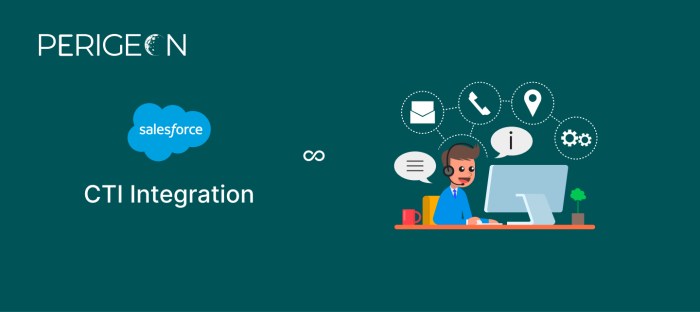
Choosing the right Salesforce CTI integration method is crucial for a seamless and efficient workflow. This involves carefully considering various factors, from the complexity of your existing systems to the specific needs of your call center agents. Understanding the different approaches and their associated technical requirements will ensure a smooth transition and a productive integration.Different CTI integration methods offer varying degrees of complexity and flexibility.
The selection depends on the size and sophistication of your business, as well as your existing technological infrastructure. Careful planning and evaluation are essential to guarantee a successful implementation.
Comparison of Integration Methods
Different approaches to integrating CTI with Salesforce offer varying levels of customization and technical complexity. Selecting the appropriate method is essential for a successful and efficient implementation.
| Integration Method | Description | Pros | Cons |
|---|---|---|---|
| API Integration | Utilizing Salesforce’s APIs (e.g., REST, SOAP) to connect with CTI platforms. This approach allows for a more flexible and scalable integration. |
|
|
| Custom Integration | Developing a tailored integration solution using custom code or third-party tools. This approach provides the most control over the functionality and features. |
|
|
Technical Requirements for a Successful Integration
Successful Salesforce CTI integration requires a strong foundation of technical capabilities. This involves careful planning and consideration of various factors to ensure a seamless transition.
- Data Mapping: Accurate mapping of data fields between Salesforce and the CTI platform is critical for smooth data flow. This ensures that the correct information is passed between systems, improving accuracy and consistency.
- Security Considerations: Implementing robust security measures is paramount. This involves ensuring data encryption, authentication, and access controls to protect sensitive information. Implementing role-based access controls is crucial for maintaining security.
- Testing and Validation: Rigorous testing throughout the integration process is essential to identify and resolve potential issues before deployment. Thorough testing ensures that the integration functions as expected and meets business requirements.
- Scalability: The chosen integration method should be scalable to accommodate future growth and increased call volumes. Scalability ensures that the integration can handle expanding business needs.
Examples of CTI Platforms and Compatibility
Several CTI platforms are compatible with Salesforce, each offering varying functionalities and levels of integration. Consider the features and capabilities when evaluating compatibility with Salesforce.
- RingCentral: RingCentral offers robust CTI features, often integrating seamlessly with Salesforce through APIs. Its comprehensive functionality and integration capabilities are attractive to many businesses.
- Five9: Five9 is a popular CTI platform known for its advanced features and integrations with Salesforce. Its ability to streamline call center operations and enhance customer service is notable.
Best Practices for Optimizing Integration Performance
Optimizing integration performance involves various strategies that contribute to a seamless user experience. Focusing on these practices will lead to a smoother and more effective integration.
- Efficient Data Transfer: Employing efficient data transfer mechanisms minimizes latency and ensures quick data processing.
- Regular Maintenance: Performing regular maintenance on the integration is crucial to address any performance issues promptly and maintain optimal functionality.
- Monitoring and Troubleshooting: Implementing monitoring tools and procedures helps to identify and resolve issues quickly, maintaining a reliable and responsive integration.
Configuring Salesforce CTI Settings
Configuring Salesforce CTI settings correctly is essential for optimal functionality. This includes proper parameterization and configuration to match business requirements.
- User Permissions: Ensure that users have the necessary permissions to access and use the CTI features in Salesforce.
- Customization of Settings: Customize settings to match your business processes and agent workflows, optimizing the integration for efficiency.
- Regular Monitoring and Adjustment: Regularly monitor and adjust settings to maintain optimal performance and ensure the integration aligns with evolving business needs.
Maintaining and Optimizing the Salesforce CTI Integration
Keeping your Salesforce CTI integration humming along requires ongoing attention. Just like any sophisticated system, it needs regular maintenance to ensure optimal performance, security, and alignment with evolving business needs. Ignoring these aspects can lead to decreased efficiency, security vulnerabilities, and ultimately, lost revenue opportunities.Proactive maintenance and optimization are crucial for a successful CTI integration. This involves continuous monitoring, proactive troubleshooting, and adaptability to ensure the integration remains a valuable asset to your business.
A well-maintained system minimizes disruptions and maximizes the return on investment from your CTI implementation.
Importance of Ongoing Monitoring and Maintenance
Regular monitoring of the integration’s performance is essential to identify potential issues early on. This includes tracking key metrics such as call handling times, agent productivity, and system response times. Monitoring tools and dashboards should be configured to alert administrators to deviations from expected performance. By proactively addressing minor issues, you can prevent them from escalating into significant problems.
Strategies for Troubleshooting Integration Issues
Troubleshooting CTI integration problems requires a systematic approach. Establish a clear process for documenting issues, including detailed descriptions of the problem, affected users, and the steps taken to reproduce the problem. Utilize logs and error messages to pinpoint the root cause. Employ a combination of manual checks, system diagnostics, and possibly contacting the vendor for assistance. Comprehensive documentation ensures consistent and efficient resolution of future issues.
A structured troubleshooting methodology minimizes downtime and improves operational efficiency.
Best Practices for System Security
Maintaining the security of your Salesforce CTI integration is paramount. Implement robust access controls to limit access to sensitive data and functionalities. Regularly review and update security protocols, keeping abreast of emerging threats and vulnerabilities. Enforce strong password policies and utilize multi-factor authentication wherever possible. Regular security audits and penetration testing can help identify potential weaknesses in the system.
By proactively addressing security concerns, you can protect sensitive data and maintain compliance with industry regulations.
Adapting the Integration to Changing Business Needs
Business needs evolve over time. Your CTI integration should be flexible enough to adapt to these changes. This involves identifying and addressing new requirements in a timely manner, adjusting configurations, and potentially adding new functionalities. Regular communication between IT and business stakeholders is crucial for understanding and anticipating future needs. By anticipating and addressing changes proactively, you can maintain alignment with your business objectives and avoid costly system overhauls.
Scaling the Integration for Growth
As your business grows, your CTI integration needs to scale accordingly. This involves evaluating the current capacity of the system and identifying potential bottlenecks. Consider factors such as call volume, agent count, and data storage capacity. Scaling involves implementing appropriate solutions such as upgrading hardware, expanding cloud storage, or adding more licenses to support additional agents. Careful planning for future growth avoids performance degradation and ensures continued support for expanding operations.
Updating and Upgrading Integration Components
Regular updates and upgrades of CTI components are essential for maintaining compatibility and fixing bugs. This process usually involves careful planning, testing, and rollback procedures. Stay informed about new releases and updates from your vendor. Develop a schedule for upgrading components, and test the upgrade thoroughly in a non-production environment before deploying it to the live system.
Boosting your Salesforce CTI integration can significantly improve your sales team’s efficiency. To truly understand how account-based marketing (ABM) strategies can supercharge your results, check out these insightful resources: 10 account based marketing ebooks you must read. Ultimately, a well-integrated CTI system, paired with a solid ABM approach, will give your business a competitive edge in the market.
This proactive approach ensures the integration continues to function optimally and benefits from new features and security improvements.
Cost and ROI Analysis
Implementing a Salesforce CTI integration is an investment, and understanding the associated costs and potential return on investment (ROI) is crucial for making informed decisions. This section delves into the typical expenses involved, methods for calculating ROI, and real-world examples of successful integrations.
Typical Costs Associated with Salesforce CTI Integration, Salesforce cti integration for your business
The cost of Salesforce CTI integration varies significantly based on the chosen integration method, the complexity of the implementation, and the specific features required. Factors influencing costs include the customization level, the number of users, the chosen technology, and the duration of the project. It’s important to note that these costs encompass not only software licensing and implementation fees but also the potential for additional expenses, such as ongoing maintenance, training, and support.
Methods for Calculating ROI
Calculating the ROI of a Salesforce CTI integration involves quantifying the benefits derived from the system against the initial and ongoing costs. Key performance indicators (KPIs) such as increased call efficiency, improved customer satisfaction, reduced handling time, and increased sales conversions can be used to measure the return. A common method is to compare the costs and benefits over a defined period, typically one to three years.
The formula for ROI calculation is typically: (Total Benefits – Total Costs) / Total Costs
– 100%.
Examples of Positive ROI
Several businesses have demonstrated positive ROI from Salesforce CTI integration. For instance, a telecommunications company saw a 15% reduction in call handling time after implementing a CTI solution. This translated to significant cost savings and improved agent productivity. Another example is a retail company that noticed a 10% increase in sales conversions due to the improved lead management capabilities enabled by CTI integration.
These examples highlight the potential for substantial returns through optimized call handling and enhanced customer interactions.
Creating a Budget for the Project
Creating a comprehensive budget is crucial for a successful project. It should Artikel all anticipated expenses, including software licenses, implementation services, training materials, and potential ongoing maintenance costs. A detailed breakdown of each component allows for realistic cost estimation and better financial planning. This should also account for potential unforeseen issues and adjust accordingly.
Potential Cost Savings through Improved Efficiency
Salesforce CTI integration can yield significant cost savings through improved efficiency. By automating tasks, reducing handling times, and enhancing agent productivity, businesses can see a substantial reduction in operational costs. Improved lead management and customer service through enhanced data analysis further contributes to overall cost savings.
Estimated Costs and Potential ROI for Different Integration Scenarios
| Integration Scenario | Estimated Costs | Potential ROI |
|---|---|---|
| Basic Integration (Phone System + Salesforce) | $10,000 – $25,000 | 15-30% increase in sales within 6 months |
| Advanced Integration (Including CRM, IVR, and other features) | $25,000 – $100,000+ | 25-50% increase in sales within 12 months, with a return on investment of 200-300% within 3 years |
Note: These figures are estimates and may vary based on specific requirements and implementation details.
Future Trends and Innovations
Salesforce CTI integration is constantly evolving, driven by advancements in technology and the ever-changing needs of businesses. This dynamic environment demands a forward-looking approach, anticipating future trends and adapting to innovations to maintain a competitive edge. Understanding the potential impact of emerging technologies on CTI systems is crucial for businesses seeking to maximize the value of their investments and stay ahead of the curve.The future of Salesforce CTI integration is poised for significant transformation, driven by the convergence of artificial intelligence, cloud computing, and evolving customer expectations.
This evolution will not only streamline existing processes but also create entirely new opportunities for businesses to engage with their customers more effectively and efficiently.
Emerging Trends in Salesforce CTI Integration
The landscape of CTI integration is experiencing a rapid shift, driven by innovations in cloud-based solutions and artificial intelligence. Businesses are increasingly seeking solutions that offer greater scalability, flexibility, and intelligence. This adaptability is crucial for navigating the complex and ever-changing demands of the modern business environment.
Impact of AI and Machine Learning on CTI
Artificial intelligence (AI) and machine learning (ML) are poised to revolutionize CTI systems. AI-powered chatbots and virtual assistants can handle basic customer inquiries, freeing up human agents to focus on more complex issues. ML algorithms can analyze customer interactions to identify patterns and predict future needs, allowing businesses to proactively address potential problems and personalize their service offerings.
For example, AI-powered sentiment analysis can assess customer satisfaction during calls and flag issues requiring immediate attention.
Role of Cloud-Based Solutions in the Future of CTI
Cloud-based solutions are becoming increasingly integral to the future of CTI. The flexibility, scalability, and cost-effectiveness of cloud platforms are driving their adoption. Cloud-based CTI systems enable businesses to access their data and applications from anywhere with an internet connection, improving efficiency and responsiveness. Furthermore, cloud-based platforms facilitate seamless integration with other business applications, enabling a more holistic and integrated approach to customer service.
Innovative CTI Solutions Being Developed
Several innovative CTI solutions are emerging, focusing on enhanced personalization, predictive analytics, and seamless integration with other business applications. These solutions include advanced analytics tools for identifying customer needs, proactive support systems to address potential issues before they escalate, and intelligent routing systems to connect customers with the most appropriate agent. One notable example is the development of AI-powered chatbots capable of handling complex customer issues, reducing the workload on human agents and improving overall response time.
Future Direction of Salesforce CTI Integration
The future of Salesforce CTI integration is characterized by increased automation, enhanced personalization, and greater integration with other business systems. Businesses will increasingly rely on AI-powered insights to anticipate customer needs and proactively address potential issues. Integration with other CRM systems and business intelligence tools will become more seamless, enabling a more holistic view of the customer journey.
Evolution of CTI Technologies
CTI technologies have evolved significantly over time, progressing from simple call routing systems to sophisticated solutions that integrate with CRM systems and other business applications. Early CTI systems focused primarily on call handling and routing. Later iterations incorporated features like call recording and agent performance tracking. Modern CTI solutions leverage advanced technologies like AI and machine learning to personalize customer interactions and predict future needs.
This evolution underscores the ongoing commitment to enhance customer service experiences.
Last Word
In conclusion, Salesforce CTI integration offers significant opportunities for businesses seeking to optimize customer interactions and boost overall performance. By understanding the various aspects, from integration methods to cost considerations, you can effectively implement a solution tailored to your specific needs and drive a positive return on investment. The future of customer service lies in seamlessly connecting your CRM and call center.
Let’s make it happen!