
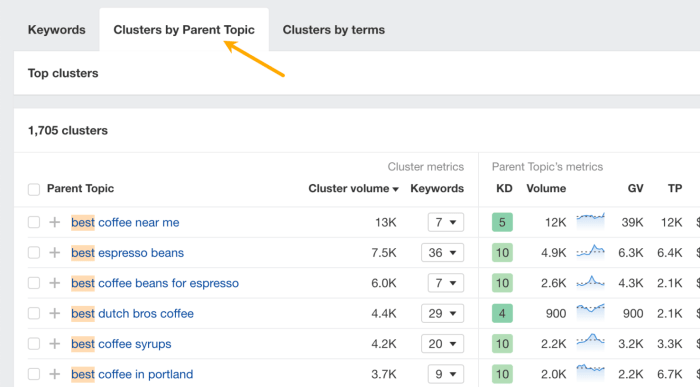
Easy methods for keyword clustering – Easy methods for clustering unlocks the secrets to organizing your s effectively. This guide dives deep into practical techniques for grouping similar terms, enhancing content organization, and boosting your search engine optimization (). We’ll explore various methods, from simple manual approaches to sophisticated automated tools, equipping you with the knowledge to create powerful clusters.
By understanding the principles behind clustering, you’ll be able to create a more targeted and effective content strategy. This process is crucial for optimizing your website’s visibility in search results, ultimately driving more organic traffic and achieving better search engine rankings.
Introduction to Grouping Similar Terms
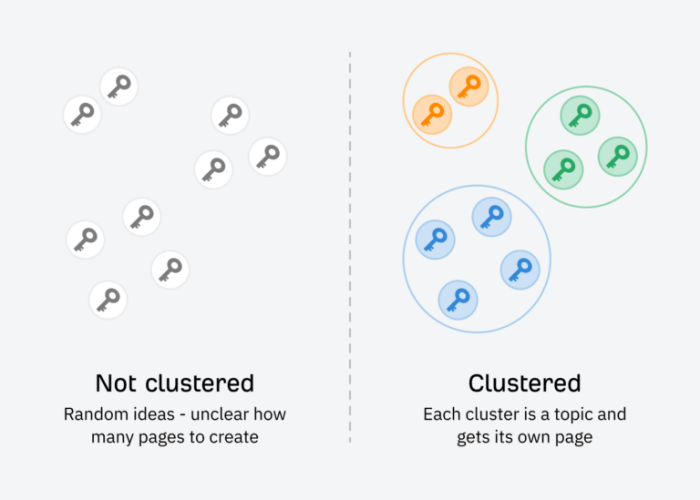
Grouping similar terms is a fundamental aspect of content organization and search engine optimization (). It involves identifying and categorizing words, phrases, and concepts that share semantic meaning or relevance. This process is crucial for creating a structured and coherent website that search engines can easily understand and users can easily navigate. Effective grouping allows for better content organization, enhanced user experience, and ultimately, improved search engine rankings.Effective grouping of similar terms enhances both user experience and search engine optimization.
Quick keyword clustering is super helpful, right? One easy method is grouping semantically related terms. But, focusing on customer success strategies, like understanding customer needs beyond initial support, is crucial. For example, if you’re looking at the difference between customer support and customer success, check out this insightful article on customer success vs customer support which one matters.
Ultimately, effective keyword clustering relies on understanding your audience and their needs, just like successful customer relationships do.
By clustering semantically related terms, you create a more intuitive and logical structure for your website’s content. Users can easily find what they are looking for, and search engines can better understand the context and relevance of your pages. This improved understanding leads to better rankings in search results, increasing visibility and driving more organic traffic to your website.
Benefits of Grouping Similar Terms
Grouping similar terms offers several key advantages for content organization and search engine optimization. Firstly, it streamlines the information architecture of your website, making it easier for users to navigate and find relevant information. This leads to a better user experience, which is a crucial factor in modern . Secondly, it helps search engines understand the context and meaning of your content, leading to improved search engine rankings.
Finally, it enables you to create more comprehensive and detailed content around a specific topic, which is highly valued by both users and search engines.
Improved Content Organization
Grouping similar terms directly improves content organization by creating logical categories and subcategories. Consider a website about gardening. Instead of having individual pages for “tomatoes,” “peppers,” “zucchini,” etc., you could group them under a broader category like “vegetables.” This structured approach enhances the overall user experience by creating a clear and intuitive navigation structure. Further, you can create more detailed subcategories, such as “types of tomatoes” or “how to grow zucchini,” making your content even more valuable and comprehensive.
This is a more user-friendly approach compared to scattered pages.
Finding related keywords is crucial for SEO, and thankfully, there are some easy methods for keyword clustering. Understanding user intent and grouping similar search terms can significantly boost your content strategy. This directly ties into the power of engagement metrics, like click-through rates and time on page, which provide valuable insights into how users interact with your content.
Analyzing these engagement metrics can help you refine your keyword clusters and optimize your content for better results, further improving your keyword clustering efforts. power of engagement metrics are a key factor in that process.
Implications
Grouping similar terms is a powerful tool for enhancing . By clustering semantically related s, you create opportunities for variations and related searches. Search engines recognize these connections, and it leads to improved rankings for those related searches. For example, if you group “organic gardening,” “sustainable gardening,” and “eco-friendly gardening,” you signal to search engines that these terms are closely related and increase the likelihood of ranking for searches involving any of these terms.
Illustrative Table of Clustering
| Main Topic | Related s |
|---|---|
| Organic Gardening | Sustainable gardening, Eco-friendly gardening, Natural pest control, Composting, Heirloom seeds |
| Tomato Cultivation | Tomato varieties, Tomato planting, Tomato care, Tomato harvesting, Growing tomatoes indoors |
| Vegetable Gardening | Gardening tools, Soil preparation, Crop rotation, Companion planting, Vegetable seeds |
Identifying Similarities in Terms
Uncovering the hidden relationships between words is crucial for effective clustering. Understanding how terms share semantic meaning allows for more accurate and comprehensive groupings. This process goes beyond simple matching, delving into the nuances of language to identify terms that, while not identical, convey similar concepts. By understanding these shared characteristics, we can create more insightful and relevant clusters for various applications.Effective clustering hinges on identifying similarities between terms.
This involves recognizing shared semantic meaning, not just surface-level similarities. Different approaches exist for achieving this, each with its own strengths and weaknesses. By comparing and contrasting these methods, we can select the most suitable approach for a specific task or dataset.
Methods for Recognizing Shared Characteristics
Several methods can be employed to identify shared characteristics among words. These methods range from simple techniques like checking for common prefixes or suffixes to more sophisticated techniques involving semantic analysis. The choice of method depends on the nature of the data and the desired level of granularity in the analysis.
- Lexical Similarity: This method focuses on the shared structure and form of words. Techniques include examining common prefixes, suffixes, roots, and morphemes. For example, “automobile” and “motorcycle” share the root “mobile,” indicating a relationship in their meaning. This approach is relatively straightforward and computationally inexpensive, making it suitable for large datasets.
- Semantic Similarity: This method delves deeper into the meaning of words. Techniques like WordNet, a lexical database of English, can be used to measure the semantic distance between terms. For example, WordNet might assign a lower semantic distance to “cat” and “feline” than to “cat” and “table.” Semantic similarity is more nuanced and computationally intensive but can yield more accurate results.
- Contextual Similarity: This approach analyzes the context in which words appear. Words appearing frequently in similar sentences or documents are more likely to be semantically related. Natural Language Processing (NLP) techniques can be used to analyze large corpora of text and identify contextual relationships. For example, “hospital” and “doctor” often appear in the same documents, indicating a strong contextual relationship.
Comparing and Contrasting Approaches
Different approaches to finding related terms have distinct advantages and disadvantages. The choice of method depends on the specific needs of the project. A straightforward approach like lexical similarity might be suitable for preliminary clustering, while a more sophisticated approach like semantic similarity might be necessary for a more nuanced analysis.
| Approach | Strengths | Weaknesses |
|---|---|---|
| Lexical Similarity | Simple, computationally inexpensive, suitable for large datasets | Limited to surface-level similarities, may miss subtle semantic relationships |
| Semantic Similarity | Captures nuanced semantic relationships, more accurate | Computationally intensive, may require specialized tools |
| Contextual Similarity | Considers the surrounding words, captures contextual relationships | Dependent on the availability of large text corpora, potentially noisy data |
Distinguishing Between Similar and Identical Terms
It’s important to differentiate between terms that are similar in meaning and those that are identical. While similar terms share semantic relationships, identical terms are essentially the same word. This distinction is crucial for avoiding redundancy in clusters. Methods like stemming or lemmatization can help to reduce identical variations of a word to a single representation, improving the accuracy of the analysis.
For example, “running,” “runs,” and “runner” can be reduced to “run” for better clustering.
Methods for Grouping Terms
clustering, a crucial step in many natural language processing tasks, aims to group semantically similar terms together. This process is fundamental for tasks like information retrieval, topic modeling, and content organization. Effective clustering allows systems to understand the relationships between different s and improve their overall performance. Various methods exist, both automatic and manual, each with its own strengths and weaknesses.Different methods for clustering cater to various needs and data characteristics.
Choosing the right method depends on the specific task, the volume of data, and the desired level of granularity in the clusters. Understanding the nuances of each method allows for a more informed approach to clustering, ultimately leading to better outcomes.
Automatic Clustering Methods
Automatic clustering methods use algorithms to group terms based on their relationships without explicit human intervention. These methods are valuable for large datasets where manual clustering would be impractical. The core principle involves calculating the similarity between terms and grouping those with high similarity scores.
- Term Frequency-Inverse Document Frequency (TF-IDF): This method assigns weights to terms based on their frequency within documents and how frequently they appear across a corpus. Higher weights indicate that a term is more important for describing a specific document or set of documents. TF-IDF scores are used to calculate the similarity between terms. This method works well for identifying terms that are relevant to specific topics within a large collection of documents.
For example, if “machine learning” and “artificial intelligence” frequently appear together in a dataset of research papers, TF-IDF would likely cluster these terms together.
- Cosine Similarity: This method measures the similarity between two vectors representing terms based on their occurrences in documents. Terms appearing in similar documents are assigned higher cosine similarity scores, allowing them to be grouped together. This method is effective in highlighting terms with similar contextual usage, such as “programming” and “coding”. The cosine similarity method is especially powerful for analyzing large document collections.
- Clustering Algorithms (e.g., k-means, hierarchical clustering): These algorithms automatically partition terms into clusters based on their proximity in a multi-dimensional space. k-means, for example, aims to find ‘k’ clusters that minimize the average distance between each term and the centroid of its cluster. Hierarchical clustering, on the other hand, builds a hierarchy of clusters, allowing for different levels of granularity. These algorithms are adaptable to various data structures and can handle complex relationships between terms.
Manual Clustering Methods
Manual clustering methods involve human experts to categorize terms based on their understanding of the subject matter. This approach is particularly valuable for specialized domains or when a high level of accuracy is required.
- Expert Judgment: Subject matter experts manually review and categorize terms based on their knowledge and intuition. This method is suitable for situations where domain expertise is crucial. For example, a group of librarians could manually cluster books based on genre or subject matter.
- Collaborative Tagging: Multiple individuals can collaboratively tag terms to group similar ones. This approach benefits from collective knowledge and diverse perspectives, which is useful in large-scale projects.
Comparison of Methods
| Method | Description | Strengths | Weaknesses |
|---|---|---|---|
| TF-IDF | Weights terms based on frequency | Simple, computationally efficient, effective for large datasets | Doesn’t capture semantic relationships, sensitive to term frequency |
| Cosine Similarity | Measures similarity between term vectors | Captures contextual relationships, suitable for diverse datasets | Requires vector representation, can be computationally expensive for massive datasets |
| k-means | Partitions terms into clusters | Effective for large datasets, adaptable to various data structures | Requires specifying the number of clusters, may not capture complex relationships |
| Hierarchical Clustering | Builds a hierarchy of clusters | Provides multiple levels of granularity, robust to noisy data | Computationally intensive, can be complex to interpret |
| Expert Judgment | Human experts categorize terms | High accuracy, captures nuanced semantic relationships | Time-consuming, subjective, may not scale to large datasets |
| Collaborative Tagging | Multiple individuals collaboratively tag terms | Leverages collective knowledge, diverse perspectives | Requires coordination, can be challenging to achieve consensus |
Tools and Resources for Clustering
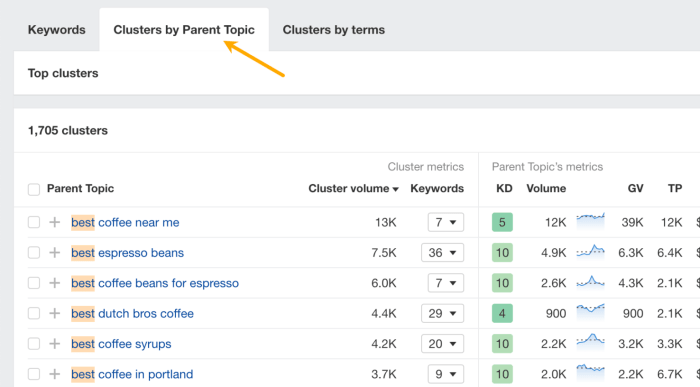
clustering, a crucial step in and content strategy, benefits significantly from specialized tools. These tools automate the process of identifying relationships between terms, saving time and effort compared to manual methods. They offer features like similarity scores and visual representations of clusters, enhancing understanding of groups and facilitating strategic content creation.Effective clustering requires more than just identifying similar terms.
The right tools can analyze large datasets, uncover hidden patterns, and provide actionable insights. The tools and resources available vary in features, complexity, and pricing, allowing users to choose solutions that align with their needs and budget.
Looking for easy ways to cluster keywords? Understanding the spending patterns of TikTok and Meta advertisers, like those detailed in the Q1 2025 report for tiktok meta advertisers q12025 , can offer valuable insights. Analyzing their ad campaigns provides a fantastic lens to identify high-performing keywords and potential areas for improvement in your own keyword clustering strategies.
This data-driven approach can be a game-changer in your keyword clustering efforts.
Available Tools and Software
Various software options facilitate clustering. These tools range from free online platforms to paid enterprise-level solutions. The selection depends on the size of the dataset, desired features, and the user’s technical expertise. Choosing the right tool is crucial for efficiency and accuracy in the clustering process.
Free Online Tools
Free online tools often offer basic clustering capabilities. These platforms typically provide simple interfaces and limited features, but are suitable for small-scale projects or quick analyses. They often require user input in terms of s or seed terms. For example, some tools might allow you to input a list of related products and generate a cluster of similar terms.
Paid Software Solutions
Paid software solutions provide more comprehensive features, including advanced algorithms, larger dataset handling, and sophisticated visualization tools. These tools are often preferred for businesses needing to analyze substantial volumes of data. Advanced features might include options for adjusting similarity thresholds or incorporating external data sources, leading to more precise and insightful clusters. Examples include specialized software or marketing analytics platforms.
Steps to Utilize Clustering Tools Effectively, Easy methods for keyword clustering
To effectively leverage clustering tools, follow these steps:
- Define the scope of your analysis. Clearly identify the target audience, industry, and specific s relevant to your analysis. This ensures the tool focuses on the right information.
- Input your data. Provide the necessary s or data points to the tool. This step often involves formatting the data according to the tool’s specifications.
- Select appropriate algorithms and settings. Tools often offer various algorithms for clustering. Selecting the right algorithm and tuning the settings is essential for accurate results.
- Analyze the generated clusters. Evaluate the quality and relevance of the clusters. Review the terms within each cluster and identify potential gaps or areas for improvement.
- Refine and validate the clusters. Based on the analysis, refine the clusters by adding or removing s. Validating the clusters against real-world data or user behavior is crucial for effective implementation.
User-Friendly Tools and Resources
Several user-friendly tools and resources streamline the clustering process. These platforms often provide intuitive interfaces, making them accessible to users with varying levels of technical expertise. Examples include free online research tools and browser extensions that highlight related search terms. These resources are especially beneficial for quick assessments or initial explorations.
Comparison Table of Clustering Tools
| Tool | Features | Advantages | Disadvantages |
|---|---|---|---|
| Tool A | Basic clustering, visual representation, limited dataset size | Free, easy to use | Limited features, not suitable for large datasets |
| Tool B | Advanced algorithms, large dataset handling, sophisticated visualizations | Accurate results, comprehensive analysis | Paid, requires technical knowledge |
| Tool C | Focus on , integrates with content management systems | -specific insights, streamlined workflow | May not be suitable for broader clustering tasks |
Implementing the Clustering Process
Putting clustering into practice involves a structured approach to group related terms effectively. This process is crucial for , content strategy, and market research, enabling businesses to understand customer needs and optimize their online presence. A well-executed clustering strategy can significantly improve search engine rankings and user engagement.Understanding the goals and objectives of your research is the first step in the implementation phase.
Identifying the specific areas of your business or website you wish to target with the clustering process will inform the selection of appropriate terms and the choice of clustering method.
Selecting Appropriate Terms for Clustering
The success of any clustering exercise hinges on the selection of relevant and representative terms. A comprehensive list of potential s needs to be created from various sources, including website analytics, competitor analysis, and customer feedback. These terms should reflect the topics, themes, and concepts most important to your business or website.
Using the Chosen Clustering Method
Once you’ve selected a clustering method (e.g., hierarchical, k-means), you need to apply it to your chosen terms. This typically involves using a software tool or algorithm to analyze the relationships between terms and group them based on similarity. The specific steps within each method will vary depending on the tool or algorithm you’re employing. Crucially, the method should be appropriate for the volume and nature of your data.
For example, if your list is extensive, an algorithm optimized for large datasets is necessary.
Evaluating Clustering Results
Evaluating the quality of your clusters is essential to ensure the effectiveness of your clustering process. This involves assessing the relevance, coherence, and usefulness of each cluster. Are the terms in each cluster genuinely related? Do the clusters align with your initial goals and objectives? Are there any terms that appear misplaced or unrelated to other terms in the cluster?
A crucial aspect of this evaluation is considering the potential impact of each cluster on your strategy.
Best Practices for Evaluating the Results
- Review cluster themes: Examine the overarching topics or themes within each cluster. Are the themes clearly defined and meaningful? Do they reflect your understanding of your target audience and their search intent?
- Analyze cluster size: Consider the size of each cluster. Are the clusters too large or too small? Large clusters may contain terms that are too diverse, while small clusters may not capture the full scope of related terms.
- Assess term relevance: Verify that each term within a cluster is genuinely related to the other terms. This ensures the cluster represents a coherent topic area. An example of a misaligned term would be a term about a product that is unrelated to the other terms in a cluster about a different product line.
- Consider cluster density: The density of a cluster refers to the number of terms in the cluster and their closeness in semantic meaning. A dense cluster indicates a high degree of relatedness between the terms. A poorly-clustered set of terms will have low density and not reflect the intended grouping.
Implementing the Clustering Process: Step-by-Step Guide
The table below Artikels the key stages involved in implementing the clustering process. Each stage is crucial for ensuring the accuracy and efficiency of your clustering results.
| Stage | Description |
|---|---|
| 1. Define Objectives | Clearly articulate the goals and target audience for the clustering exercise. |
| 2. Data Collection | Gather a comprehensive list of potential s from various sources (e.g., website analytics, competitor analysis). |
| 3. Term Selection | Choose the most relevant and representative s from the collected data, focusing on terms that align with your defined objectives. |
| 4. Clustering Method Selection | Select the most suitable clustering method based on your data volume and desired outcome. |
| 5. Clustering Application | Apply the chosen method to the selected s, grouping similar terms together. |
| 6. Evaluation & Refinement | Evaluate the generated clusters for relevance, coherence, and density. Refine the clusters as needed. |
Refining and Improving Clusters: Easy Methods For Keyword Clustering
clustering, while powerful, requires refinement to achieve optimal results. Simply grouping terms isn’t enough; the process needs iterative improvement to ensure accuracy and usefulness. This stage involves analyzing the clusters, identifying weaknesses, and adjusting the parameters to maximize their value for various applications.Effective clustering goes beyond initial grouping; it’s about understanding the nuances of the terms and relationships within the clusters.
Refining the clusters ensures that the groupings are relevant, insightful, and actionable, leading to more targeted marketing, improved search engine optimization, and better content strategy.
Feedback-Driven Refinement
Identifying and addressing areas needing improvement in clusters is crucial. Feedback from stakeholders, such as marketing teams or content creators, is invaluable. This feedback helps pinpoint inaccuracies or gaps in the initial groupings. Analyzing user search queries, website analytics, and sales data can also highlight areas where clusters might be underperforming.
Addressing Cluster Issues
Various issues can arise within the clusters. These may include overlapping terms, missing relevant terms, or clusters that are too broad or too narrow. Overlapping terms within a cluster often indicate a need to further segment or refine the groups. Missing relevant terms suggest gaps in the initial data or the clustering method used. A cluster that is too broad might need to be subdivided into more specific subgroups, while a cluster that is too narrow may need to be merged with related clusters.
Enhancing Accuracy and Usefulness
Improving the accuracy and usefulness of clusters involves adjusting the clustering algorithm parameters. For example, if the clusters are too broad, increasing the similarity threshold might help to refine them. Conversely, decreasing the threshold might be necessary to identify finer distinctions between terms. Additionally, the choice of distance metric (e.g., cosine similarity, Jaccard index) impacts the clustering results.
Adjusting Parameters for Enhanced Results
The choice of parameters significantly influences the quality of the clusters. Adjusting these parameters allows for more nuanced groupings and better reflects the semantic relationships between s. For instance, if the clusters are too narrow, reducing the similarity threshold can broaden the groups and merge related s. If clusters are too broad, increasing the threshold can isolate terms and refine the grouping.
Refinement Strategies and Impacts
| Refinement Strategy | Impact on Clusters | Example |
|---|---|---|
| Increasing Similarity Threshold | Creates more distinct and focused clusters, potentially reducing overlap | Moving from broad product categories to more specific subcategories. |
| Decreasing Similarity Threshold | Combines more related terms into broader clusters, potentially increasing the comprehensiveness of the group | Merging related s like “running shoes” and “athletic footwear” into a larger cluster. |
| Changing Distance Metric | Alters the criteria for defining similarity, resulting in different cluster structures. | Switching from cosine similarity to Jaccard index to account for the presence or absence of s rather than their vector magnitude. |
| Adding/Removing s | Refines the cluster by incorporating new terms or removing misclassified s. | Identifying and adding “sustainable running shoes” to an existing cluster. |
Practical Applications and Examples
clustering isn’t just a theoretical exercise; it’s a powerful tool with real-world applications across various fields. By grouping similar terms, you gain a deeper understanding of your target audience’s search intent and can optimize your content for better discoverability. This leads to improved user experience and ultimately, better results for your business.Effective clustering helps you organize your content in a way that is logical and user-friendly.
This, in turn, boosts performance, improves marketing campaigns, and simplifies the content creation process. The process is highly adaptable, working equally well with blog posts, product descriptions, or even complex technical documents.
Optimization
clustering is crucial for success. By grouping semantically related s, you can create content that targets a broader range of search queries. This improves your site’s visibility in search engine results pages (SERPs) and attracts a more targeted audience. For example, if you sell gardening tools, clustering s like “gardening shears,” “pruning shears,” “hand tools,” and “garden clippers” allows you to create a comprehensive guide that addresses various user needs and search intents.
This comprehensive approach significantly improves your chances of ranking higher for a wider array of relevant searches.
Marketing Campaigns
Clustering s allows for a more targeted and effective approach to marketing campaigns. By grouping similar terms, you can create targeted ad campaigns that resonate with specific customer segments. For example, if you’re promoting a new fitness app, you could cluster s around “weight loss,” “exercise routines,” “home workouts,” and “fitness tracking.” This allows you to tailor your marketing messaging and budget more effectively, reaching the right audience with the right message.
Content Creation
clustering streamlines the content creation process. By identifying groups of related s, you can create content that covers a broader range of topics within a specific niche. This leads to more comprehensive and valuable content for your audience. For instance, if you’re writing about “sustainable living,” you could cluster s around “eco-friendly products,” “waste reduction,” “renewable energy,” and “sustainable fashion.” This framework allows you to create a series of articles or a blog post that delves deeper into various aspects of sustainable living, improving both user engagement and content value.
Adapting to Different Content Types
The process of clustering is remarkably adaptable to various content types. Whether you’re working with blog posts, product descriptions, or technical documents, the underlying principles remain the same. The key is to identify the core themes and concepts within your content and group s that relate to those themes.
Practical Use Cases
| Content Type | Cluster Example | Benefit |
|---|---|---|
| E-commerce product descriptions | “Women’s Running Shoes,” “Lightweight Running Shoes,” “Trail Running Shoes,” “Supportive Running Shoes” | Targeting specific needs and improving search engine visibility for various shoe types. |
| Blog posts | “Organic Gardening,” “DIY Garden Projects,” “Vegetable Gardening,” “Flower Gardening” | Creating a series of blog posts that address various aspects of gardening, appealing to a broader audience. |
| Technical documentation | “Software Development,” “API Integration,” “Database Management,” “Cloud Computing” | Structuring complex information logically, helping users quickly find the specific information they need. |
Final Review
In conclusion, mastering easy methods for clustering empowers you to structure your content strategically and improve your . This comprehensive guide provides a practical roadmap for identifying, grouping, and refining s, ultimately helping you achieve your content marketing goals. By utilizing the various methods and tools presented, you can effectively organize your content and boost your website’s search engine visibility.